
Back to Course
Top Teacher Theory 1: How people learn
0% Complete
0/0 Steps
-
Welcome to Top Teacher Theory6 Topics
-
How People Learn24 Topics
-
Behaviorism in practice
-
A simple lesson flow using behaviorist steps (example: multiplication fluency)
-
Cognitive approaches
-
1) Memory — the constraints and opportunities
-
2) Attention — the gatekeeper of learning
-
3) Processing — surface vs deep; serialistic vs holistic; Kolb’s cycle
-
4) Developmental & content sensitivity (Piaget + brain findings)
-
5) Metacognition and targeted learning
-
6) Social constructivism: learning together is powerful
-
7) Assessment and feedback — formative as the engine
-
8) Practical design checklist for a cognitively-smart lesson
-
9) Adapting for different learner strategies and styles
-
10) Short sample micro-lesson (45 minutes) — topic: density (ages 11–12, concrete-operational)
-
11) Five small changes you can make next lesson
-
Constructivism and active learning
-
Practical teacher moves: how to support learning-by-doing
-
Short example lesson — “Three-legged stool” (transfer-focused)
-
Sample teacher checklist for active, constructivist lessons
-
Social and motivational factors
-
Peers and group dynamics — social constructivism in practice
-
Identity, self‑concept and subject‑specific esteem
-
Motivation: intrinsic vs extrinsic (and why rewards can backfire)
-
Classroom practices — before, during and after teaching
-
Responding to the “unstable” or “rejected” student
-
Behaviorism in practice
-
Differentiation and Personalization35 Topics
-
Tiered activities and choice
-
Models of tiered activities
-
Practical, ready-to-use examples
-
Simple choice tools you can implement today
-
A simple Tiered Activity Planner (use for any lesson)
-
Assessment, feedback & grading (don’t hurt self‑esteem)
-
Troubleshooting common issues
-
Mini 45‑minute lesson plan you can try tomorrow
-
Flexible grouping
-
Data-driven grouping: a simple three-step process
-
Types of groups — choose the right one for the learning goal
-
Designing group tasks for targeted growth
-
Practical classroom routines & logistics
-
Avoiding stigma and supporting self-esteem
-
Example: a simple lesson cycle using flexible grouping
-
Dos and don’ts — at a glance
-
Universal Design for Learning (UDL)
-
Practical UDL strategies — structure by the three UDL principles
-
UDL in the lesson cycle: Before → During → After (practical checklist)
-
Mini UDL lesson template (practical, ready to copy/paste)
-
Quick adaptations for common classroom situations
-
Formative assessment & UDL — short how-to
-
EdTech for personalization
-
Practical toolbox (what to use and why)
-
Step-by-step workflow: how to design a personalized lesson with EdTech
-
Sample mini lesson flows (practical examples)
-
Metacognition and self-paced practice (student agency)
-
A short teacher checklist before you launch a personalized EdTech lesson
-
Teacher professional development & finding research / OER
-
Student agency and voice
-
Quick classroom strategies (practical, low‑prep)
-
Scaffolding agency for different students
-
Sample choice menu (middle school science)
-
Feedback language you can use (fast scripts)
-
Quick lesson‑planning checklist for agency
-
Tiered activities and choice
-
Understanding Learner Development17 Topics
-
Developmental trajectories
-
From “pre-structural” to “abstract” — levels of information processing you’ll see
-
Vygotsky and social constructivism — learning is social
-
Practical classroom strategies by age band (concise)

-
Individual differences
-
Special educational needs
-
Before teaching: gather info & plan inclusively
-
During teaching: practical classroom strategies
-
Quick classroom tools (printable in your lesson kit)
-
Sample lesson modification — short example (Math: area of rectangles)
-
Teacher development: keep learning
-
Cultural and language diversity
-
Practical classroom strategies
-
Assessment: fair, supportive, and learning-focused
-
Classroom routines and small activities
-
Dealing with cultural misunderstandings and behavior differences
-
Sample mini-lesson flow (Before / During / After) — practical and brief
-
Developmental trajectories
-
Your Feedback Matters 🙏
Participants 3
Lesson 4,
Topic 4
In Progress
Practical classroom strategies by age band (concise)
didactec 08.09.2025
Lesson Progress
0% Complete
Preschool / early years (0–6)
- Give rich sensory, play-based experiences; talk a lot; use gestures and objects.
- Repeat and build routines; offer lots of hands-on language and motor play.
- Prioritize safe attachment and warm teacher-child interactions.
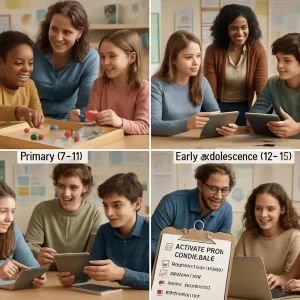
Primary / concrete phase (~7–11)
- Use manipulatives, labs, and concrete problems.
- Build conceptual links: compare, classify, and have kids explain reasoning in plain words.
- Start teaching metacognitive strategies (simple goal-setting, “what helped you solve this?”).
Early adolescence (~12–15)
- Offer structured opportunities for hypothetical reasoning (debates, experiments).
- Provide scaffolds when tasks require abstraction; encourage planning and peer feedback.
- Support emotional regulation and group identity — social context still heavily influences learning.
Older teens (16+)
- Present open-ended projects, research tasks, critical analyses.
- Promote abstract argumentation, transfer across contexts, and self-directed learning.
- Prepare students for real-world problem-solving and metacognitive independence.
Across all ages
- Activate prior knowledge before introducing new concepts.
- Make learning experiential and meaningful (real problems, projects, simulations).
- Use formative feedback; emphasize understanding over rote recall.
- Build relationships first — students learn best when they feel safe and valued.
Assessment and differentiation
- Diagnose prior knowledge early (so assimilation works).
- Use tasks at varying complexity (unistructural → relational → hypothetical).
- Differentiate by content familiarity: a quiet, confident child in art might be lost in algebra — match support to domain.
- Feedback should help students reflect (metacognition), not just grade them.
Quick checklist for teachers (ready to use)
- Did I activate relevant prior knowledge before the lesson?
- Is the task concrete enough for current development level? Can I add a richer concrete example?
- Am I offering social scaffolding (peer or teacher support) for students who need it?
- Have I considered affective factors (does the student feel safe/valued)?
- Can I design a follow-up that pushes one level higher (from multistructural to relational)?
- Am I aware of sensitive periods (language, motor skills) and providing rich experience?
- Have I varied formats (hands-on, reflective, abstract) so different learners can connect?
Final thought — plan for brain, heart and context
Development follows broad, biologically informed trajectories, but experience, relationships and content shape how and when higher-level thinking appears. A “good” teacher plans for the brains (developmental readiness), hearts (attachment and motivation), and contexts (familiar content, social learning) of learners — and that combination produces real, lasting growth.
Please take the quiz to proceed: