
Quick lesson‑planning checklist for agency

didactec 18.09.2025
Lesson Progress
0% Complete
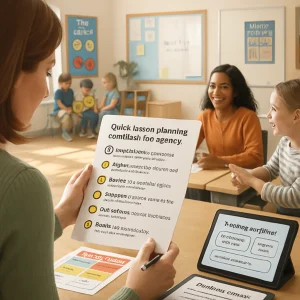
- Have I checked students’ prior knowledge and emotional readiness? (diagnostic)
- Is the learning goal co‑created or negotiable? (voice)
- Are there 2–3 meaningful choices available and scaffolded? (choice)
- Have I planned formative checkpoints and feedback language? (support)
- Are celebration/recognition methods authentic, not just prizes? (motivation)
- Do I have an option for students who need micro‑scaffolding or one‑to‑one guidance? (equity)
Short sample routines to start tomorrow
- Monday: Quick interest survey — “What real‑world questions do you want to explore in this unit?”
- Each lesson: 2‑minute exit ticket with a voice prompt.
- Weekly: 10‑minute class meeting to choose one small change for the next week’s lessons.
- Monthly: Student‑led mini‑conference (5 min each) with self‑check + goal setting.
Final notes (big picture)
Student agency and voice don’t automatically produce learning — they work when the emotional and instructional foundations are solid. That means:
- Start by strengthening teacher–student interaction and self‑esteem.
- Anchor student voice in meaningful tasks connected to prior knowledge.
- Use structured choices and formative feedback to grow internal motivation.
- Differentiate the level of agency based on students’ social and emotional readiness.
You’ll get deeper learning, more engagement, fewer behavior problems — and students who see themselves as learners, not just recipients of grades.
If you want, you can ask AI (Copilot, ChatGTP, Gemini, etc.) to:
- Draft a one‑week unit plan with agency options.
- Create a fillable co‑created rubric template.
- Build a starter choice menu for a specific subject or age group. Which would you like?
Please take the quiz to proceed: