
Practical teacher moves: how to support learning-by-doing

didactec 17.09.2025
Lesson Progress
0% Complete
- Start where learners are
- Use quick diagnostic checks (pre-tests, concept maps, K-W-L charts, short interviews).
- Ask: “What do you already think about this?” Anchor new tasks to those ideas.
- Design meaningful, authentic tasks
- Real-world problems, simulations, mini-projects or case studies.
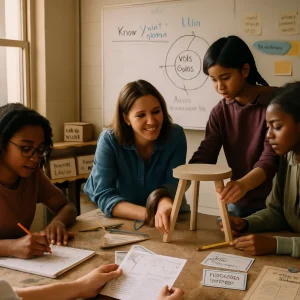
- Example: instead of “define plane” give the stool problem — ask students to design a three-legged outdoor stool and explain why it never rocks. That invites transfer from geometry to design.
- Scaffold inside the Zone of Proximal Development (ZPD)
- Model strategies, provide prompts and worked examples.
- Gradually fade support as competence rises (guided → assisted → independent).
- Use Kolb-style cycles
- Concrete Experience: experiment, role-play, build a model.
- Reflective Observation: structured reflection prompts or group discussion.
- Abstract Conceptualization: help students connect observations to principles.
- Active Testing: give a new situation to apply the principle.
- Teach metacognition & metamemory explicitly
- Show how to set process goals: “By the end of this hour I will be able to…”
- Teach memory strategies: spacing, retrieval practice (self-tests), elaboration, interleaving.
- Use reflection prompts: “What surprised you? What confused you? What will you try next?”
- Build self-evaluation routines and peer feedback habits.
- Make social learning routine
- Structured talk: think–pair–share, jigsaw, peer instruction, group problem-solving with roles.
- Emphasize that collaboration is for learning, not just dividing tasks.
- Train groups to reflect on how they worked together (process assessment).
- Emphasize understanding over rote recall
- Ask open tasks requiring explanation, justification and multiple representations.
- Use performance tasks that show application in new contexts (transfer).
- Give formative feedback that builds self-esteem
- Focus on progress, strategies used, and next steps.
- Avoid rewards that replace intrinsic motivation — praise process and effort, not just outcome.
- Use frequent, low-stakes checks to guide learners (quizzes, one-minute papers, exit tickets).
- Design assessments for learning
- Make rubrics that prioritize conceptual understanding and skills.
- Include self-assessment and peer-assessment as regular elements.
- Use summative tests as part of the feedback loop, not the end of learning.
- Differentiate while keeping learning goals common
- Vary entry points and supports (scaffolds, choice of tools) to honour different learning styles (Kolb’s styles — give experiences, reflection, conceptual tasks, testing opportunities).
- Keep the same core understanding target for everyone, but allow multiple ways to reach and demonstrate it.
Please take the quiz to proceed: