

Back to Course

Top Teacher Theory 1: How people learn

0% Complete
0/0 Steps
  1. Welcome to Top Teacher Theory
    6 Topics
  2. How People Learn
    24 Topics
  3. Differentiation and Personalization
    35 Topics
  4. Understanding Learner Development
    17 Topics
  5. Your Feedback Matters 🙏
Lesson Progress
0% Complete
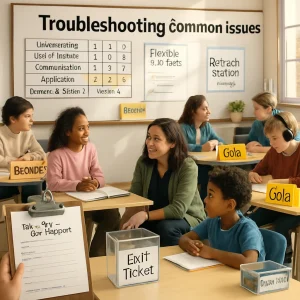
Editorial-quality photoreal scene of a modern, diverse classroom where a teacher kneels at a small-group table delivering a scaffolded mini-lesson to attentive students while others work at labeled Bronze / Silver / Gold stations. A poster-sized rubric grid lists Understanding, Use of Evidence, Communication, Application with scores 1–4 and a note 'Bronze=2, Silver=3, Gold=4'. Foreground shows a student holding a signed learning-contract clipboard titled 'Take a Risk — Get Support'; nearby an 'Exit Ticket' box collects slips and a 'Level Up' box holds badges. Mixed-ability peer-coaching pairs converse at a round table, a whiteboard displays flexible sub-tasks and a 'Reteach Station' sign, and warm natural window light with shallow depth of field highlights realistic textures and expressions. Composed to show multiple simultaneous strategies and solutions across the room, ideal for an article on formative assessment and differentiated support.
  • Students pick the easiest task every time:
    • Strategy: require students to try the easier tier then reteach and offer incentive of “level up” if they demonstrate mastery.
    • Use learning contracts that encourage risk with support.
  • Too many students in one tier:
    • Strategy: prepare flexible sub‑tasks or compact instruction for that group, or create mixed‑ability peer coaching pairs.
  • Tasks are too hard (lots of blank faces):
    • Strategy: check prior knowledge again; add a scaffolded mini‑lesson or pair students for peer support.
  • Assessment gaps:
    • Strategy: use quick exit ticket data to adjust tiers next lesson; incorporate reteach stations.

Quick rubric idea (one rubric for all tiers — different levels of depth)

Criteria

  • Understanding of concept (1–4)
  • Use of evidence or data (1–4)
  • Communication & clarity (1–4)
  • Application / transfer (1–4)

Set descriptors so that Bronze meets level 2, Silver level 3, Gold level 4. That way everyone is assessed by the same dimensions.