Back to Course
Top Teacher Theory 1: How people learn
0% Complete
0/0 Steps
-
Welcome to Top Teacher Theory6 Topics
-
How People Learn24 Topics
-
Behaviorism in practice
-
A simple lesson flow using behaviorist steps (example: multiplication fluency)
-
Cognitive approaches
-
1) Memory — the constraints and opportunities
-
2) Attention — the gatekeeper of learning
-
3) Processing — surface vs deep; serialistic vs holistic; Kolb’s cycle
-
4) Developmental & content sensitivity (Piaget + brain findings)
-
5) Metacognition and targeted learning
-
6) Social constructivism: learning together is powerful
-
7) Assessment and feedback — formative as the engine
-
8) Practical design checklist for a cognitively-smart lesson
-
9) Adapting for different learner strategies and styles
-
10) Short sample micro-lesson (45 minutes) — topic: density (ages 11–12, concrete-operational)
-
11) Five small changes you can make next lesson
-
Constructivism and active learning
-
Practical teacher moves: how to support learning-by-doing
-
Short example lesson — “Three-legged stool” (transfer-focused)
-
Sample teacher checklist for active, constructivist lessons
-
Social and motivational factors
-
Peers and group dynamics — social constructivism in practice
-
Identity, self‑concept and subject‑specific esteem
-
Motivation: intrinsic vs extrinsic (and why rewards can backfire)
-
Classroom practices — before, during and after teaching
-
Responding to the “unstable” or “rejected” student
-
Behaviorism in practice
-
Differentiation and Personalization35 Topics
-
Tiered activities and choice
-
Models of tiered activities
-
Practical, ready-to-use examples
-
Simple choice tools you can implement today
-
A simple Tiered Activity Planner (use for any lesson)
-
Assessment, feedback & grading (don’t hurt self‑esteem)
-
Troubleshooting common issues
-
Mini 45‑minute lesson plan you can try tomorrow
-
Flexible grouping
-
Data-driven grouping: a simple three-step process
-
Types of groups — choose the right one for the learning goal
-
Designing group tasks for targeted growth
-
Practical classroom routines & logistics
-
Avoiding stigma and supporting self-esteem
-
Example: a simple lesson cycle using flexible grouping
-
Dos and don’ts — at a glance
-
Universal Design for Learning (UDL)
-
Practical UDL strategies — structure by the three UDL principles
-
UDL in the lesson cycle: Before → During → After (practical checklist)
-
Mini UDL lesson template (practical, ready to copy/paste)
-
Quick adaptations for common classroom situations
-
Formative assessment & UDL — short how-to
-
EdTech for personalization
-
Practical toolbox (what to use and why)
-
Step-by-step workflow: how to design a personalized lesson with EdTech
-
Sample mini lesson flows (practical examples)
-
Metacognition and self-paced practice (student agency)
-
A short teacher checklist before you launch a personalized EdTech lesson
-
Teacher professional development & finding research / OER
-
Student agency and voice
-
Quick classroom strategies (practical, low‑prep)
-
Scaffolding agency for different students
-
Sample choice menu (middle school science)
-
Feedback language you can use (fast scripts)
-
Quick lesson‑planning checklist for agency
-
Tiered activities and choice
-
Understanding Learner Development17 Topics
-
Developmental trajectories
-
From “pre-structural” to “abstract” — levels of information processing you’ll see
-
Vygotsky and social constructivism — learning is social
-
Practical classroom strategies by age band (concise)
-
Individual differences
-
Special educational needs
-
Before teaching: gather info & plan inclusively
-
During teaching: practical classroom strategies

-
Quick classroom tools (printable in your lesson kit)
-
Sample lesson modification — short example (Math: area of rectangles)
-
Teacher development: keep learning
-
Cultural and language diversity
-
Practical classroom strategies
-
Assessment: fair, supportive, and learning-focused
-
Classroom routines and small activities
-
Dealing with cultural misunderstandings and behavior differences
-
Sample mini-lesson flow (Before / During / After) — practical and brief
-
Developmental trajectories
-
Your Feedback Matters 🙏
Participants 3
Lesson Progress
0% Complete

Student-centered scaffolding
- Start with a short hook that connects to learners’ lives — anchor to prior knowledge.
- Model the task with a think-aloud (show how you would approach it).
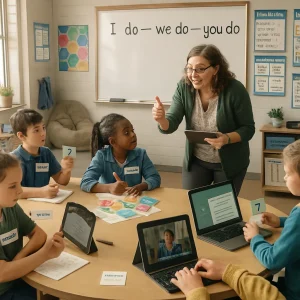
- Use “I do — we do — you do” gradual release.
- Provide sentence starters and graphic organizers to reduce processing load.
Universal Design for Learning (UDL) — three simple moves
- Multiple means of representation: offer the same content as text + visuals + short video/audio.
- Multiple means of engagement: offer choices (which topic to explore, which product to make).
- Multiple means of expression: allow responses via drawing, oral answer, video, or written text.
Differentiation (content/process-product)
- Content: simplify language, pre-teach key vocabulary, highlight core ideas.
- Process: work in short, focused chunks; use mixed-ability pairs; give extra processing time.
- Product: let students show learning by making a poster, recording an explanation, building a model.
Group work & social scaffolds
- Structure groups with clear roles (recorder, explainer, checker).
- Use peer tutoring / pairing stronger with weaker students — Vygotsky’s assisted learning.
- Teach collaboration skills explicitly (how to ask for help, how to give feedback).
Formative assessment & feedback
- Frequent low-stakes checks: thumbs up/down, exit tickets, one-minute papers.
- Feedback: timely, specific, actionable. Focus on progress (“You used two strong reasons — next, add an example”) not just scores.
- Encourage metacognition: ask learners what helped them and what they found tricky.
Behavior & emotional supports
- Create predictable routines and visual schedules.
- Have a calm-down space and brief sensory breaks available.
- Use positive reinforcement and specific praise to build self‑esteem: “You stuck with that problem — that perseverance helped you solve it.”
Sensory & physical access
- Seat planning: near teacher or away from distractions as needed.
- Provide fidgets, headphones, or alternative seating for sensory needs.
- Ensure large print, high contrast, or audio for vision/hearing differences.
Use technology wisely
- Assistive tech: speech-to-text, word-predictors, screen readers.
- Interactive apps for practice with immediate feedback (good for repetition and brain-friendly spacing).
- Keep tech purposeful — not a gimmick.
After teaching: assessment, reflection, and next steps
- Use formative evidence to decide next steps. Was the scaffold enough? Remove, keep, or change?
- Measure small wins — celebrate and record progress to boost self‑esteem.
- Communicate with parents/caregivers: share successes, strategies that worked, and next goals.
- Update IEP/learning plan based on observed performance and formative data.
- Reflect: What worked? What barriers remained? Plan adaptations for next lesson.
Please take the quizs to proceed: