Before teaching: gather info & plan inclusively

didactec 17.09.2025
Lesson Progress
0% Complete
- Quick intake checklist
- Does the student have a documented SEN (IEP, 504, support plan)? What are the legal/required accommodations?
- Academic profile: strengths, struggles, preferred modalities (visual, hands-on, conversational), previous successes.
- Social-emotional profile: attachment style, what calms them, triggers, helpful routines.
- Classroom access needs: vision/hearing aids, mobility, sensory sensitivities, language support.
- Ask about prior knowledge
- Short diagnostic questions or quick task to see what the learner already knows (this is diagnostic assessment).
- Use those results to anchor the lesson — avoid teaching from scratch if they already have partial schemata.
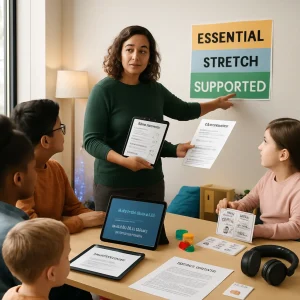
- Plan tiered outcomes
- Essential outcome(s) (what everyone should be able to do).
- Stretch outcomes (what advanced students aim for).
- Supported outcomes (targeted, achievable goals for learners with additional needs).
- Prepare materials and accommodations
- Provide multiple entry points (text/audio/video/experiential).
- Chunk content and plan breaks.
- Prepare simplified instructions and visual organizers.
- Technology: text-to-speech, captions, enlarged fonts, manipulatives, interactive simulations.