
Back to Course

Top Teacher Theory 1: How people learn

0% Complete
0/0 Steps
  1. Welcome to Top Teacher Theory
    6 Topics
  2. How People Learn
    24 Topics
  3. Differentiation and Personalization
    35 Topics
  4. Understanding Learner Development
    17 Topics
  5. Your Feedback Matters 🙏
Lesson 2, Topic 22
In Progress

Motivation: intrinsic vs extrinsic (and why rewards can backfire)

didactec 17.09.2025
Lesson Progress
0% Complete
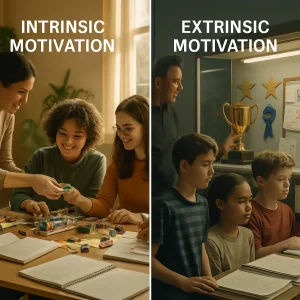
Photoreal cinematic split-scene contrasting intrinsic and extrinsic motivation: left, a warm sunlit corner where a diverse group of students smile and focus on hands-on projects—open notebooks, sketches, science kits and plants suggest curiosity, autonomy and meaningful challenge as a teacher privately offers a quiet handwritten praise; right, a cold fluorescent display of trophies, gold stars, ribbons, stacks of graded papers and a visible leaderboard where students stare at grades and prizes, anxious or performing mechanically, one student reaching for a shiny trophy but appearing less joyful while a teacher loudly promises rewards. Natural skin tones, high-detail textures, HDR lighting, 35mm lens look, warm earthy palette on the intrinsic side versus cool metallic tones on the extrinsic side—editorial, high-realism image suitable for an article illustration.

Main ideas from the course:

  • Intrinsic motivation (interest, curiosity, internal satisfaction) produces deeper, more durable learning.
  • Extrinsic rewards (prizes, grades used as carrots) do motivate — but primarily for the reward itself. Promising rewards for a task can reduce intrinsic motivation for that task.
  • Unexpected rewards are less harmful than promised ones: surprise praise or an unplanned token after good work is better than “do X and you’ll get Y.”
  • Grades are double‑edged: they can motivate externally for insecure students, but they can also be interpreted as punishment by some and severely damage self‑esteem and motivation.

Practical principles:

  • Design tasks with cognitive appeal: novelty, relevance, challenge and perceived usefulness boost intrinsic motivation.
  • Use autonomy and meaningful choice: let students make real decisions about topics, methods, or products.
  • Emphasize mastery goals (improving, understanding) over performance goals (getting the highest grade).
  • Use extrinsic rewards sparingly and carefully; prefer unexpected acknowledgments and private, specific praise.
Please take the quiz to proceed: