
Designing group tasks for targeted growth

didactec 18.09.2025
Lesson Progress
0% Complete
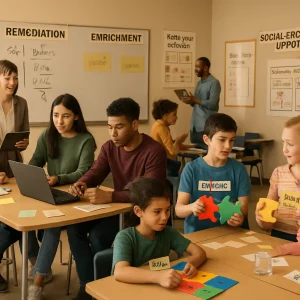
Make tasks match both the group type and the cognitive demand:
- For remediation groups:
- Short, scaffolded tasks with immediate feedback.
- Use worked examples → guided practice → independent attempt.
- Anchor to prior knowledge (Ausubel/Piaget): link new ideas to what students already know.
- For enrichment groups:
- Open problems that require synthesis (higher-order thinking).
- Real-world or project tasks that invite transfer.
- For mixed groups:
- Use “jigsaw” or layered tasks: each student is responsible for a piece; they teach each other.
- Plan specific roles so stronger students don’t dominate.
- For Kolb-style cycles:
- Start with a concrete experience (lab, simulation).
- Pause for reflection (group discussion).
- Move to abstract conceptualization (teacher mini-lecture, modeling).
- Finish with active testing (apply in new context).
- For social-emotional support:
- Low-risk tasks that build competence early.
- Cooperative tasks with success built-in, so self-esteem strengthens quickly.
Always include explicit success criteria and a short feedback loop.
Please take the quiz to proceed: