

Back to Course
Top Teacher Theory 1: How people learn
0% Complete
0/0 Steps
-
Welcome to Top Teacher Theory6 Topics
-
How People Learn24 Topics
-
Behaviorism in practice
-
A simple lesson flow using behaviorist steps (example: multiplication fluency)
-
Cognitive approaches
-
1) Memory — the constraints and opportunities
-
2) Attention — the gatekeeper of learning
-
3) Processing — surface vs deep; serialistic vs holistic; Kolb’s cycle
-
4) Developmental & content sensitivity (Piaget + brain findings)
-
5) Metacognition and targeted learning
-
6) Social constructivism: learning together is powerful
-
7) Assessment and feedback — formative as the engine
-
8) Practical design checklist for a cognitively-smart lesson
-
9) Adapting for different learner strategies and styles
-
10) Short sample micro-lesson (45 minutes) — topic: density (ages 11–12, concrete-operational)
-
11) Five small changes you can make next lesson
-
Constructivism and active learning
-
Practical teacher moves: how to support learning-by-doing
-
Short example lesson — “Three-legged stool” (transfer-focused)
-
Sample teacher checklist for active, constructivist lessons
-
Social and motivational factors
-
Peers and group dynamics — social constructivism in practice
-
Identity, self‑concept and subject‑specific esteem
-
Motivation: intrinsic vs extrinsic (and why rewards can backfire)
-
Classroom practices — before, during and after teaching
-
Responding to the “unstable” or “rejected” student
-
Behaviorism in practice
-
Differentiation and Personalization35 Topics
-
Tiered activities and choice
-
Models of tiered activities
-
Practical, ready-to-use examples
-
Simple choice tools you can implement today
-
A simple Tiered Activity Planner (use for any lesson)
-
Assessment, feedback & grading (don’t hurt self‑esteem)
-
Troubleshooting common issues
-
Mini 45‑minute lesson plan you can try tomorrow
-
Flexible grouping
-
Data-driven grouping: a simple three-step process
-
Types of groups — choose the right one for the learning goal
-
Designing group tasks for targeted growth
-
Practical classroom routines & logistics
-
Avoiding stigma and supporting self-esteem
-
Example: a simple lesson cycle using flexible grouping
-
Dos and don’ts — at a glance
-
Universal Design for Learning (UDL)
-
Practical UDL strategies — structure by the three UDL principles
-
UDL in the lesson cycle: Before → During → After (practical checklist)
-
Mini UDL lesson template (practical, ready to copy/paste)
-
Quick adaptations for common classroom situations
-
Formative assessment & UDL — short how-to
-
EdTech for personalization
-
Practical toolbox (what to use and why)
-
Step-by-step workflow: how to design a personalized lesson with EdTech
-
Sample mini lesson flows (practical examples)
-
Metacognition and self-paced practice (student agency)
-
A short teacher checklist before you launch a personalized EdTech lesson
-
Teacher professional development & finding research / OER
-
Student agency and voice
-
Quick classroom strategies (practical, low‑prep)
-
Scaffolding agency for different students
-
Sample choice menu (middle school science)
-
Feedback language you can use (fast scripts)
-
Quick lesson‑planning checklist for agency
-
Tiered activities and choice
-
Understanding Learner Development17 Topics
-
Developmental trajectories
-
From “pre-structural” to “abstract” — levels of information processing you’ll see
-
Vygotsky and social constructivism — learning is social
-
Practical classroom strategies by age band (concise)
-
Individual differences
-
Special educational needs
-
Before teaching: gather info & plan inclusively
-
During teaching: practical classroom strategies
-
Quick classroom tools (printable in your lesson kit)
-
Sample lesson modification — short example (Math: area of rectangles)
-
Teacher development: keep learning
-
Cultural and language diversity
-
Practical classroom strategies
-
Assessment: fair, supportive, and learning-focused
-
Classroom routines and small activities
-
Dealing with cultural misunderstandings and behavior differences
-
Sample mini-lesson flow (Before / During / After) — practical and brief
-
Developmental trajectories
-
Your Feedback Matters 🙏
Participants 3
Lesson Progress
0% Complete
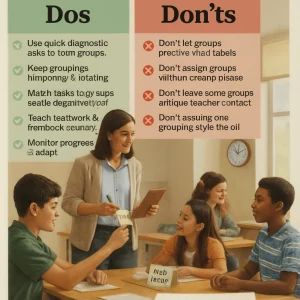
Dos
- Do use data (quick diagnostics) to form groups.
- Do keep groupings temporary and rotating.
- Do match tasks to the group’s goal and cognitive level.
- Do teach teamwork and feedback routines.
- Do monitor progress and adapt.
Don’ts
- Don’t let groups become fixed labels.
- Don’t assign groups without a clear instructional purpose.
- Don’t leave some groups without teacher contact (especially struggling students).
- Don’t assume one grouping style fits all objectives.
Ready-to-use checklist before you group
- [ ] I have a clear instructional goal for each group.
- [ ] I collected quick diagnostic data.
- [ ] Group sizes and duration are planned.
- [ ] Tasks and materials are prepared for each group.
- [ ] Roles and success criteria are posted and modeled.
- [ ] I scheduled time to monitor and give feedback.
Flexible grouping is a tool — not a panacea. When we use it with clear purpose, short cycles, and careful monitoring, it reduces unfair dispersion, raises motivation, and helps every student move forward. Try one small cycle this week (20–30 minutes) — collect a quick exit ticket, form groups, and notice the difference. If something doesn’t work, change it and try again. The groups should serve learning — and we should continually measure whether they do.
Please take the quiz to proceed: