

Back to Course

Top Teacher Theory 1: How people learn

0% Complete
0/0 Steps
  1. Welcome to Top Teacher Theory
    6 Topics
  2. How People Learn
    24 Topics
  3. Differentiation and Personalization
    35 Topics
  4. Understanding Learner Development
    17 Topics
  5. Your Feedback Matters 🙏
Lesson Progress
0% Complete
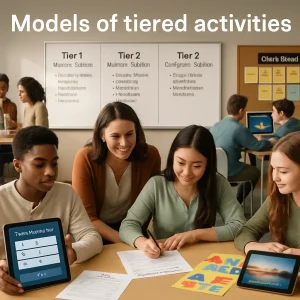
A photorealistic editorial 16:9 image of a modern classroom bathed in natural window light. Foreground: three diverse students at a table — one holds a tablet with an on-screen quiz modal reading "Please take the quiz to proceed" and multiple-choice buttons, a second signs a printed "Learning Contract" while a smiling teacher leans in, and a third assembles a colorful poster. Midground: a large whiteboard divided into three vertical panels labeled "Tier 1: Basic + Guided", "Tier 2: Moderate + Independent" and "Tier 3: Complex + Transfer" with short readable bullet examples; beside it, a bulletin board displays a tic-tac-toe choice board with sticky-note task cards. Background and side scenes show students conducting a small lab experiment, two students collaborating at a laptop viewing a simulation, and a pair engaged in a friendly debate; on a nearby table three finished products — a printed test, a poster, and a tablet showing a multimedia slideshow — complete the balanced, warm, high-resolution editorial composition with crisp detail and legible text.

Use one or more of these structures depending on your lesson.

  • Tiering by complexity (most common)
    • Tier 1: Basic understanding + guided supports
    • Tier 2: Moderate complexity + independent practice
    • Tier 3: Complex tasks + transfer/extension/hypothesis testing
  • Tiering by product
    • All students learn the concept; they show learning with different end products (poster, short test, multimedia presentation).
  • Tiering by process
    • Different learning paths/processes to reach the same goal (lab experiments, simulations, research, debate).
  • Choice board / Menu / Tic‑Tac‑Toe
    • Students pick tasks from a grid (often mixing skill levels or types of output).
  • Learning contracts
    • Student + teacher agree on goals, tasks, evidence, and deadlines — great for strong self‑managers.

Please take the quiz to proceed: