Back to Course

Top Teacher Theory 1: How people learn

0% Complete
0/0 Steps
  1. Welcome to Top Teacher Theory
    6 Topics
  2. How People Learn
    24 Topics
  3. Differentiation and Personalization
    35 Topics
  4. Understanding Learner Development
    17 Topics
  5. Your Feedback Matters 🙏
Lesson Progress
0% Complete
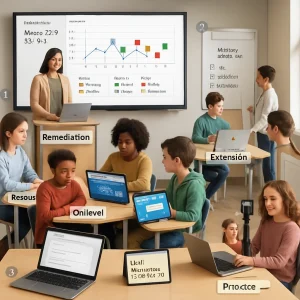
Photorealistic editorial image of a modern classroom illustrating a six-step personalized lesson workflow: a teacher at a laptop displaying a Google Forms diagnostic with a large wall screen behind showing an analytics dashboard (mean and SD, bar/line charts and colored flags for students far below/above the mean); four small student groups clearly labeled "Remediation","On-level","Extension","Project" working on laptops and tablets, one group receiving a teacher-led mini-lesson at a portable whiteboard, another student recording a short application video; visible device screens show conditional playlists, adaptive learning modules and a flashcard app for retrieval practice, a laptop open to a one-sentence student reflection and a sticky note reading "Goal: Master fractions — try these 3 steps", and a poster/tablet labeled "Mastery Checkpoint" with checkboxes; subtle numbered step markers 1–6 point to each scene, all bathed in natural daylight with crisp photorealistic detail and a clean editorial composition suitable for an article header.
  1. Before class — diagnose
    • Short diagnostic (5–10 questions) in Google Forms or platform baseline.
    • Analyse results: compute mean & SD, flag students far below/above the mean.
  2. Group & plan
    • Form 3–4 flexible groups: remediation, on-level practice, extension, and project-based application.
    • Prepare short teacher-led mini-lessons for groups who need reteach.
  3. Assign personalized activities
    • Conditional playlists in LMS or links to adaptive modules (Khan, IXL), simulations, and microtasks.
    • Use EdPuzzle or Flip for application practice; use Anki/Quizlet for retrieval practice.
  4. Monitor and intervene
    • Check dashboards every 1–3 days for time-on-task, mastery rates, and stalls.
    • Run short teacher check-ins (5 minutes) with students who haven’t progressed.
  5. Feedback & reflection
    • Provide descriptive feedback focused on process and strategy (“You have nearly mastered fractions—try these 3 steps next”).
    • Ask students to set a short goal in the LMS and submit a one-sentence reflection after practice (metacognitive habit).
  6. Summative/checkpoint
    • Use a mastery-based checkpoint: students pass when they demonstrate competence across scenarios, not just one quiz.