
Back to Course

Top Teacher Theory 1: How people learn

0% Complete
0/0 Steps
  1. Welcome to Top Teacher Theory
    6 Topics
  2. How People Learn
    24 Topics
  3. Differentiation and Personalization
    35 Topics
  4. Understanding Learner Development
    17 Topics
  5. Your Feedback Matters 🙏
Lesson 2, Topic 17
In Progress

Short example lesson — “Three-legged stool” (transfer-focused)

didactec 17.09.2025
Lesson Progress
0% Complete
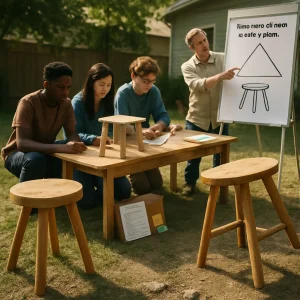
A sunlit, documentary-style classroom yard captures a blue three-legged wooden stool sitting solid on three contact points atop uneven grass and rock while a four-legged stool wobbles with one leg off the ground. Centered, a small, diverse group of middle/high school students kneel around a workbench building a yard stool from cardboard and wood—measuring with rulers, sketching plans, and consulting a checklist rubric and sticky-note reflections—while a teacher points to a whiteboard easel showing a clear triangle diagram labeled "three non-collinear points = plane" and a simple stool-leg sketch. High-resolution, realistic textures (wood grain, cardboard, grass, clothing), natural warm daylight, candid poses and a shallow depth-of-field keep the scene crisp and documentary-ready for an educational article.

Goal: Students explain why three points define a plane and apply that to design.

  1. Hook (concrete experience): show a 3-legged stool wobbling vs stable, and a 4-legged stool wobbling.
  2. Diagnostic: quick poll — why does the 3-legged stool not wobble?
  3. Task: In groups, design a yard stool that won’t wobble on uneven ground. Build a model (cardboard/wood) or simulate.
  4. Reflection: groups record observations — what did they notice? What problems emerged?
  5. Conceptualize: teacher guides discussion connecting observations to geometry (three non-collinear points define a plane) and to design constraints.
  6. Transfer challenge: predict whether a 3-legged desk on rocky terrain would be stable; explain and defend.
  7. Assessment: rubric checks reasoning (cause–effect), ability to apply concept in new scenario, and group reflection on learning strategies.
  8. Metacognitive wrap-up: students write one strategy they used to remember the rule and one question they still have.

Please take the quiz to proceed: