Back to Course

Top Teacher Theory 1: How people learn

0% Complete
0/0 Steps
  1. Welcome to Top Teacher Theory
    6 Topics
  2. How People Learn
    24 Topics
  3. Differentiation and Personalization
    35 Topics
  4. Understanding Learner Development
    17 Topics
  5. Your Feedback Matters 🙏
Lesson Progress
0% Complete

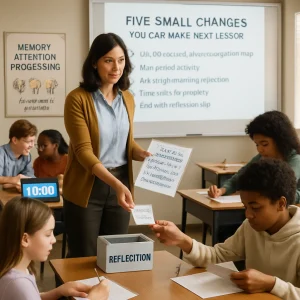
Photorealistic, candid classroom scene showing practical tweaks a teacher can make next lesson: a teacher at the front holds a laminated 90-second advance-organizer map and points to a projected slide titled "Five Small Changes" with a short bulleted map and a single warm-up retrieval question; in the midground two students work together at a tablet displaying a visible 10:00 countdown in place of a lectern while other students quietly write three-question reflection exit slips and drop them into a labeled "Reflection" box; the teacher leans in to hand a student a small handwritten, process-focused formative feedback note. Classroom walls display a tasteful poster reading "Memory, Attention, Processing — the plumbing of learning" with subtle icons (brain/pipes, lightbulb, hands-on activity). Warm natural daylight, shallow depth of field and high-resolution photorealism emphasize a calm, inclusive, documentary-style learning environment.

  1. Begin with a 90-second advance organizer (map the main idea).
  2. Add one retrieval question from last lesson as a warm-up.
  3. Replace 10 minutes of lecture with a 10-minute paired activity.
  4. Give students a 3-question reflection at the end.
  5. Add one specific formative feedback comment per week per student (process-focused).

Final note — keep it learner-centered and evidence-informed

Memory, attention and processing are not abstract research terms — they are the plumbing of every lesson. Build lessons that respect working memory, activate schemas, harness attention (emotion + novelty), and push students toward deep processing through experience, reflection and application. Anchor assessment in learning, not just grading. And remember: social interaction, safe classrooms, and well-planned experiences are as important as “cognitive tricks.” Teach the mind, but teach the whole learner.

Please take the quiz to proceed: