
A simple lesson flow using behaviorist steps (example: multiplication fluency)

didactec 07.09.2025
Lesson Progress
0% Complete
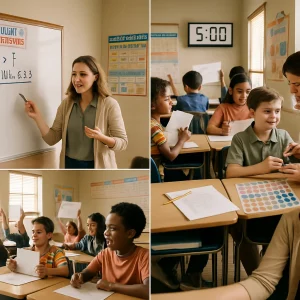
- Objective: Students will multiply single-digit numbers accurately and within 5 seconds.
- Model: Teacher demonstrates strategies (skip-counting, known facts) while thinking aloud.
- Guided practice: Class practices 10 problems together; teacher corrects errors immediately.
- Focused drills: 5-min timed practice (distributed across several days).
- Immediate feedback: Teacher circulates, giving specific corrective cues: “When you get 6×7, try doubling 6×3 first…”
- Reinforcement: Praise for correct strategies and improvement. Small mastery sticker when a student meets the speed+accuracy criterion.
- Transfer: After fluency, present word problems that require multiplication (move toward deeper processing).
Sample feedback language (quick scripts teachers can use)
- Corrective + supportive: “Nice setup — you made one small mistake in the subtraction step. Re-do that step and you’ll get the right answer.”
- Reinforcing effort: “I can see you practiced those facts — your speed improved a lot. Keep it up.”
- When error persists: “Try this hint: what happens if you double the smaller number? Let’s try one together.”
These phrases strengthen self-esteem (important for motivation) while giving actionable guidance.
Aligning behaviorism with Piaget / Ausubel / Constructivism
- Start with behaviorist methods to build reliable procedural skill and anchor new content on prior knowledge (Ausubel). For concrete-stage learners (Piaget), behavioral practice gives the necessary experience.
- Once fluency/skill is established, shift toward constructivist tasks: problem-solving, group reflection, hypothesis testing, and transfer tasks that require higher-order thinking.
- Use behaviorist tools as stepping stones, not the end goal.
Common pitfalls and how to avoid them
- Over-emphasis on rote memorization — pair drills with explanation and varied tasks to promote understanding.
- Excessive extrinsic rewards — favor praise, mastery recognition, and fade rewards to support internal motivation.
- Feedback that is too general (e.g., “Good job”) — aim for corrective, specific, and timely feedback.
- Ignoring affective factors — a student’s home/attachment background and self-esteem influence whether feedback and reinforcement work. Build a safe, respectful classroom first.
Quick teacher checklist (before, during, after practice)
- Before: Set clear objective + show model. Check prior knowledge.
- During: Provide focused practice, immediate corrective feedback, and reinforcement. Monitor errors and prompt.
- After: Use a quick formative check; schedule spaced review; fade prompts and rewards as mastery grows.
Final thought — behaviorism is a pragmatic tool
Behaviorist practices — clear models, repetition, feedback — are powerful for building reliable skills and neural connections. But they’re most effective when integrated into a broader teaching approach that includes social interaction, meaningful context, and opportunities for reflection and transfer. Use behaviorism to build the base; use constructivist strategies to turn those skills into flexible, meaningful competence.