Back to Course

Top Teacher Theory 1: How people learn

0% Complete
0/0 Steps
  1. Welcome to Top Teacher Theory
    6 Topics
  2. How People Learn
    24 Topics
  3. Differentiation and Personalization
    35 Topics
  4. Understanding Learner Development
    17 Topics
  5. Your Feedback Matters 🙏
Lesson Progress
0% Complete
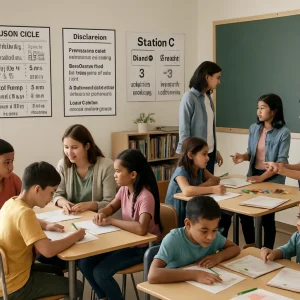
Photorealistic wide-angle portrait of a sunlit classroom mid-lesson, organized into three clearly labeled stations: Station A (Group 1 — Remediate, 4 students) at a small table with the teacher providing direct instruction; Station B (Group 2 — Practice, 5 students) at a table with guided worksheets and a peer tutor while the teacher circulates; Station C (Group 3 — Extend, 3 students) standing at a problem-solving challenge using manipulatives and engaged in deep discussion. A wall chart shows the lesson-cycle timeline (Warm-up 5 min, Stations 8–10 min each, Regroup + Share 8 min, Exit Ticket 5 min, rotate next lesson) and a laminated quick-decision flow chart with short prompts for grouping choices. Diverse students, authentic materials (worksheets, markers, clipboards, exit-ticket slips), natural soft daylight and candid documentary composition create a high-resolution, realistic snapshot of flexible-grouping instruction in action.
  1. Warm-up (5 min): Quick diagnostic quiz (5 items). Teacher notes patterns.
  2. Group formation (2 min): Based on results:
    • Group 1 (remediate): 4 students, focused skill spiral.
    • Group 2 (practice): 5 students, guided worksheets + peer tutor.
    • Group 3 (extend): 3 students, problem-solving challenge.
  3. Stations (25 min): Each station is 8–10 minutes. Teacher teaches Group 1 directly, circulates to Group 2, checks thinking in Group 3.
  4. Regroup + share (8 min): Groups report one takeaway.
  5. Exit ticket (5 min): Short problem that addresses the original objective.

Rotate groups next lesson so membership changes.


Quick decision flow (text version)

  • Did a formative check show mixed readiness? → Yes → Consider grouping by readiness for a short reteach cycle.
  • Is your goal to build discussion and transfer? → Yes → Use heterogeneous groups with clear roles.
  • Is the problem motivational? → Yes → Use interest-based groups and high-success tasks to boost self-esteem.
  • Is it about social or emotional skills? → Yes → Create small relational groups and coach soft skills explicitly.