Back to Course

Top Teacher Theory 1: How people learn

0% Complete
0/0 Steps
  1. Welcome to Top Teacher Theory
    6 Topics
  2. How People Learn
    24 Topics
  3. Differentiation and Personalization
    35 Topics
  4. Understanding Learner Development
    17 Topics
  5. Your Feedback Matters 🙏
Lesson Progress
0% Complete
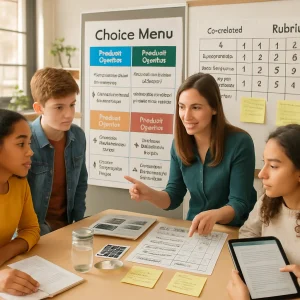
Documentary eye-level photo of a diverse middle-school science class clustered around a large laminated Choice Menu poster that clearly lists content options (local water quality; renewable energy design; human impacts on biodiversity), process options (lab investigation + data log; interview a local expert + summary; field observation + photo journal) and product options (5-minute presentation + Q&A; 2-page illustrated report; interactive poster/short video). Visible classroom details include a checkpoint schedule card (Week 2: proposal & success criteria; Week 3: evidence draft + peer feedback; Week 4: final product + self-assessment), a co-created rubric template with 1–4 scales for Understanding, Use of evidence, Communication & organization, Creativity/real-world connection and Reflection, plus sticky notes showing students' handwritten two-sentence improvement plans. Props on the table—a water sample jar, mini solar panel model, field notebook with photos and a tablet displaying a draft report—are bathed in warm natural daylight; shallow depth of field, crisp textures and engaged expressions make this image ideal for an educational article header.

Content (pick 1)

  • Local water quality
  • Renewable energy design
  • Human impacts on biodiversity

Process (pick 1)

  • Lab investigation + data log
  • Interview a local expert + summary
  • Field observation + photo journal

Product (pick 1)

  • 5‑minute presentation + Q&A
  • 2‑page illustrated report
  • Interactive poster or short video

Checkpoint schedule

  • Week 2: proposal & success criteria (co‑created)
  • Week 3: evidence draft + peer feedback
  • Week 4: final product + self‑assessment

Co‑created rubric (short template)

Criteria (students + teacher add specifics)

  • Understanding of key concepts (1–4)
  • Use of evidence (1–4)
  • Communication & organization (1–4)
  • Creativity/real‑world connection (1–4)
  • Reflection on learning (1–4)

Students write a 2‑sentence plan for improving each area after formative feedback.