-
Welcome to Top Teacher Theory6 Topics
-
How People Learn24 Topics
-
Differentiation and Personalization35 Topics
-
Tiered activities and choice
-
Models of tiered activities
-
Practical, ready-to-use examples
-
Simple choice tools you can implement today
-
A simple Tiered Activity Planner (use for any lesson)
-
Assessment, feedback & grading (don’t hurt self‑esteem)
-
Troubleshooting common issues
-
Mini 45‑minute lesson plan you can try tomorrow
-
Flexible grouping
-
Data-driven grouping: a simple three-step process
-
Types of groups — choose the right one for the learning goal
-
Designing group tasks for targeted growth
-
Practical classroom routines & logistics
-
Avoiding stigma and supporting self-esteem
-
Example: a simple lesson cycle using flexible grouping
-
Dos and don’ts — at a glance
-
Universal Design for Learning (UDL)
-
Practical UDL strategies — structure by the three UDL principles
-
UDL in the lesson cycle: Before → During → After (practical checklist)
-
Mini UDL lesson template (practical, ready to copy/paste)
-
Quick adaptations for common classroom situations
-
Formative assessment & UDL — short how-to
-
EdTech for personalization
-
Practical toolbox (what to use and why)
-
Step-by-step workflow: how to design a personalized lesson with EdTech
-
Sample mini lesson flows (practical examples)
-
Metacognition and self-paced practice (student agency)
-
A short teacher checklist before you launch a personalized EdTech lesson
-
Teacher professional development & finding research / OER
-
Student agency and voice
-
Quick classroom strategies (practical, low‑prep)
-
Scaffolding agency for different students
-
Sample choice menu (middle school science)
-
Feedback language you can use (fast scripts)
-
Quick lesson‑planning checklist for agency
-
Tiered activities and choice
-
Understanding Learner Development17 Topics
-
Your Feedback Matters 🙏
Participants 3


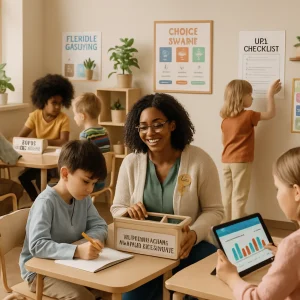
Welcome! In this lesson we’re going to dig into practical ways teachers adapt instruction so every learner can progress from their own starting point. Think of differentiation and personalization as the friendly toolkit a Top Teacher uses: same learning goals, different roads to get there.
This approach sits squarely in the student-centered, Finnish-inspired philosophy that Petri Lounaskorpi writes about: every child is an individual learner with unique prior knowledge, emotional needs, and ways of processing information. When we plan with those differences in mind — attention to interaction, self‑esteem, motivation, and metacognition — we not only improve learning outcomes but we also strengthen students’ confidence and willingness to engage.
What this lesson will cover
- Tiered activities and choice — how to design tasks at different levels (and give meaningful choices) so learners work where they can grow.
- Flexible grouping — simple ways to mix students based on need, task, or learning style to boost learning and social development.
- Universal Design for Learning (UDL) — three practical UDL moves to remove barriers and offer multiple ways to access, engage with, and express learning.
- EdTech for personalization — how to use tech thoughtfully to track starting points, scaffold progress, and free you up for targeted teaching.
- Student agency and voice — techniques to invite students into setting goals, choosing paths, and owning their learning (key to intrinsic motivation).
Why this matters (short version)
- Students come with prior knowledge, emotions, and learning preferences — and instruction that ignores that creates big gaps (and damaged self‑esteem).
- Differentiation is the teacher’s job: vary process, product, and supports.
- Personalization invites the student in: build metacognitive skills so learners can set goals, monitor progress, and transfer learning.
- Assessment (diagnostic + formative) guides where to differentiate — it’s feedback for both student and teacher.
Quick practical promise
By the end of this lesson you’ll have concrete ideas to use tomorrow: a simple tiered task template, 3 grouping strategies to try, a UDL checklist for one lesson, a shortlist of EdTech tools that actually save time, and classroom moves that amplify student voice.
Before we start: think of one student whose learning you want to support better this year. Keep them in mind as we move through the topics — you’ll be shaping real strategies for real learners. Ready? Let’s get practical.