
Back to Course

Top Teacher Theory 1: How people learn

0% Complete
0/0 Steps
  1. Welcome to Top Teacher Theory
    6 Topics
  2. How People Learn
    24 Topics
  3. Differentiation and Personalization
    35 Topics
  4. Understanding Learner Development
    17 Topics
  5. Your Feedback Matters 🙏
Lesson 2, Topic 11
In Progress

8) Practical design checklist for a cognitively-smart lesson

didactec 08.09.2025
Lesson Progress
0% Complete
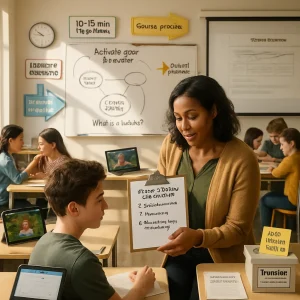
Wide, sunlit editorial photo of a modern classroom where a diverse teacher leans in with a clipboard checklist showing Clear learning goal, Success criteria and Advance organizer / concept map; the whiteboard displays a large concept map and a short diagnostic question under 'Activate prior knowledge', while a demo tablet plays an emotionally engaging hook video. Signage, bright arrows and a wall timer mark '10–15 min segments' and signaling; a projector shows a worked example as students work in pairs (guided practice), others work independently, a small group does a hands‑on task, one student writes in a notebook (individual reflection) and two whisper in discussion. A desk tablet shows a short quiz labeled 'retrieval', a calendar highlights spaced follow‑up dates, a sticky note reads 'How did I learn?' as a metacognitive prompt, the teacher gives immediate, specific feedback, a worksheet titled 'Transfer: real‑world task' sits on a desk and an exit‑ticket box labeled 'Main idea + One question I still have' is visible — warm natural light, realistic skin tones, shallow depth of field and high‑resolution composition, perfect for an educational article header.
  1. Objective: clear learning goal (knowledge + skill + success criteria).
  2. Advance organizer: show the big picture / concept map.
  3. Activate prior knowledge: quick diagnostic task or question.
  4. Hook: emotionally engaging example, demo or story.
  5. Chunk content into 10–15 min segments. Use signaling and guides.
  6. Use worked examples, then guided practice, then independent practice.
  7. Mix learning modes: individual reflection, pair discussion, hands-on task, whole-class synthesis.
  8. Retrieval and spacing: include a quiz or recall practice during lesson and schedule follow-up recall.
  9. Metacognitive prompt: ask students to reflect on strategy and understanding.
  10. Formative feedback: immediate, specific, process-focused.
  11. Transfer task: short real-world application or problem.
  12. Exit ticket: one main idea + one question I still have.