Back to Course

Top Teacher Theory 1: How people learn

0% Complete
0/0 Steps
  1. Welcome to Top Teacher Theory
    6 Topics
  2. How People Learn
    24 Topics
  3. Differentiation and Personalization
    35 Topics
  4. Understanding Learner Development
    17 Topics
  5. Your Feedback Matters 🙏
Lesson Progress
0% Complete

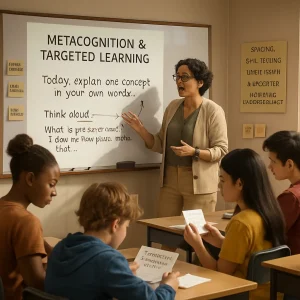
Photorealistic classroom scene of a diverse teacher modeling a think‑aloud metacognition lesson, writing and speaking as they annotate a whiteboard and a projected slide titled "Metacognition & Targeted Learning" with a clear process goal: "Today: explain one concept in your own words." Students of varying ages and ethnicities sit at desks — some complete reflection sheets showing the three prompts "What did I learn? What was hard? What will I try next?", others hold flashcards or small self-test quizzes, one student marking a spaced-practice calendar; sticky notes with brief strategy reminders and a poster listing "spacing, self-testing, summarizing, elaboration, monitor comprehension" are visible on the walls. Natural daylight, warm tones, shallow depth of field and high-resolution realism highlight focused, curious facial expressions and a clean composition suitable for an article illustration.

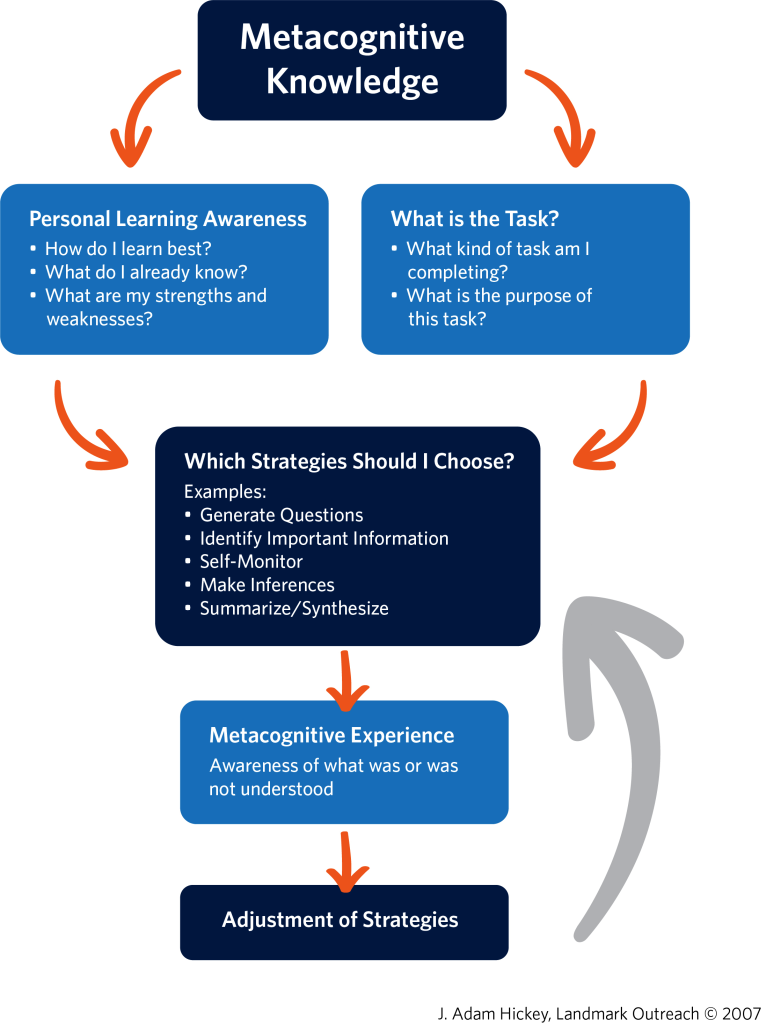
  • Metacognition (knowing one’s own thinking) is a teachable skill. Metamemory (knowledge of memory) helps students choose strategies.
  • Teach students how to study: spacing, self-testing, summarizing, elaboration, and monitoring comprehension.
Classroom strategies:

  • Model thinking aloud when solving problems.
  • Ask students to set learning goals, predict performance, and self-evaluate after tasks.
  • Include brief “process goals” in lessons (e.g., “Today practice explaining one concept in your own words”).
  • Make assessment diagnostic: tasks should measure metacognitive skills, not only factual recall.

Sample classroom routine:

  • After a task, students complete a 3-question reflection: What did I learn? What was hard? What will I try next?