
Sample teacher checklist for active, constructivist lessons

didactec 17.09.2025
Lesson Progress
0% Complete
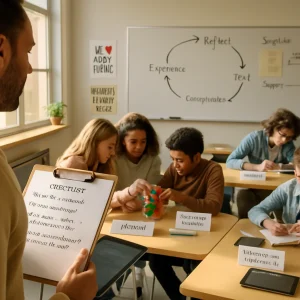
- [ ] I started by eliciting prior knowledge and misconceptions.
- [ ] The central task is authentic and asks students to apply/construct understanding.
- [ ] There are stages: experience → reflect → conceptualize → test.
- [ ] I planned scaffolds and a fading schedule.
- [ ] Students will work socially with clear roles and norms.
- [ ] I included prompts and routines for metacognition.
- [ ] Formative checks and feedback opportunities are built into the lesson.
- [ ] Assessment focuses on understanding and transfer, not only facts.
- [ ] The classroom climate supports risk-taking and values mistakes as learning.
Pitfalls to avoid
- Starting with too much lecture before any experience — students memorize, don’t construct.
- Over-scaffolding and never releasing responsibility — students become dependent.
- Using extrinsic rewards that undermine intrinsic curiosity (avoid treating grades as the only motivator).
- Ignoring emotional/social needs — insecure students won’t engage; build trust first.
- Assessment that only measures recall — misses whether students truly understand or can transfer.
Quick tips for supporting different learners
- If a student lacks prior knowledge: provide a minimal anchor expérience or an analogy; break tasks into simpler subgoals.
- For students needing hands-on: offer manipulatives, simulations, or practical roles.
- For reflective learners: give journaling time and opportunities to analyze.
- For struggling students: pair them with peers using structured or reciprocal teaching; give clear checklists.
- For advanced learners: add transfer challenges, open problems, or leadership roles in group work.
Final takeaways
- Constructivism says learners build knowledge by connecting new experiences to existing ideas — and the job of the teacher is to design the experiences, conversations and supports that make that building reliable.
- Active learning (doing + reflecting + testing + social interaction) is not optional fluff — it’s how durable learning and transfer happen, and neuroscience supports that.
- Help learners become better learners: teach metacognitive strategies, create safe collaborative classrooms, design authentic tasks, and make assessment part of the learning process.
Please take the quiz to proceed: