Back to Course

Top Teacher Theory 1: How people learn

0% Complete
0/0 Steps
  1. Welcome to Top Teacher Theory
    6 Topics
  2. How People Learn
    24 Topics
  3. Differentiation and Personalization
    35 Topics
  4. Understanding Learner Development
    17 Topics
  5. Your Feedback Matters 🙏
Lesson Progress
0% Complete

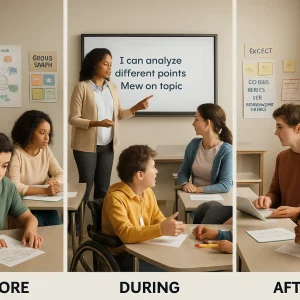
Photorealistic editorial triptych of a modern classroom illustrating a UDL lesson cycle: LEFT (BEFORE) — teacher with a tablet quickly checking prior knowledge as students complete 3‑minute concept maps and a short quiz; visible multiple representations (colorful diagram poster, tablet playing a short video, headphones), a choice board and scaffolded task tiers. CENTER (DURING) — teacher launches with a clear student‑friendly learning goal on an interactive whiteboard while students choose entry tasks, rotate through flexible small groups, use manipulatives and engage in peer discussion; formative checks (exit cards, thumbs up/down, one‑minute paper) and a metacognitive prompt poster (“What helps you understand this?”) are visible. RIGHT (AFTER) — teacher gives comment‑focused feedback with a rubric as a student revises on a laptop and records feedback on a phone; sticky‑note reflection prompts, a chart tracking choices and growth, and a “revision/retake” sign emphasize mastery. Diverse students and teacher (varied ethnicities, ages, abilities, one using a mobility aid), inclusion of low‑resource options like paper tools and phones, warm natural daylight, shallow depth of field, high resolution and clean composition suitable for an article header.

Use the familiar lesson phases from the course.

Before teaching

  • Find out prior knowledge with a quick diagnostic: concept map, short quiz, or discussion prompt (Ausubel).
  • Prepare at least two representations of core content (visual + text/audio).
  • Plan choices in engagement and expression that map to learning goals.
  • Create a few scaffolded tiers for tasks: core (all must meet), stretch (extension), support (remediation).

During teaching

  • Launch with an advance organizer and an explicit learning goal.
  • Offer choices of entry tasks and encourage students to pick one.
  • Monitor with formative checks (exit cards, thumbs up/down, one-minute papers).
  • Use flexible grouping; rotate peers so learners gain from social constructivist interaction.
  • Pause for metacognitive prompts: “What helps you understand this?” “What strategy will you try next?”

After teaching

  • Use formative feedback cycles: comment-focused rubrics, peer critique, or recorded teacher feedback.
  • Allow revision/retake opportunities tied to clear success criteria.
  • Ask reflective questions to develop metacognition: “How did your strategy help?” “What will you try differently next time?”
  • Document and share student choices and growth so you can personalize future lessons.

Please take the quiz to proceed: