Back to Course
Top Teacher Theory 1: How people learn
0% Complete
0/0 Steps
-
Welcome to Top Teacher Theory6 Topics
-
How People Learn24 Topics
-
Behaviorism in practice
-
A simple lesson flow using behaviorist steps (example: multiplication fluency)
-
Cognitive approaches
-
1) Memory — the constraints and opportunities
-
2) Attention — the gatekeeper of learning
-
3) Processing — surface vs deep; serialistic vs holistic; Kolb’s cycle
-
4) Developmental & content sensitivity (Piaget + brain findings)
-
5) Metacognition and targeted learning
-
6) Social constructivism: learning together is powerful
-
7) Assessment and feedback — formative as the engine
-
8) Practical design checklist for a cognitively-smart lesson
-
9) Adapting for different learner strategies and styles
-
10) Short sample micro-lesson (45 minutes) — topic: density (ages 11–12, concrete-operational)
-
11) Five small changes you can make next lesson
-
Constructivism and active learning
-
Practical teacher moves: how to support learning-by-doing
-
Short example lesson — “Three-legged stool” (transfer-focused)
-
Sample teacher checklist for active, constructivist lessons
-
Social and motivational factors
-
Peers and group dynamics — social constructivism in practice
-
Identity, self‑concept and subject‑specific esteem
-
Motivation: intrinsic vs extrinsic (and why rewards can backfire)
-
Classroom practices — before, during and after teaching
-
Responding to the “unstable” or “rejected” student
-
Behaviorism in practice
-
Differentiation and Personalization35 Topics
-
Tiered activities and choice
-
Models of tiered activities
-
Practical, ready-to-use examples
-
Simple choice tools you can implement today
-
A simple Tiered Activity Planner (use for any lesson)
-
Assessment, feedback & grading (don’t hurt self‑esteem)
-
Troubleshooting common issues
-
Mini 45‑minute lesson plan you can try tomorrow
-
Flexible grouping
-
Data-driven grouping: a simple three-step process
-
Types of groups — choose the right one for the learning goal
-
Designing group tasks for targeted growth
-
Practical classroom routines & logistics
-
Avoiding stigma and supporting self-esteem
-
Example: a simple lesson cycle using flexible grouping
-
Dos and don’ts — at a glance
-
Universal Design for Learning (UDL)
-
Practical UDL strategies — structure by the three UDL principles
-
UDL in the lesson cycle: Before → During → After (practical checklist)
-
Mini UDL lesson template (practical, ready to copy/paste)
-
Quick adaptations for common classroom situations
-
Formative assessment & UDL — short how-to
-
EdTech for personalization
-
Practical toolbox (what to use and why)
-
Step-by-step workflow: how to design a personalized lesson with EdTech
-
Sample mini lesson flows (practical examples)
-
Metacognition and self-paced practice (student agency)
-
A short teacher checklist before you launch a personalized EdTech lesson
-
Teacher professional development & finding research / OER
-
Student agency and voice
-
Quick classroom strategies (practical, low‑prep)
-
Scaffolding agency for different students
-
Sample choice menu (middle school science)
-
Feedback language you can use (fast scripts)
-
Quick lesson‑planning checklist for agency
-
Tiered activities and choice
-
Understanding Learner Development17 Topics
-
Developmental trajectories
-
From “pre-structural” to “abstract” — levels of information processing you’ll see
-
Vygotsky and social constructivism — learning is social
-
Practical classroom strategies by age band (concise)
-
Individual differences
-
Special educational needs
-
Before teaching: gather info & plan inclusively
-
During teaching: practical classroom strategies
-
Quick classroom tools (printable in your lesson kit)
-
Sample lesson modification — short example (Math: area of rectangles)
-
Teacher development: keep learning
-
Cultural and language diversity
-
Practical classroom strategies
-
Assessment: fair, supportive, and learning-focused
-
Classroom routines and small activities
-
Dealing with cultural misunderstandings and behavior differences
-
Sample mini-lesson flow (Before / During / After) — practical and brief
-
Developmental trajectories
-
Your Feedback Matters 🙏
Participants 3
Lesson Progress
0% Complete

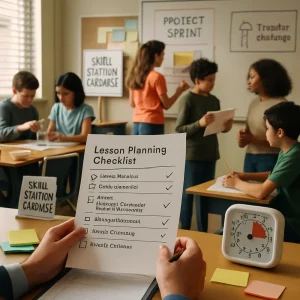
- Have I identified both the skills and the competence I want students to develop?
- Are skill-practice activities concrete, well-scaffolded and time-limited?
- Are there experiential tasks where students combine skills into real performances?
- Is there time for reflection and peer discussion (deep processing)?
- Have I planned formative checks for skills and a rubric for the competence?
- Will the task allow transfer (apply learning in a different context)?
- Have I considered students’ Piagetian/experience levels — do they need more concrete supports?
Practical classroom activities (quick ideas)
- “Skill station carousel”: 15–20 minute stations focusing on discrete techniques; rotate.
- “Mini-lab then explain”: short concrete experiment → group reflection → write a conceptual summary.
- “Project sprint”: week-long problem-based project with explicit checkpoints for skills (teacher-led mini-lessons) and a final authentic product (competence).
- “Metacognitive minute”: end of lesson — students write what helped them learn the skill and what they’ll try to apply next time.
- “Transfer challenge”: present a novel scenario and ask students to adapt their skills; grade with a competence rubric.
Rubric sketch (for competence assessment)
Use performance levels (Emerging / Developing / Proficient / Advanced) and rate:
- Application: integrates skills effectively in context
- Understanding: explains reasoning and connections
- Adaptation: applies learning to new situations
- Communication: presents findings clearly and justifies choices
- Collaboration (if applicable): contributes and negotiates effectively
Common pitfalls and how to avoid them
- Pitfall: teaching a competence by only lecturing on theory. Fix: add concrete tasks and guided practice.
- Pitfall: over-emphasizing drills without context (atomism). Fix: connect drills to real tasks and add reflection.
- Pitfall: expecting abstract transfer too early (Piaget reminder). Fix: provide experiential anchors and scaffolding.
- Pitfall: assessment that prizes “correct answers” only. Fix: include evaluations of reasoning, application and process.
Please take the quiz to proceed: