
Tips for students who struggle with routine or social safety

didactec 22.09.2025
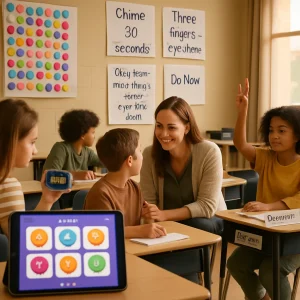
Students with unstable home or low self-esteem often need predictable cues and small successes.Warm calls: brief, private check-ins before/after class.
Anchored roles: give a struggling student a low-pressure role (timekeeper) to build competence.
Visible progress: show them data that tracks small wins (sticker chart, digital badges).
Attention-seeking / disruptive students often benefit from structured opportunities for leadership and clear boundaries. Predictable transitions reduce opportunities for attention-seeking misbehavior.
Quick scripts & teacher language that support routine
To start: “Okay team — three things: quiet, eyes here, Do Now. You’ve got three minutes.”
For transitions: “Chime = 30 seconds to wrap up. Three fingers = eyes on me.”
For group work: “Pause. Who’s the Recorder? Who’s the Reporter? Start now.”
For correcting behavior: “I need you to do X now. Then we’ll be ready to continue.” (short, neutral, immediate)
For feedback: “Tell me one thing you learned and one thing you want help with.”
Sample week routine (high-level)
Monday: Goals & warm-up + explicit routine rehearsal
Tuesday: New content + group exploration
Wednesday: Hands-on / lab / virtual simulation (concrete experience)
Thursday: Reflection + critique circles (reflective observation)
Friday: Synthesis + formative assessment + celebration of growth
Troubleshooting common problems
Routine isn’t followed: reteach it in 3 minutes and practice it. Routines are skills — they need coaching.
Students “zone out” during routines: check cognitive load — are routines too long or unclear? Shorten and simplify.
Online chaos in breakout rooms: pre-assign roles, use shared docs, lower the task load.
Over-reliance on external rewards: replace with public recognition of strategy use and growth, not material rewards.
Please take the quiz to proceed: