
Core classroom routines (with scripts you can copy)

didactec 22.09.2025
Lesson Progress
0% Complete
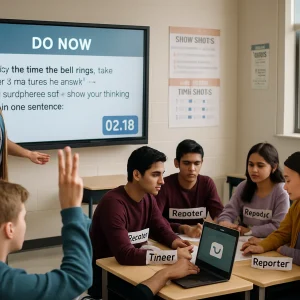
Below are routines that free up cognitive capacity and strengthen culture. For each: purpose, suggested script, timing.
- Start-of-lesson “Do Now”
- Purpose: settle quickly, activate prior knowledge, diagnostic for next steps.
- Script: “By the time the bell rings, take 3 minutes to answer this prompt. No phones out — show me your thinking in one sentence.”
- Time: 3–7 minutes
- Entry & Tech-check (hybrid / online)
- Purpose: ensure everyone’s connected and ready; avoid tech disruptions mid-lesson.
- Script: “Post a green emoji in chat if your audio works, red if it doesn’t. If green, type one thing you remember from last time.”
- Time: 2–5 minutes
- Transition signals
- Purpose: quick, non-verbal direction (saves time and attention).
- Examples: hand bell/soft chime, 3-finger signal (stop/talk/listen), countdown on screen.
- Script: “When you hear 3 chimes, finish your sentence and look here.”
- Group-work protocol + roles
- Purpose: reduce chaos, clarify social expectations, ensure equitable contribution.
- Roles: Facilitator, Recorder, Timekeeper, Reporter (rotate weekly).
- Script: “Start by agreeing on one shared sentence, Recorder types it, Timekeeper checks progress at 7 minutes. If you finish early, use the reflection prompt.”
- Time: set clear timeboxes (e.g., 12–15 minutes)
- Breakout / Small-group norms (online)
- Purpose: make virtual group work work.
- Norms to post: turn on camera when speaking if possible, use the shared doc, keep chat for ideas only.
- Script: “Agree on a question to answer first, then record your group’s 3-second summary to paste in the main chat.”
- Think–Pair–Share / Reflective pause
- Purpose: scaffold reflection (Kolb: experience → reflect).
- Script: “2 minutes to think, 3 minutes to partner-share, then we’ll share one idea from each pair.”
- Time: 6–8 minutes
- Formative feedback loop (quick checks)
- Purpose: ongoing assessment + guidance (improves metacognition).
- Tools: exit tickets, mini-whiteboards, LMS poll, one-sentence summary.
- Script for exit ticket: “In one sentence: what was the main idea? In one sentence: what still confuses you?”
- Time: 2–4 minutes
- Exit routine (“Exit Ticket”)
- Purpose: consolidate learning, guide next lesson.
- Script: “Before you go, answer this: What is one thing you’ll remember tomorrow? What’s one question you still have?”
- Time: 2–3 minutes
- Re-entry & Warm-up after breaks
- Purpose: re-anchor attention and restore emotional climate.
- Script: “3 deep breaths, quick recap of our goal today, then Do Now.”
- Classroom repair & reset
- Purpose: repair social ruptures quickly and constructively.
- Script: “We’ll take a 2-minute cool-down. After that, each person gives one sentence about how to move forward.”
Sample digital checklist for an online lesson routine
- 24–48 hours before: Post agenda + resources in LMS; announce breakout groups if pre-assigned.
- Start (0–5 min): Tech-check + Do Now in chat.
- Mid-lesson (after concept intro): Small-group activity with roles and shared doc.
- 10–15 min left: Whole-class synthesis + formative poll.
- End (last 3 min): Exit ticket + remind of next steps and homework location.
Please take the quiz to proceed: