
Metacognition & reflection (make it explicit)

didactec 22.09.2025
Lesson Progress
0% Complete
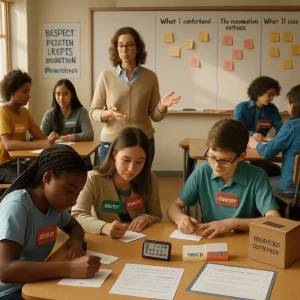
- After any peer activity, require a short reflection:
- What did I understand better after explaining?
- What misconception did my peer help me notice?
- What will I change in my study plan?
- Teach metamemory strategies: have students judge confidence (high/medium/low) on answers and then check accuracy — this trains self-evaluation.
Grouping, roles and equity
- Keep groups small (2–4) for active participation.
- Rotate roles (explainer, questioner, recorder, reporter) so weaker or shy students get scaffolding and stable students aren’t always leaders.
- When grouping, consider:
- Mixed-ability pairs for peer tutoring (proximal support)
- Homogeneous groups for targeted remediation
- Interest-based groups to increase engagement for low-motivation students
- Protect self‑esteem:
- Start with low-stakes practice: peer feedback should never be the sole basis for grading at first.
- Use anonymous peer assessment for early stages if students are fragile.
- Give positive feedback training; encourage noticing strengths first.
Linking to prior knowledge and transfer
- Begin each activity with a diagnostic prompt: “Show how this connects to X we learned.”
- Require students to produce an example from outside school (real-life transfer) — e.g., geometry → furniture stability example.
- Design tasks where students must apply one concept in a new context (transfer). Use group discussion to surface different transfer paths.
Classroom management & establishing norms
- Create a social contract: respect, explain, listen, question, no put-downs.
- Model how to disagree with ideas (not people).
- Teach “how to fail”: norm that mistakes are opportunities and part of learning (reduces fear of assessment).
- Have short routines for group work: clarify task, assign roles, set time, deliverable, and debrief.
Please take the quiz to proceed: