
Collaborative learning and peer instruction

didactec 26.08.2025
Lesson Progress
0% Complete
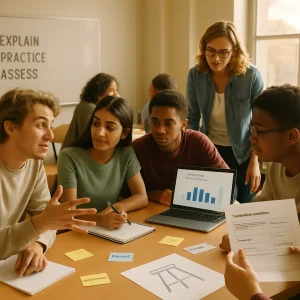
Using peers as resources for explaining, practicing and assessing
Welcome — this topic shows you how to make classmates into powerful learning resources. We’ll keep it practical: why peer-based teaching works (backed by the theories you’ve already met), how to design activities that anchor new knowledge to prior knowledge, how to use peers for explanation, practice and formative assessment, and quick tools you can reuse in any class.
Learning outcomes (what teachers will be able to do)
- Explain why collaborative learning and peer instruction accelerate meaningful learning (Ausubel, Vygotsky, constructivism, Kolb).
- Design at least three classroom activities that use peers to explain, practice and assess.
- Scaffold peer feedback so it supports metacognition, motivation and fair formative assessment.
- Manage group composition, roles and norms to protect students’ self‑esteem and encourage participation.
- Use simple rubrics and feedback sentence stems so peer assessment is reliable and helpful.
Why it works (short, practical theory)
- Social constructivism (Vygotsky): students often learn things with peers that they can’t yet learn alone. Collaborative talk expands the zone of proximal development.
- Prior knowledge (Ausubel, Piaget): new information sticks when anchored to what students already know. Peers are great at finding analogies and everyday anchors.
- Experiential cycle (Kolb): group reflection on shared experiences deepens learning; groups enable faster cycles of experience → reflection → conceptualizing → testing.
- Brain research: social, emotional and experiential learning strengthens synaptic networks — group learning creates richer, more durable memory traces.
- Motivation & self‑esteem: positive peer interaction and formative peer feedback boost internal motivation. Conversely, poor group dynamics can harm self‑esteem — group setup and norms matter.
Design principles (keep these front of mind)
- Start from students’ prior knowledge. Ask: What can they already do? What misconceptions might be circulating?
- Make tasks challenging but achievable (novelty + anchor = engagement).
- Build activities that require explanation, not just answer-sharing. Explaining is thinking.
- Teach and model good feedback — students need training to assess usefully.
- Use peer assessment mainly formatively: feedback for learning, not punishment.
- Keep groups small and clearly role-based to avoid social loafing and to support unstable/rejected students.