

Lesson Progress
0% Complete
How predictable structures free up cognitive space for learning
Let’s be blunt: when students don’t have to spend mental energy figuring out “what now?” they can spend that energy on learning. Routines, clear expectations and a supportive class culture turn a lot of background noise into predictable patterns — and predictability is cognitive gold. It reduces working memory load, supports emotional safety, increases motivation and creates the conditions for real social learning (Vygotsky, Kolb, Ausubel — they all nod in agreement). Below are practical ideas you can use tomorrow, whether you teach in-person, online, or hybrid.
Why routines, expectations and culture matter (short & practical)
- Brain research: predictable, repeated activity helps build and strengthen synapses. Routine automates procedural demands so learning-related synapses can form more easily.
- Cognitive load: routines reduce extraneous load so students can focus on intrinsic (the new content) and germane (processing/reflecting) load.
- Social constructivism: with less time spent on logistics, students can use social interaction to reflect and co-construct knowledge — the high-value learning Vygotsky and Kolb describe.
- Motivation & self-esteem: a safe, consistent environment supports attachment and self-worth. When students expect fair, supportive interactions, internal motivation grows (and external rewards become less necessary).
- Developmental fit: predictable structures are especially important for younger learners and for learners operating primarily at concrete stages (Piaget). They scaffold growth toward higher-level reasoning.
Design principles for routines and expectations
Keep these in mind as you design any routine or norm:
- Keep it explicit: teach the routine like a mini-lesson.
- Keep it simple: one short sequence per routine (3–5 steps).
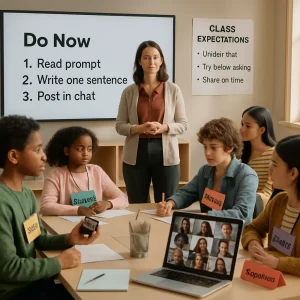
- Make it visible: post the steps (wall, slide, LMS module).
- Practice and rehearse: students need guided repetition.
- Be consistent but flexible: rules are firm; implementation has wiggle room.
- Co-create where possible: when students help set expectations they own them (boosts affective commitment).
- Link to purpose: explain why the routine exists (“this frees brain space for…”).