
Responsive strategies for the three student profiles

didactec 22.09.2025
Lesson Progress
0% Complete
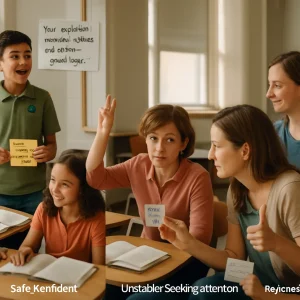
Use relationship + scaffolded competence, adjusting tone and supports.
Safe (confident, engaged)
- Challenge them cognitively: deep tasks, leadership roles.
- Use specific feedback: “Your explanation connected evidence and claim — great logic.”
Avoid: over‑praising trivial tasks or overusing rewards.
Unstable / Seeking (tests acceptance by drawing attention)
- First, stabilize relationship: consistent small interactions (5–10 sec) each day.
- Teach and rehearse social scripts (how to get attention appropriately, how to apologize, etc.).
- Offer structured choices: “You can start with A or B — which do you prefer?” (gives control without chaos).
- Use planned attention: brief one‑on‑one after class or at defined moments.
- When testing happens, avoid dramatic punishment. Use brief redirection + private talk.
Rejected / Withdrawn (silent, passive, may avoid school)
- Gentle, consistent firmness:
- Small, doable tasks that match ability — immediate, positive feedback for tiny wins.
- Offer predictable, private invitations to participate (“Can I hear one sentence from you?”).
- Use mentoring/buddy systems; pair with a safe peer or older student.
- If they avoid, don’t force public exposure. Build trust in low‑stakes contexts (corridor chats, checking work privately).
Please take the quiz to proceed: