Participants 3


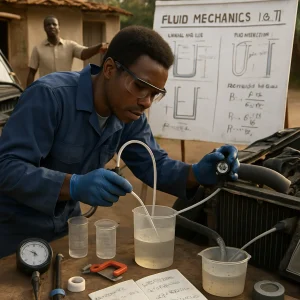
This lesson develops foundational fluid mechanics knowledge and practical skills essential for diagnosing, maintaining and repairing automotive cooling, lubrication, braking and fuel systems in resource‑constrained African contexts. The content is competency‑based and balanced between concise theory and hands‑on practice. Emphasis is placed on safe procedures, low‑cost measurement techniques and the use of locally available materials so that learners can produce reliable, repeatable results in workshop and field environments.
Learners completing this lesson will be able to:
- Describe key fluid properties (density, viscosity, pressure) and the principles of hydrostatics as they apply to vehicle systems.
- Use simple field instruments and improvised low‑cost methods (manometers, bucket‑and‑stopwatch, U‑tube, basic pitot/venturi approximations) to measure flow and pressure with sufficient accuracy for maintenance and diagnosis.
- Inspect and diagnose common faults in lubrication, cooling and braking systems and carry out appropriate maintenance or temporary field repairs using robust, locally available methods.
- Apply dimensional analysis and similitude to scale test results and to interpret measurements from simplified rigs and prototypes.
- Estimate and analyse flow losses in pipes and hoses, select appropriate remedial actions and perform safe, practical repairs in the field.
Lesson structure and topics
- Topic 1 — Fluid properties and hydrostatics: Definitions of density, specific weight, viscosity and pressure; Pascal’s principle; static pressure in tanks and brake systems; simple pressure‑head calculations and manometry.
- Topic 2 — Flow measurement and instrumentation: Practical measurement techniques for moderate accuracy diagnostics; construction and use of U‑tube and inclined manometers, bucket‑and‑stopwatch flow tests, simple pitot/venturi checks and reading techniques suitable for low‑tech workshops.
- Topic 3 — Lubrication, cooling and braking systems: Functional requirements; fluid selection and contamination control; common failure modes; practical maintenance procedures (oil change and analysis, radiator and hose inspection, brake bleeding and leak diagnosis) and low‑cost diagnostic checks.
- Topic 4 — Dimensional analysis and similitude: Non‑dimensional numbers (Reynolds, Froude), scaling rules for bench tests and model experiments, and how to interpret small‑scale measurements for full‑scale components when formal laboratory equipment is unavailable.
- Topic 5 — Flow losses, piping and field repairs: Head loss in pipes and flexible hoses, fittings and valves; simple calculations for pressure drop; common leak types and robust field repair techniques using locally sourced materials and safe interim solutions.
Teaching and assessment approach
- Delivery mixes short, focused theory presentations with workshop practice and field exercises. Each topic includes step‑by‑step procedures, diagnostic checklists and small practical tasks designed for low‑cost setups.
- Typical instruments and materials used: clear plastic tubing, transparent containers, hand‑held manometers (or U‑tube substitutes), buckets and graduated containers, stopwatches, basic clamps, thread seal materials, hose repair kits and simple improvised fixtures.
- Assessment is competency based and includes a written knowledge check, demonstration of at least two practical diagnostic/repair tasks (e.g., flow measurement and brake bleeding/repair), and a submitted logbook describing field measurements and repairs.
Safety and ethical practice
- Strict adherence to personal protective equipment (PPE), safe handling and disposal of oils, coolants and brake fluids, and proper ventilation during operations is mandatory.
- Ethical practice includes accurate reporting of measurements, safe repair standards, and transparent communication with vehicle owners about the limitations of temporary field repairs.
This lesson prepares learners to apply reliable fluid mechanics principles with limited resources, enabling safe and effective maintenance and diagnosis of critical vehicle systems. Practical competence here supports broader trade skills in diesel and gasoline system maintenance, engineering drawing interpretation and responsible workshop practice.