

Topic overview
This topic explains how reliable, accessible and ethically delivered automotive maintenance and repair services contribute to individual livelihoods, community mobility, and local economic development in resource-constrained African contexts. It highlights inclusive practices, community engagement strategies, and the technician’s ethical responsibilities to maximise social benefits while minimising harm.
Learning objectives
By the end of this topic, the learner will be able to:
- Describe how vehicle uptime and reliable maintenance support mobility, commerce, health, and education in local communities.
- Explain the economic multiplier effects of automotive services, including employment and supply-chain development.
- Apply inclusive practices that increase access to services for women, people with disabilities and low-income clients.
- Plan basic community engagement actions that build trust, share knowledge, and improve service quality.
- Identify ethical and environmental considerations (safety, fair pricing, waste management) relevant to community impact.
Key concepts
- Vehicle uptime: the proportion of time vehicles are available and safe for use. High uptime supports regular transport services, agricultural operations, emergency access, and business activities.
- Informal transport and services: many African communities depend on informal operators (motorcycle taxis, minibuses, boda-boda) and small repair shops. These sectors are major employers and require practical, low-cost maintenance solutions.
- Multiplier effect: spending on vehicle repair and operation circulates locally—parts, fuel, food and transport services—supporting wider economic activity.
- Inclusion: designing services and business practices so women, elderly, youth and people with disabilities can use, afford and benefit from mobility and repair services.
- Community engagement: two-way communication and cooperative activities (training, cooperatives, feedback mechanisms) that align services with local needs.
How reliable maintenance supports mobility and livelihoods
-
Mobility for daily needs
- Regular maintenance reduces breakdowns, ensuring people can reach markets, schools, clinics and workplaces. For remote and peri-urban communities where transport is limited, this continuity is essential to maintain access to services.
-
Economic livelihoods
- Transport operators (minibus drivers, motorcyclists, small-farm equipment users) earn incomes dependent on vehicle availability. Fewer breakdowns translate directly into more operating hours and higher earnings.
- Repair shops and mechanics create local employment. A functioning automotive sector supports allied trades (spare parts sellers, metalworkers, fuel stations).
-
Agriculture and trade
- Well-maintained vehicles and tractors reduce post-harvest losses and facilitate market access for farmers, improving household incomes and food security.
-
Emergency and health services
- Ambulances, community transport and other emergency vehicles must be reliable to save lives. Preventive maintenance programs reduce failures during critical moments.
-
Cost savings and affordability
- Preventive maintenance is often cheaper than frequent major repairs. Teaching vehicle owners low-cost maintenance techniques reduces total ownership costs and extends asset life.
Economic multiplier effects and local development
- Jobs and entrepreneurship: Small workshops, mobile mechanics, and parts distribution create micro- and small-enterprises.
- Local procurement: Sourcing labor, materials and services locally keeps expenditure within the community, stimulating demand for other goods and services.
- Investment and growth: Consistent transport services encourage local markets, attract small investments (shops, processors) and enable expansion of trade networks.
- Resilience: A local ecosystem of service providers increases community resilience by reducing dependency on distant suppliers.
Ethical responsibilities of technicians with social impact in mind
- Competence and quality: Delivering technically competent repairs that prioritise safety and durability.
- Honesty and transparency: Communicating expected costs, risks and timelines clearly; avoiding overcharging or unnecessary repairs.
- Affordability and fairness: Offering scalable service options (basic checks, preventive maintenance) so low-income clients can afford some level of reliability.
- Environmental stewardship: Proper disposal of used oil, batteries, tyres and chemicals; reducing emissions by advising on simple tune-ups and fuel-efficient practices.
- Confidentiality and respect: Treat all clients with dignity, respect privacy and avoid discriminatory practices.
Inclusive practices to increase social benefit
- Flexible pricing and micro-credit: Offer tiered pricing, small instalment plans or collaborate with local microfinance groups to help low-income owners afford preventive maintenance.
- Mobile and outreach services: Provide periodic mobile workshops to reach remote areas or markets where vehicle operators congregate.
- Gender-inclusive services: Ensure workshop timings, locations, and staff attitudes are welcoming to women (operators and owners). Encourage female apprentice recruitment and training.
- Accessibility for people with disabilities: Adapt lift/repair areas and communication methods; provide transportation advice that supports accessible mobility.
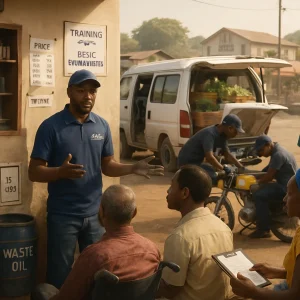
- Community-based training: Run short, practical maintenance courses for drivers and owners to build basic preventive skills and reduce simple failures.
Community engagement strategies
- Needs assessment: Conduct simple surveys or focus groups with drivers, traders and farmers to identify common faults, affordability constraints, and peak demand times.
- Public awareness: Hold short demonstrations at markets on basic checks (tyre pressure, oil level, brake inspection) and safe practices.
- Partnership with local institutions: Work with cooperatives, transport unions, schools, clinics and municipal bodies to schedule training and coordinate services.
- Feedback and grievance mechanisms: Establish clear, low-cost ways for customers to provide feedback or report poor practice (suggestion box, phone number, community representative).
- Cooperative models: Encourage grouping small operators into cooperatives for bulk buying of spare parts, shared tools, and coordinated maintenance schedules.
Environmental and safety considerations with social implications
- Waste management: Safe collection and disposal or recycling of oils, filters and batteries protects community water sources and health.
- Emissions reduction: Regular tuning reduces smoke and fuel consumption, improving air quality—especially important in dense urban or roadside trading areas.
- Workplace safety: Enforcing safe workshop practices reduces injury risks to technicians and customers.
Indicators to measure social and economic impact
Consider simple, locally-collectible measures:
- Vehicle uptime or average hours/day in service.
- Number of breakdowns per 1,000 km or per month.
- Average repair turnaround time.
- Income change for transport operators (self-reported).
- Number of jobs created/maintained in the repair and supply chain.
- Customer satisfaction scores and number of clients reached by outreach activities.
- Quantity of hazardous waste collected and disposed of safely.
Practical activities and assessment suggestions
-
Community needs survey (practical)
- Design and carry out a short survey with 10 vehicle owners/operators asking about common faults, repair costs, and barriers to maintenance. Produce a one-page summary of findings and propose one low-cost intervention.
-
Inclusive service plan (written)
- Create a plan for a small workshop to increase inclusion (describe pricing, outreach, accessibility measures, and a two-month schedule for mobile visits).
-
Cost-benefit calculation (numeracy)
- Calculate and compare the annual cost to an operator of reactive repairs versus a basic preventive maintenance schedule (use provided example figures).
-
Reflection essay (ethical reasoning)
- Reflect on a real or hypothetical case where a technician must decide between recommending a low-cost temporary fix versus a safer, more expensive repair. Discuss ethical obligations and social consequences.
Case examples (brief)
- Motorcycle taxis: Regular chain, brake and tyre checks reduce accidents and increase daily income by reducing downtime; mobile workshops visiting taxi stands every two weeks provide accessible preventive services.
- Smallholder farmers: Shared tractor maintenance cooperatives reduce individual costs, keep machines working during harvest season, and increase collective bargaining power for spare parts.
Further resources and references
- Local transport unions and cooperatives: contact lists for partnership and outreach.
- National or municipal waste management guidelines for oils and batteries.
- Basic manuals on preventive maintenance and low-cost diagnostic checks (LMS resource links or downloadable PDFs).
End of topic — Reflection question for learners:
- Identify one common vehicle type in your community. Describe three practical, low-cost actions you (as a technician) could introduce to increase its uptime, and explain the expected economic and social benefits.