

(Engineering Mathematics I & II — Topic)
Learning objectives
- Understand the practical meaning of derivatives and integrals for technicians.
- Use differentiation to compute rates (flow, fuel burn, RPM change) and to find maxima/minima (peak power, optimum operating point).
- Use integration to compute totals (fuel consumed, fluid volume, work from pressure–volume data).
- Apply simple numerical methods (finite differences, trapezoidal rule) suitable for low-cost, resource‑constrained measurement.
- Perform unit conversions and simple, reliable calculations using basic tools (stopwatch, measuring jug, ruler, graph paper, low-cost sensors).
Introduction — why calculus matters for technicians
Calculus provides tools to describe and quantify change (differentiation) and accumulation (integration). In automotive and fluid systems these concepts are used constantly:
- Rates: instantaneous fuel flow (L/min), mass flow (kg/s), change in engine speed (RPM/s).
- Totals: fuel used over a trip, fluid volume through a pipe over time.
- Performance curves: torque vs RPM, power vs RPM, pump head vs flow — find peaks and areas.
- Energy and work: work done by a piston = ∫ p dV (pressure integrated over volume change).
This topic focuses on practical calculation methods and low-cost measurement techniques suitable for resource‑constrained African workshops and training centres.
Basic concepts (practical definitions)
- Derivative (d/dt or d/dx): the instantaneous rate of change of one quantity with respect to another. Example: if V(t) is volume in the tank, dV/dt is the flow rate (L/s or L/min).
- Integral (∫ f(x) dx): the accumulated total of a quantity. Example: total fuel consumed between t1 and t2 is ∫ f(t) dt, where f(t) is fuel flow (L/min).
- Finite difference (Δy/Δx): a simple approximation of the derivative using two measured points. Useful when you have discrete data.
- Numerical integration (trapezoidal, rectangle rules): approximate integrals from discrete measurements when no analytic expression exists.
Key practical formulas and reminders
- Angular velocity (rad/s) from RPM: ω = 2π × RPM / 60.
- Power (watts) from torque and angular velocity: P (W) = T (N·m) × ω (rad/s).
- Work from pressure–volume: W = ∫ p dV (SI: Pa·m^3 = J).
- Volume of a piston cylinder: V = A × stroke; A = π r^2 (for circular piston).
- Unit checks: always convert to SI for energy calculations (1 bar = 1×10^5 Pa; 1 cm^3 = 1×10^-6 m^3; 1 L = 1×10^-3 m^3).
Differentiation — practical uses and method
What it does: finds how fast something changes and identifies maxima/minima.
Common uses
- Rate-of-change of engine speed: acceleration α = d(RPM)/dt (or angular acceleration in rad/s^2).
- Sensitivity of torque to RPM: dT/dRPM indicates how torque drops or rises with speed.
- Finding peak power: differentiate the power function and set derivative = 0 to find maxima.
Finite difference approximation (resource‑constrained)
Given two measurements (x1, y1) and (x2, y2): approximate derivative ≈ (y2 − y1) / (x2 − x1).
- Example: If fuel flow is 5.0 L/min at t = 10 s and 4.2 L/min at t = 20 s, average rate of change = (4.2 − 5.0) / (20 − 10) = −0.08 L/min per second. That means the flow is decreasing.
Example — find RPM for maximum power (worked)
Suppose measured torque (T) vs RPM (n) is approximated by:
T(n) = 300 − 0.00002 n^2 (Nm), with n in RPM.
Power P(n) = T(n) × ω = T(n) × (2π n / 60).
To find n at maximum power, compute dP/dn and set to zero.
Steps:
- ω = (π/30) n. dω/dn = π/30.
- dT/dn = −0.00004 n.
- dP/dn = (dT/dn) ω + T (dω/dn).
Substitute: dP/dn = (−0.00004 n) (π/30 n) + (300 − 0.00002 n^2) (π/30).
Factor π/30: dP/dn = (π/30) [300 − 0.00006 n^2]. - Set bracket = 0 => 300 − 0.00006 n^2 = 0 => n^2 = 5 000 000 => n ≈ 2 236 RPM.
At n ≈ 2 236 RPM,
T ≈ 200 N·m, ω ≈ 234.9 rad/s, P ≈ 200 × 234.9 ≈ 46 980 W ≈ 47.0 kW.
Interpretation: the engine reaches peak power near 2 236 RPM. In practice, verify by measurement.
Integration — practical uses and method
What it does: computes totals from rates and areas under curves.
Common uses
- Total fuel consumed over time: Fuel total = ∫ flow(t) dt.
- Volume of fluid moved: Volume = ∫ area(x) dx or ∫ velocity(t) × area dt.
- Work from PV data: indicated work per cycle = ∫ p dV.
Numerical integration — trapezoidal rule (recommended for low-cost contexts)
For discrete data at times t0, t1, …, tn with values f0, f1, …, fn:
∫ f dt ≈ Σ (fi + fi+1)/2 × (ti+1 − ti).
This requires only addition, multiplication and a simple calculator.
Worked example — fuel consumption (trapezoidal)
Measured flow (L/min) at 1‑minute intervals:
t (min): 0, 1, 2, 3
f (L/min): 4.5, 5.0, 4.2, 3.8
Compute area (litres):
Interval 0–1: (4.5 + 5.0)/2 × 1 = 4.75 L
Interval 1–2: (5.0 + 4.2)/2 × 1 = 4.6 L
Interval 2–3: (4.2 + 3.8)/2 × 1 = 4.0 L
Total ≈ 13.35 L consumed over 3 minutes.
Worked example — indicated work from PV points (practical)
Given PV measurements from one cylinder (converted to SI):
V (cm^3): 50, 150, 350, 450 → V (m^3): 5e-5, 1.5e-4, 3.5e-4, 4.5e-4
P (bar): 20, 10, 5, 1 → P (Pa): 2.0e6, 1.0e6, 5.0e5, 1.0e5
Using trapezoidal rule on segments:
Segment 1 area = avgP × ΔV = ((2.0e6 + 1.0e6)/2) × (1.0e-4) = 150 J
Segment 2 area = ((1.0e6 + 5.0e5)/2) × (2.0e-4) = 150 J
Segment 3 area = ((5.0e5 + 1.0e5)/2) × (1.0e-4) = 30 J
Total work per cycle ≈ 330 J.
If engine speed is 3 000 RPM (50 rev/s) and it is a 4‑stroke single-cylinder, power strokes occur every 2 revs → 25 power strokes/s. Estimated power = 330 J × 25 = 8 250 W ≈ 8.25 kW. This is a simple, practical way to estimate indicated power from measured PV data.
Numerical differentiation — discrete slope example
Velocity measured at times:
t (s): 0, 1, 2
v (m/s): 0, 1.8, 3.5
Approximate acceleration at t = 1 s (central difference):
a ≈ (v(2) − v(0)) / (2 s) = (3.5 − 0) / 2 ≈ 1.75 m/s^2.
Numerical methods notes and error awareness
- Trapezoidal rule is simple and reasonably accurate for smooth curves. Use smaller intervals for better accuracy.
- Finite difference approximations are noisy if sensor data is noisy—apply simple smoothing (running average) before differentiation.
- Keep units consistent; convert to SI for energy/power computations.
- Be explicit about measurement uncertainty: instrument precision, human timing error, and interpolation assumptions.
Low-cost measurement techniques and practical tips
- Flow: measuring jug + stopwatch for average flow. For better resolution, use smaller time intervals (e.g., 10 s) and repeated trials.
- RPM: use affordable tachometers, smartphone apps, or simple optical pickups; counting pulses over a fixed time & converting to RPM works well.
- Torque: low-cost dynamometer alternatives include a lever arm and a calibrated spring scale or load cell; torque = force × lever arm length.
- PV data: assemble a simple indicator (pressure transducer + volume encoder) if available; otherwise use manufacturer curves or approximate P values from cylinder pressure measurements with a piezo sensor when available.
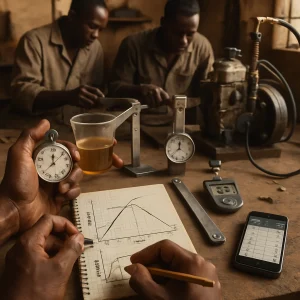
- Plot on graph paper: visually inspect curves, use a ruler to compute slopes (rise/run), and count grid squares for area approximations.
- Use a basic calculator or smartphone spreadsheet to perform trapezoidal sums and finite differences.
Practical exercises (recommended for lessons / workshops)
- Collect fuel flow (L/min) measurements every 30 s for 5 minutes while idling and driving. Compute total fuel consumed by trapezoidal rule. Comment on measurement uncertainty.
- Measure RPM and torque at 5 speed points on a dynamometer or using a brake test. Fit a simple polynomial T(n) and compute approximate power P(n). Find the RPM of maximum power by differentiation.
- Using a simple PV indicator or approximate PV points from a textbook, compute indicated work per cycle with trapezoidal rule and convert to indicated power at a given RPM.
Summary — practical rules to remember
- Derivative = rate of change. Use finite differences if data are discrete.
- Integral = accumulation/area under the curve. Use trapezoidal rule for discrete data.
- Power = torque × angular velocity (ensure consistent units: torque in N·m, ω in rad/s).
- Work from a PV diagram: W = ∫ p dV (units J).
- In resource‑constrained conditions rely on careful measurement, simple numerical methods, clear unit conversions, and cross‑checks (repeat measurements, compare rough hand calculations with spreadsheet results).
Reference quick sheet (for toolbox)
- ω (rad/s) = 2π × RPM / 60
- P (W) = T (N·m) × ω (rad/s)
- Trapezoidal sum: Σ (fi + fi+1)/2 × Δx
- Finite difference derivative: (y2 − y1) / (x2 − x1)
- Cylinder area: A = π r^2 → stroke × A = displacement per stroke
End of topic.