

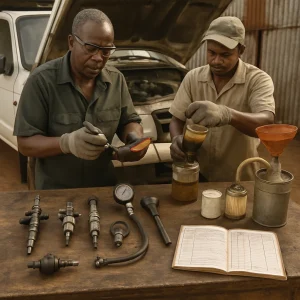
Topic: Diesel Engine Management Systems
This topic describes the operating principles, advantages and limitations of the principal diesel fuel-injection technologies used in commercial and passenger vehicles — unit injectors, unit pumps and common-rail systems — and then sets out practical, maintenance-oriented guidance and common failure modes suitable for beginners working in resource-constrained African contexts. Emphasis is on safe, low-cost, robust maintenance and diagnostics using locally available resources.
1. Overview: role of the injection system
The fuel injection system:
- Pressurises diesel fuel and delivers it to each cylinder at the correct timing, pressure and quantity.
- Influences power, fuel economy, cold-start behaviour, noise and exhaust emissions.
- Is one of the most critical systems for safe and reliable diesel operation; poor maintenance or contaminated fuel quickly degrades performance and causes component failure.
Key maintenance priorities are cleanliness (filtration and water separation), correct timing/operation, and protection from mechanical damage and contamination.
2. Injection system types — principles and differences
2.1 Unit injector (UI)
- Principle: Each cylinder has a single unit that combines a high‑pressure pump and an injector in one assembly. The unit is driven mechanically by the camshaft (or an intermediate cam driven by the camshaft).
- Operation: Cam-driven plunger pressurises fuel directly inside the injector body; a solenoid or mechanical valve controls injection timing/quantity.
- Typical pressure range: Historically up to ~1,800–2,200 bar in modern systems that still use unit injectors; older designs lower.
- Applications: Heavy-duty engines and some passenger diesels historically; used where packaging and high pressure are required.
- Advantages:
- Very accurate timing and short fuel lines (reduced pressure loss).
- High repeatability and compact package.
- Disadvantages:
- Mechanical complexity at the head; replacement of the whole unit often required.
- Difficult to service without specialist tools; removal often necessary for bench testing.
- Strong reliance on camshaft drive — mechanical wear affects operation.
2.2 Unit pump (UP)
- Principle: Each cylinder has its own pump (mounted on or near the cylinder head), but the injector is a separate component connected by a short high‑pressure line.
- Operation: Camshaft-driven pump pressurises fuel and supplies it to a separate injector nozzle.
- Typical pressure range: Historically up to ~1,200–1,800 bar depending on design.
- Applications: Medium-duty engines, some passenger diesels.
- Advantages:
- Separate pump and injector allow some component-level repair/replacement.
- Short high-pressure lines reduce some pressure-loss issues compared with long-distribution systems.
- Disadvantages:
- Still mechanically driven; wear and mechanical timing issues affect pump performance.
- Short high‑pressure lines and connectors can leak and are potential failure points.
2.3 Common-rail (CR)
- Principle: A high-pressure pump maintains a common accumulator ("rail") with system fuel at very high pressure. Electronic control units (ECU) control individual injectors (solenoid or piezo actuated) to open/close and meter fuel quantity and timing independently of pump strokes.
- Operation: The pump supplies fuel to the rail; injectors receive fuel at constant high pressure, but injection events are precisely controlled electronically.
- Typical pressure range: 1,200 bar up to 2,500+ bar depending on generation.
- Applications: Modern passenger vehicles, light and heavy-duty diesel engines; dominant technology since the 2000s.
- Advantages:
- Very flexible injection strategies (multiple injections per stroke, pilot/main/post) for emissions control, improved noise, and fuel economy.
- ECU control allows diagnostic feedback and adaptation.
- Easier to replace individual injectors and easier calibration on bench testers (relative to UIs).
- Disadvantages:
- High electronic dependence; sensitive to fuel quality.
- High pressures require specialised tools and safety precautions for diagnosis and repair.
- Expensive components (injectors, rail pressure sensors, high-pressure pump, ECU).
3. Maintenance priorities (general and system-specific)
General priorities for all systems:
- Fuel quality control:
- Use clean, filtered fuel; avoid contaminated or water-laden fuel. Store fuel in clean, sealed containers.
- Prefer fuel from known reliable sources; use local filtration/bad‑fuel detection procedures where possible.
- Filtration and water separation:
- Ensure primary and secondary filters are present and changed at recommended intervals (shorten intervals when fuel quality is poor).
- Drain water-separator bowls frequently; fit a manual drain or low-cost sight/float sensor where possible.
- Keep the fuel tank and lines clean:
- Prevent ingress of dirt, dust and water when refuelling.
- Use clean funnels or sealed supply hoses; avoid dipping open containers into tanks.
- Regular inspection:
- Inspect lines, seals and connectors for leaks, cracks or corrosion.
- Check mounting clamps and electrical connectors.
- Cleanliness during service:
- Work in a clean area; prevent dirt entering the system during filter changes or injector removal.
System-specific priorities:
- Unit injectors/unit pumps:
- Monitor camshaft and follower wear; lubrication (engine oil quality) and valve clearances affect cam profile and injection timing.
- Change lift/rocker components as required; ensure correct torque and alignment of pump/injector units.
- Common-rail:
- Keep the low-pressure side (pre-filter) and high‑pressure pump inlet clean (contamination quickly destroys the high‑pressure pump).
- Protect rail pressure sensor and pump drive from excessive heat and vibration.
- Maintain battery and charging system: the ECU and high-pressure pump electronics depend on stable voltage.
Low-cost actions suitable in resource-constrained settings:
- Fit or maintain a visible fuel filter water‑drain bowl to quickly check for water/dirt.
- Use gravity or simple hand filters when transferring fuel into vehicle tanks to remove gross contaminants.
- Keep a logbook with filter change dates and observed water/dirt in drains.
4. Common failure modes and symptoms
This section lists typical faults, their likely symptoms and practical checks/remedies.
-
Contaminated fuel (dirt, particulates)
- Symptoms: Clogged filters, reduced power, poor cold start, rough idling, increased smoke.
- Checks: Inspect filter elements, drain water separator (may find sediment), smell or visual check of fuel.
- Remedies: Replace filters, drain separator, flush fuel lines if possible, use clean fuel source. Short term: change filters more frequently.
-
Water in fuel
- Symptoms: Hard starting, misfires, loss of power, rusted components, corrosion of injectors/pumps.
- Checks: Drain water separator, inspect element for water. Visual test for water by allowing small sample to settle.
- Remedies: Drain separator and replace filters; remove contaminated fuel from tank if large amount. Educate site operators on avoiding water ingress.
-
Clogged injector nozzles or deposits
- Symptoms: Uneven running, white/black smoke from one cylinder, loss of power, increased fuel consumption.
- Checks: Cylinder balance/engine-out test (disconnecting or isolating injectors in controlled manner), observe smoke color and injector return flow.
- Remedies: Replace or professionally clean injectors. Temporary mitigation: fit new filter, use recommended diesel system cleaner (use caution with additives and manufacturer guidance).
-
Leaking injector (tip or return leak)
- Symptoms: Hard starting, increased smoke, elevated fuel consumption, fuel smell.
- Checks: Visual leak inspection, examine injector return flow volume (excessive return flow indicates internal leakage).
- Remedies: Replace injector or repair on bench. In field, minimize driving until repair as leakage increases emissions and may wash cylinder lubrication.
-
Excessive injector return flow (common-rail and unit pump systems)
- Symptoms: Overfueling, black smoke, poor economy.
- Checks: Measure return line flow at idle or specified rpm (bench or controlled test).
- Remedies: Replace leaking injectors or defective pressure regulation components.
-
High-pressure pump failure
- Symptoms: Low rail pressure, engine limp mode, no start or severe power loss.
- Checks: Rail pressure sensor reading via diagnostic tool (if available) or measure rail pressure with high-pressure gauge (specialist).
- Remedies: Repair/replace pump; confirm feed filters and priming to prevent repeat failures.
-
Rail pressure sensor/regulator/electronic faults (common-rail)
- Symptoms: Erratic engine behaviour, fault codes, limp-home mode, inconsistent rail pressure.
- Checks: Scan ECU fault codes (if available); test sensor wiring and connectors for corrosion or damage.
- Remedies: Repair wiring/connectors; replace sensor or regulator. Ensure battery/alternator supply is stable.
-
Mechanical timing and cam wear (unit systems)
- Symptoms: Loss of power, mis-timed injection (smoke, knocking), uneven cylinder contribution.
- Checks: Verify cam timing and check for lobe wear; inspect pump drive components and tappets.
- Remedies: Replace worn components; correct timing.
-
Electrical faults (solenoid/piezo injectors, control wiring)
- Symptoms: Cylinder misfire, injector not firing, fault codes.
- Checks: Measure injector coil resistance, check wiring harness, connectors and grounds.
- Remedies: Replace faulty injector or repair wiring/connectors.
-
Air in fuel system
- Symptoms: Hard starting, intermittent stalling, loss of prime, coughing under load.
- Checks: Inspect suction lines, check for loose fittings, observe bubbles in transparent lines or bowls.
- Remedies: Tighten/replace inlet lines, bleed the system using manual primer (if fitted), change brittle hoses.
5. Diagnostic and low-cost testing techniques for resource-constrained contexts
Note: Always observe high-pressure safety precautions (see Section 7). Many high-pressure operations require specialist equipment. The following low-cost checks help identify likely faults before resorting to expensive tests.
-
Visual and sensory inspection
- Check for leaks (fuel smell, wet components), cracked hoses, loose clamps, corrosion or rodent damage.
- Drain and inspect water separator bowl frequently; record findings.
-
Smoke colour interpretation
- Black smoke: over-fuelling or incomplete combustion — suspect clogged air filter, excessive fuel delivery, or faulty injector(s).
- White smoke: raw fuel due to poor atomisation, cold start, or no compression (but for diesel, persistent white smoke suggests injector/combustion problem).
- Blue smoke: oil burning — valve stem seals or turbo issues.
- Use smoke colour only as a guide; many faults have overlapping symptoms.
-
Filter observation
- Cut open a used filter carefully (where practical) to inspect for metal fines (pump wear), excessive water, or large particulates.
- Replace filter if uncertain.
-
Cylinder balance test (simple form)
- With caution and correct procedures, briefly disable individual injectors (electrical disconnect on CR systems) to see drop in RPM/torque and identify weak/failed injectors.
- Safety: do not perform prolonged runs with injectors disconnected; avoid engine damage and ensure safe isolation of electrical systems.
-
Return‑flow observation (visual)
- Some systems have transparent return tubes or visible drain/bowl points: excessive return indicates leaking injector internals.
-
Compression test (to rule out mechanical engine problems)
- Use a simple compression gauge to compare cylinders; low compression may mimic injector problems.
-
Low‑cost pressure checks
- On older mechanical systems, a low-range fuel pressure gauge at filter or feed line can verify lift pump operation. For CR systems, high-pressure checks require specialist gauges; do not attempt if you lack tools or training.
-
Simple electrical checks
- Use a multimeter to check injector supply voltage, continuity and proper grounding to detect open circuits or bad connectors.
6. Practical maintenance schedule and recommendations (adapted to poor fuel/water conditions)
- Daily/Before use (commercial/field vehicles):
- Drain water separator (if present).
- Visual inspection for leaks around fuel system and under vehicle.
- Weekly:
- Check and top up fuel in clean containers; avoid topping trucks from unknown open sources.
- Inspect fuel lines for chafing, cracks or loose clamps.
- Every 5,000 km or monthly (whichever sooner) — adjust downward when fuel quality poor:
- Replace primary fuel filter element; change secondary filter more frequently if heavy contamination.
- Check air filter and compress/clean or replace when necessary (air starvation increases smoke and stress on injectors).
- Every 20,000–40,000 km (manufacturer dependent):
- Inspect injectors (bench test when possible) and high-pressure pump condition.
- For unit systems, inspect cam and mechanical drive components.
- When symptoms appear:
- Replace fuel filters immediately and re-check symptoms; many problems improve after simple filter change.
- If smoke or rough running persists, escalate to injector-level checks.
In resource‑constrained contexts err on the side of prevention: shorten service intervals, keep clean fuel supplies and make filter/drain checks frequent.
7. Safety and tools
Safety first: diesel injection systems, especially common-rail, operate at very high pressures. High-pressure fuel jets can penetrate skin and cause severe injury or infection.
Safety rules:
- Relieve system pressure before disconnecting high-pressure lines. Consult vehicle-specific procedure.
- Wear eye protection, gloves and cover exposed skin.
- Keep ignition sources and open flames away from work area.
- Disconnect battery before major work on electrically controlled systems.
- Dispose of contaminated fuel and filters safely and according to local regulations.
Essential tools (basic and low-cost):
- Clean containers and funnels for fuel handling.
- Torque wrenches for injector and pump mounting bolts.
- Multimeter for electrical checks.
- Manual primer and hand pump for bleeding systems.
- Low-cost fuel filter bowl with drain for water detection.
- Simple compression tester.
- Basic hand tools, wire brush and contact cleaner for connectors.
- If available: fuel pressure gauge and diagnostic code reader for common-rail systems; otherwise refer to specialist.
Do not attempt dismantling or servicing high-pressure injectors or pumps without specialist benches and training.
8. Field remedies and temporary measures
- Replace fuel and secondary filter: often resolves many symptoms quickly.
- Drain water separators daily if water contamination is recurrent.
- Use a temporary external filter between tank and engine (with clean new element) when filling from questionable sources — a low-cost interim fix.
- If contamination suspected in tank and large, remove and clean tank or siphon fuel into clean containers through fine filter.
- Avoid running vehicle under heavy load if suspecting an injector leak or pump failure — risk of engine damage increases.
These are temporary: continued operation without proper repair risks catastrophic failure.
9. When to refer to specialist equipment or workshop
- High-pressure pump or injector internal faults.
- Need for injector nozzle regrinding, precise spray-pattern testing or calibration.
- Rail pressure sensor replacement with ECU relearn/calibration.
- Any high-pressure leak that requires line removal at rail or pump.
- Persistent faults after filter/team-level checks or when diagnostic codes indicate complex ECU-related issues.
10. Quick troubleshooting guide (symptom → likely causes → immediate action)
- Engine hard to start, rough idle:
- Likely: water in fuel, clogged filter, air in system.
- Action: drain water separator, change filter, bleed system.
- Loss of power, black smoke:
- Likely: clogged air filter, over-fuelling (injector leak), poor atomisation.
- Action: check/replace air filter, inspect injectors, change filters.
- Intermittent stalling or surging:
- Likely: air leak in fuel feed, failing lift pump, electrical intermittent fault.
- Action: check suction lines, secure fittings, test pump operation if accessible.
- White smoke and poor combustion:
- Likely: injector nozzle not atomising (clogged), low compression or faulty injector timing.
- Action: check compression, inspect/replace injectors after simpler checks.
- Fault codes / limp mode (common-rail):
- Likely: sensor or actuator failure, low rail pressure.
- Action: read fault codes, check rail pressure and wiring, consider specialist.
11. Closing recommendations for resource-constrained African contexts
- Prioritise fuel cleanliness and water separation: they are the single most effective measures to extend injector and pump life.
- Train routine operators to drain separators, recognise early symptoms and record issues.
- Maintain a modest set of low-cost diagnostic tools (multimeter, compression tester, manual primer, spare filters).
- Build relationships with a dependable specialist workshop for injector bench testing and complex repairs.
- Keep replacement parts (filters, seals, basic injector/spare units where economical) in stock to reduce downtime.
This content provides the foundational knowledge and practical maintenance guidance required to understand, diagnose and manage common fuel-injection issues in diesel-powered vehicles in low-resource settings. For vehicle-specific procedures (pressure relief, torque values, bleeding steps), consult the manufacturer service manual or authorised technical documentation.