Participants 3


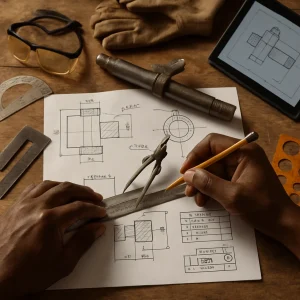
This lesson introduces fundamental drawing and documentation skills required for safe, accurate fabrication, repair and assembly in workshop environments. It is designed for beginners working in resource‑constrained African contexts and follows a competency‑based approach: learners will develop practical abilities to interpret existing technical drawings, produce clear working sketches and formal drawings, and prepare workshop documentation that supports dependable repair and manufacturing work.
Engineering drawing is the universal language of engineering. Proficiency in drawing and documentation enables communication of part geometry, fitment, tolerances and assembly relationships between technicians, fabricators and clients. In low‑resource settings, the same core principles apply but must be delivered using robust, low‑cost instruments, simple templates and reproducible sketching techniques so that work can be carried out reliably with locally available materials and tools.
Learning focus
- Read and interpret orthographic and sectional views to understand internal features and hidden geometry.
- Produce clear, proportionate working sketches and formal workshop drawings that convey manufacturing and assembly requirements.
- Apply geometric construction methods and auxiliary views to define complex shapes and intersections.
- Dimension parts correctly, specify tolerances and fits appropriate to function and local manufacturing capability.
- Create assembly drawings and concise workshop documentation (parts lists, marking, revision notes) suitable for hands‑on repair and fabrication.
Practical orientation
- Emphasis on hands‑on exercises using low‑cost instruments: pencil, scale, protractor, compass, divider, square and simple templates. Where feasible, basic free CAD tools may be introduced as an optional aid.
- Realistic workshop tasks: measure existing components, produce working drawings for repair or replacement, and prepare assembly documentation for multi‑component items.
- Safety and ethics: correct documentation reduces rework and risk. Accurate drawings are essential for safe repairs and responsible use of scarce parts and materials.
Assessment and competency evidence
- Interpretation exercises (reading drawings, identifying features and section lines).
- Sketching and formal drawing tasks (orthographic views, sections, auxiliary views).
- Dimensioning and tolerance specification exercises matched to practical manufacturing limits.
- Production of an assembly drawing and associated workshop documentation for a simple component or subassembly.
Lesson topics
- Drawing fundamentals and instruments — line types, lettering, drawing board practice and basic instrument use.
- Orthographic projection and sectional views — multi‑view layouts, hidden lines, sectioning conventions and reading sections.
- Geometric construction and auxiliary views — true lengths, inclined planes, eccentric holes and complex profile construction.
- Dimensioning, tolerances and fits — dimensioning rules, limit and fit systems, specifying practical tolerances for local fabrication.
- Assembly drawings and workshop documentation — exploded/assembled views, parts lists, marking, revision control and essential workshop notes.
By the end of this lesson learners will be able to produce and use drawings and documentation that support safe, efficient and repeatable workshop practices within the constraints of local resources and equipment.