

Learning objectives
After studying this topic the learner will be able to:
- Describe common diesel engine types and their principal differences.
- Explain the thermodynamic basis of compression-ignition operation and the main parameters that control performance and efficiency.
- Identify the main diesel engine components and explain their functions.
- Describe the four-stroke and two-stroke diesel operating cycles.
- Perform basic, low-cost diagnostic observations using simple tools and local materials, and interpret those observations to support fault-finding.
Estimated study time: 2–3 hours (reading plus hands‑on observation).
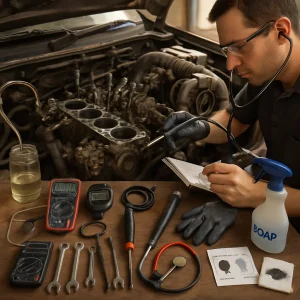
Required simple tools and materials (low-cost / locally available):
- Strong torch/flashlight, mirror
- Basic hand tools (wrenches, screwdrivers)
- Multimeter (for battery/glow plug resistance)
- Clear jar or transparent container and short length of clear fuel hose
- Stopwatch or phone timer
- Small hand pressure/ vacuum gauge or borrowed compression tester (if available)
- Feeler gauges (or shim substitutes) for valve clearance
- Rubber gloves, safety glasses, rags
- Tissue/paper, small screwdriver (for smoke/soot checks)
- Soap solution in spray bottle (for leak detection)
- Stethoscope or long screwdriver (as listening probe)
- Infrared thermometer or contact thermometer (if available)
- Notebook for recording observations
Safety note: Diesel systems operate with high pressures, hot surfaces and flammable liquids. Always follow safety procedures (engine off and cool when working on fuel lines, relieve system pressure before disconnecting lines, use eye and hand protection, work outdoors or in ventilated areas).
1. Overview of diesel engine types
Diesel engines are built in many configurations to suit vehicles, generators, agricultural and marine uses. Key classifications learners must understand:
-
By stroke and cycle:
- Four‑stroke diesel (most common in road vehicles and light industrial applications).
- Two‑stroke diesel (used in some heavy-duty or marine applications).
-
By aspiration:
- Naturally aspirated (air drawn by piston movement only).
- Turbocharged (exhaust-driven compressor increases intake air).
- Turbocharged + intercooled (reduces intake temperature for greater density).
-
By injection method:
- Indirect injection (IDI) — combustion chamber in head; easier cold start, lower emissions historically.
- Direct injection (DI) — injector sprays directly into cylinder; higher efficiency and power.
-
By cylinder layout and application:
- Inline (I4, I6) — common for small to medium engines.
- V-type (V6, V8) — used where shorter engine length is needed.
- Boxer/flat engines — lower centre of gravity in some vehicles.
- Single-cylinder or multi-cylinder stationary/marine diesels.
-
By fuel and use:
- Light-duty diesel (cars/light trucks).
- Heavy-duty diesel (trucks, buses, agricultural/marine).
- Slow-speed two-stroke marine diesels (very large displacement per cylinder).
Understanding these types helps set expectations for performance, maintenance demands and common faults.
2. Thermodynamic principles (practical focus)
Core principle: Diesel engines use compression ignition. Air is compressed to high temperature, then fuel is injected; the fuel ignites on contact with the hot compressed air.
Key concepts (explained in practical terms):
-
Compression ratio (r): ratio of cylinder volume bottom-dead-center to top-dead-center. Diesels have high compression ratios (typically 14:1 to 22:1) to reach ignition temperature without a spark. Higher r → higher theoretical thermal efficiency, but also higher mechanical and thermal stress.
-
Diesel (air‑standard) cycle basics:
- Heat addition occurs at (approximately) constant-pressure during injection (unlike Otto cycle which assumes constant-volume heat addition). Real engines deviate, but the concept explains why diesel efficiency increases with compression ratio and why the timing and duration of injection matter.
- Two parameters strongly affect performance: compression ratio (r) and cut‑off ratio (extent of fuel injection relative to cylinder volume). Longer injection (higher cut‑off) increases power but reduces efficiency and increases smoke.
-
Mean effective pressure (MEP): a practical measure of engine braking/power capability independent of displacement. Low MEP suggests low power output for a given displacement (possible causes: low compression, timing or fuel delivery issues).
-
Heat losses and friction: real engines lose efficiency to heat transfer, pumping and friction. Simple observations (excessive exhaust temperature, high oil temperature, rapid coolant boil) indicate abnormal heat losses or combustion problems.
-
Effects of air density and altitude: lower air density reduces power on naturally aspirated engines; turbochargers help compensate.
Practical implications for diagnostics:
- Low compression or poor sealing reduces combustion temperature → hard starting, white smoke, loss of power.
- Poor fuel injection timing/quantity → black smoke, high fuel consumption, rough running.
- Excess oil in combustion or worn piston rings → blue smoke, high oil consumption.
3. Main components and their functions (practical descriptions)
- Cylinder block and head: houses cylinders, coolant passages. Inspect for leaks, cracks (visual, coolant loss).
- Pistons and rings: compress air and transmit force to connecting rods. Worn rings → blow‑by, oil consumption.
- Connecting rods and crankshaft: convert reciprocating motion to rotation. Excessive play or knocks indicate wear.
- Cylinder head valves, springs and seats: control intake and exhaust flow. Valve clearance affects running and power.
- Camshaft, followers/rockers and timing train (gears, belt/chain): control valve timing. Incorrect timing causes loss of performance or damage.
- Fuel injection pump (in‑line, distributor/rotary): pressurizes and times fuel delivery. Diagnostics focus on delivery quantity, timing and leaks.
- Injectors: atomize fuel into cylinder. Spray pattern, opening pressure and sealing are critical.
- Turbocharger and intercooler (if fitted): boost intake air. Check for shaft play, oil leaks, and intercooler blockages.
- Intake and exhaust manifolds: deliver air and remove gases — blockages cause loss of power or overheating.
- Glow plugs (cold-start aid): preheat air in IDI or cold climates; check resistance and operation.
- Lubrication system (pump, filter, oil galleries): keeps components cool and lubricated; monitor oil level and contamination.
- Cooling system (radiator, pump, thermostat): controls engine temperature; monitor for leaks and thermostat operation.
- Air filter and intake system: prevent ingesting dust; critical in dusty African contexts — restrictions cause heavy smoking and power loss.
- Crankcase ventilation: excessive pressure suggests worn rings or head gasket failure.
- Electrical starter and battery: important for cranking speed; low cranking speed affects starting and fuel ignition.
4. Operating cycles (practical steps)
Four‑stroke diesel (most common):
- Intake (suction) stroke: piston moves down, fresh air drawn in.
- Compression stroke: piston moves up, compresses air to high temperature.
- Power (expansion) stroke: fuel injected near end of compression. Ignition occurs and piston is driven down.
- Exhaust stroke: piston pushes exhaust gases out.
Two‑stroke diesel:
- Combines exhaust and intake into fewer strokes with ports or valves for scavenging. Common in very large or specialized engines. Two‑stroke diesels require effective scavenging and different lubrication regimes.
Practical observation points:
- Timing of injection relative to piston position (top-dead-center) affects noise, smoke and fuel economy.
- Valve and injection timing can be checked and adjusted with simple timing marks, dial gauges or inspection ports where present.
5. Diagnostic observations achievable with simple tools
This section prioritizes low-cost, robust methods suitable for resource-constrained contexts.
General approach:
- Observe, listen, smell, feel, measure (where possible), and record. Compare readings across cylinders or sides to identify anomalies.
A. Visual and sensory checks (no special tools)
- Exhaust colour:
- Black smoke during acceleration: over-fuelling, clogged air filter, weak turbo, incorrect injection timing.
- White smoke on cold start that clears: normal if brief; persistent white/grey: poor compression, injector leaking, wrong fuel, low temperature in diesel (cold start), or wrong timing.
- Blue smoke: oil burning (worn rings, valve stem seals, turbo oil leak).
- Soot on air filter or intake: indicates rich mixture or crankcase ventilation issues.
- Fuel leaks: inspect lines, connections, pump and injectors.
- Oil contamination: milky oil = coolant ingress; heavy dark oil = overdue change; fuel dilution = injector/pump issues.
- Coolant level and colour: rust or oil contamination indicates failure modes.
B. Simple listening and mechanical checks
- Use a long screwdriver as a listening probe (or a simple stethoscope) to listen at injectors, pump and bearings:
- Loud metallic knocks: possible detonation (rare in diesel) or heavy bearing wear.
- Rhythmic injector noise on each cylinder indicates injector actuation; missing or weak sound indicates a non-firing cylinder or injector fault.
C. Cranking and starting observations (use stopwatch, multimeter)
- Cranking speed (rpm) low: weak battery, high compression, starter issues.
- Cranking time and behaviour: slow increase in speed or slow start often due to low battery, poor connections, or high compression from cold/higher oil viscosity.
- Battery voltage under cranking: use multimeter. Voltage dropping below ~9–10 V during cranking suggests battery or starter issue.
D. Simple compression checks
- If a compression tester is not available, comparative methods can help: cranking effort and acoustic differences between cylinders; borrowed compression tester is strongly recommended.
- With a compression tester:
- Record peak compression for each cylinder. Diesel typical numbers vary by engine; consistency between cylinders is more important than absolute numbers.
- Uniform low compression → possible timing or overall wear. One cylinder low → leaking valve, bad injector seal or piston ring.
E. Injector delivery test (very low‑cost bench check)
- With fuel return line disconnected and routed into a clear jar (engine stopped, prime pump or cranking under safe conditions):
- Crank engine (or use hand primer) to observe return flow. Compare volumes/time across injectors by sequentially disconnecting injectors (observe carefully and safely).
- Low flow may indicate blocked injector or pump fault; excessive return indicates overflow/regulator problem.
F. Injector spray pattern (bench or off‑engine)
- Remove injector from cylinder and operate on bench (using a hand-operated pump or borrowed test rig) into a clear container. Observe spray pattern and atomisation. Poor atomisation or dribbles indicate worn or blocked nozzle.
G. Smoke observation simple test
- Capture exhaust on white tissue at a safe distance to observe soot on acceleration vs idle. Record when smoke appears (idling, acceleration, constant speed) — timing helps identify cause.
H. Valve clearance check (feeler gauge)
- Check and adjust valve clearances per service limits. Noisy valve train often due to excessive clearance.
I. Leak detection with soap solution
- Spray soap solution on intake manifold joints and hoses during running (if safe) to identify air leaks (bubbles). Air leaks → rough idle, poor power.
J. Crankcase pressure (simple check)
- Remove oil filler cap while engine is idling (with care). Excessive blow‑by (strong fumes, oil spraying) indicates worn rings or head gasket.
K. Turbocharger checks (if fitted)
- Visual inspection for oil in intercooler piping, excess shaft axial/play (by hand when cold), unusual bearing noise when spinning (by hand with engine off). Oil in intake indicates turbo seal failure.
L. Glow plug check with multimeter
- Measure resistance of each glow plug. High or infinite resistance indicates failed glow plug (cold start problems).
M. Cooling system checks
- Monitor temperature with thermometer; observe thermostat behaviour (coolant should begin circulating at known temperature). Look for persistent hotspots or overheating under load.
Recording and comparing readings across cylinders and over time is critical. Local technicians should build a simple log sheet to track symptoms, basic measurements and any remediation done.
6. Practical troubleshooting guide (common symptoms and likely causes)
-
Symptom: Difficulty starting, long cranking, white smoke on start
- Likely causes: weak batteries/low cranking speed, cold conditions, faulty glow plugs, low compression, incorrect injection timing.
- Simple checks: battery voltage under cranking, glow plug resistance, compression check, check for fuel supply and air in lines.
- Low-cost remedies: charge/replace battery, replace defective glow plug(s), bleed fuel system, warm engine or use block heater if available.
-
Symptom: Black smoke under acceleration
- Likely causes: restricted air intake (clogged air filter), over-fuelling, faulty injection timing, weak turbo.
- Simple checks: inspect/clean/replace air filter, visually inspect turbo hoses, measure fuel delivery return flow, check for correct injection timing marks.
- Remedies: clean/replace filter, adjust timing, service turbo.
-
Symptom: Blue smoke (oil burning)
- Likely causes: worn piston rings, valve stem seals, turbo oil seal leak.
- Checks: oil level (overfull), check intake/intercooler for oil, crankcase pressure assessment.
- Remedies: address oil leaks, consider engine overhaul if rings/seals are severely worn.
-
Symptom: Misfire or rough idle, loss of one cylinder
- Likely causes: faulty injector, poor compression, valve issue.
- Checks: injector balance/listening, compression test, fuel delivery comparison.
- Remedies: clean/replace injector, repair valves, check pump timing.
-
Symptom: Overheating
- Likely causes: low coolant, clogged radiator, bad thermostat, weak cooling pump, heavy soot deposits.
- Checks: coolant level and colour, airflow through radiator, thermostat operation, water pump leaks.
- Remedies: top up coolant, clean radiator, replace thermostat or pump.
-
Symptom: Loss of power under load
- Likely causes: turbo failure, fuel delivery restriction, air restriction, low compression.
- Checks: turbo inspection, fuel filter condition, air filter, compression test.
- Remedies: service/replace turbo, change fuel/air filters, bleed and check fuel lines.
7. Low-cost test procedures (step-by-step examples)
A. Basic visual-start checklist (5–10 minutes)
- Check battery terminals for clean tight connections and correct electrolyte level if serviceable.
- Check engine oil and coolant levels.
- Inspect air filter and intake hoses for blockages or loose clamps.
- Check fuel filters for recent replacement date and look for water in sediment bowl (if fitted).
- Start engine and observe exhaust colour, listen for abnormal noises.
B. Simple injector return-flow comparison (with clear jar)
- Safety: vehicle off, engine cool; wear gloves and eye protection.
- Place a clear jar under the fuel return manifold and loosen the return line of the first injector so it drains into the jar.
- Crank engine briefly (or operate hand primer) and observe volume in a fixed time (e.g., 10 seconds). Repeat for each injector.
- Compare volumes — large differences indicate injector or pump issues.
C. Listening for injector action (no special tool)
- With engine running, use a long screwdriver handle with tip against the injector housing and ear at the handle’s end as a basic stethoscope.
- Listen for rhythmic clicks or injector actuation. A missing or weak sound can identify suspect injector.
D. Simple smoke test for air restriction
- With engine at idle, tape a white tissue near the tailpipe at safe distance.
- Snap throttle or accelerate and observe soot deposit on tissue — heavy soot indicates incomplete combustion often caused by air restriction or over-fuelling.
These tests are safe, low-cost and provide useful comparative data. Always return components to safe condition and resecure fittings.
8. Record keeping and progressive diagnostics
- Record all observations: cylinder compression values, injector return volumes, battery voltage under cranking, exhaust colour at various loads and RPMs, valve clearances.
- Compare to manufacturer specifications where available. Where specifications are not available, compare cylinder-to-cylinder uniformity and historic data from the same engine.
- Use the process of elimination: start with the simplest and least invasive checks (visual, filters, fuel/water separation) before moving to more complex tasks (injector bench testing, removal of head).
9. Assessment and practical tasks (suggested)
- Practical task 1: Perform a visual-start checklist, document three observed faults and recommended actions.
- Practical task 2: Using a clear jar and hose, perform an injector return flow comparison on a multi‑cylinder diesel and interpret the results.
- Practical task 3: Measure and record battery voltage at rest and during cranking; explain implications for starting.
- Knowledge quiz: multiple choice and short answer on Diesel vs Otto cycle, definitions (compression ratio, MEP), and component functions.
Assessment criteria: correct identification of symptoms, logical test sequence, safe procedures, and accurate interpretation of low-cost diagnostic results.
10. Further reading (suggested)
- Manufacturer service manual for the specific engine (primary reference).
- Introductory textbooks on diesel mechanics and thermodynamics.
- Practical guides on injector maintenance and turbocharger inspection.
Summary
This topic has explained the essential types of diesel engines, the thermodynamic basis of compression ignition and diesel cycle behaviour, the main engine components and operating cycles, and, importantly, a set of practical, low-cost diagnostic observations and tests suited to resource‑constrained contexts. Emphasis has been given to simple comparative measurements, sensory observations (sight, sound, smell), and low-cost adaptations (clear jars, hoses, listening probes) that enable effective fault identification without sophisticated equipment.