

Overview
This topic examines the professional and ethical responsibilities of automotive technicians and the elements of a robust safety culture. It balances principles with practical guidance tailored to resource-constrained African workshop environments. Emphasis is placed on low-cost, sustainable measures, clear client communication, and creating systems of accountability and risk awareness that improve safety, quality of work, and community trust.
Learning objectives
After completing this topic the learner will be able to:
- Explain the ethical obligations of automotive technicians toward clients, colleagues, employers and the public.
- Identify core workplace safety standards and adapt them to low-resource contexts.
- Communicate effectively and ethically with clients about risks, costs and consent.
- Implement practical steps to build a culture of accountability and continuous risk awareness in a small workshop or field setting.
- Use simple checklists and reporting tools to document safety and quality actions.
1. Ethical obligations of automotive technicians
Technicians hold responsibilities that affect clients’ safety, property, and livelihood. Ethical behavior protects people, preserves professional reputation, and fosters sustainable local business.
Key obligations:
- Competence and honesty
- Only accept work you are competent to perform; seek supervision or decline when necessary.
- Provide honest diagnostics and clear limitations of your skills and tools.
- Safety-first decision making
- Prioritize safety over speed or profit. Do not cut corners that create hazards for users or the community.
- Transparency and informed consent
- Explain recommended repairs, alternatives, estimated costs, risks and warranties in language the client understands. Obtain explicit agreement before proceeding.
- Confidentiality and privacy
- Protect client information (contact details, vehicle history) and do not exploit it for personal gain.
- Fair pricing and avoidance of fraud
- Charge fair prices; do not substitute cheaper, inappropriate parts without client approval.
- Environmental stewardship
- Dispose of oils, fuels, batteries and solvents responsibly. Minimise pollution risks even when formal disposal systems are absent.
- Professional conduct
- Treat colleagues and clients respectfully. Avoid nepotism, favouritism or corrupt practices.
Ethical dilemmas are frequent in constrained settings. Use the principles above as a guide, document decisions and, where possible, seek peer or supervisor counsel before acting.
2. Workplace safety standards — practical and low-cost adaptations
Safety standards are principles: hazard identification, risk reduction, safe procedures, training and emergency readiness. Many controls can be implemented with low-cost or locally sourced materials.
Essential elements and practical measures:
- Hazard identification and basic risk assessment
- Conduct a quick pre-job check for each vehicle: fuel leaks, loose batteries, unstable jacks, broken guards, sharp edges.
- Use a simple risk-rating (Low / Medium / High) to decide whether to proceed immediately or mitigate risks first.
- Personal protective equipment (PPE)
- Aim to provide: safety boots, gloves, eye protection, hearing protection and respiratory protection where needed.
- Low-cost adaptations: rubber-soled boots (sturdy, closed-toe) over sandals; leather or heavy-duty work gloves; locally made face shields (clear PET bottles cut and mounted) as interim eye/face protection.
- Maintain and replace PPE; keep a visible PPE station.
- Safe lifting and support
- Use rated jacks and jack stands; if unavailable, use robust wooden cribbing constructed with safe practices. Never rely solely on a jack to support a vehicle.
- Lockout/Tagout (LOTO) adapted
- Simple LOTO: isolate battery (disconnect negative terminal), remove ignition key, and attach a wallet-sized tag or colored tape labeling "DO NOT START". Keep keys under control.
- Ventilation and fuel handling
- Work in well-ventilated spaces; when indoors, ensure natural ventilation and use fans if available.
- Store small quantities of fuel and solvents in clearly labeled, closed metal containers, away from ignition sources.
- Fire safety
- Stock and maintain at least one multi-purpose (ABC or equivalent) extinguisher. Where purchased extinguishers are unavailable, maintain sand buckets and water sources while recognizing their limitations for fuel fires.
- Keep flammable materials away from heat/sparks; implement a "no open flame" policy near work areas.
- Chemical and waste handling
- Use secondary containment for drums; absorb spills using locally available absorbents (sawdust, sand). Label waste containers and arrange safe disposal or community collection days.
- Electrical safety
- Use insulated tools; ensure extension cords and wiring are in good condition; use RCDs (residual current devices) where feasible.
- First aid & emergency planning
- Keep a stocked first aid kit and train staff in basic first aid and burn care. Agree on nearest medical facility, emergency contact numbers, and a quick evacuation route.
- Housekeeping
- Keep floors clear of oil and debris to reduce slips and trips. Use simple floor marking (paint/tape) to designate work areas, storage and exits.
Document local adaptations and review them periodically. Always prefer proven safety practices; adaptations are temporary measures pending procurement of standard equipment.
3. Client communication: clarity, consent and trust
Good communication reduces misunderstandings, reduces risk and builds long-term relationships. It is also an ethical duty.
Principles for client interaction:
- Clear explanation of findings
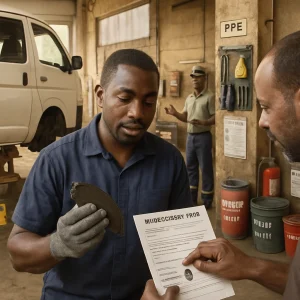
- Use plain language. Show the client the problem when possible (e.g., show worn brake pad) and explain safety implications.
- Transparent cost estimates and options
- Provide at least two options where practical: minimal safe repair, and recommended full repair. Include labour, parts and expected uncertainties.
- Documented consent
- Obtain written or recorded client agreement before major repairs or when using non-original parts. Use simple intake forms and get a signature or thumbprint where literacy is limited.
- Communicating limitations and warranty
- Be explicit about what you guarantee (e.g., workmanship for X months) and what conditions void warranty (misuse, subsequent modifications).
- Handling disputes
- Listen actively, document the technical facts, offer to inspect and discuss differences. Avoid confrontational language. Use a third-party mediator if necessary (local workshop association).
- Cultural and language sensitivity
- Use local languages where possible and respect cultural norms in communication and negotiation.
Sample simple client intake template (one page):
- Client name, contact, vehicle make/model, odometer, reported problem.
- Visible safety risks identified.
- Recommended work with cost estimates (Option A – minimal safety repair; Option B – full repair).
- Estimated time to complete.
- Signature / thumbprint and date; technician name and signature.
Keep a copy for client and one in the workshop file.
4. Building a culture of accountability and risk awareness
A safety culture is the shared values and practices that prioritize safety and proper workmanship. It is not an add-on — it must be led and reinforced.
Steps to build and maintain the culture:
- Leadership and example
- Owners and senior technicians must model safe behaviour and ethical conduct. Their actions set norms for others.
- Defined roles and responsibilities
- Post a simple responsibilities chart: who conducts pre-job checks, who is responsible for first aid, who maintains tools and PPE.
- Simple written procedures and checklists
- Standardize recurring tasks with short checklists (e.g., pre-start, post-repair inspection). Checklists reduce errors and support accountability.
- Regular briefings and training
- Hold short toolbox talks at the start of each workday/week to discuss risks, incidents and lessons learned. Use local examples.
- Near-miss and incident reporting
- Encourage reporting of near-misses without blame. Use a simple form and short review meetings to identify preventive actions.
- Peer observation and mentoring
- Pair less-experienced technicians with mentors who provide feedback on both technical and safety practices.
- Recognition and corrective action
- Recognize safe behaviour and improvements publicly. Address unsafe behaviour through coaching, not punishment, while maintaining standards.
- Continuous improvement
- Use periodic safety audits (even by peers) and review checklists. Implement small, low-cost improvements iteratively.
- Community and regulatory engagement
- Participate in local mechanic associations and share practices. Keep informed about local legal requirements and standards.
Practical example of a small workshop routine:
- Morning toolbox talk (5–10 minutes): assign work, mention hazards, confirm PPE use.
- Pre-job checklist completed and signed by technician.
- Supervisor or peer conducts post-repair inspection against a short checklist.
- If any incident or near-miss occurs, document and discuss corrective action in next toolbox talk.
5. Checklists and simple tools (templates)
Use concise forms that can be photocopied and filled by hand.
Example: Pre-job safety checklist (yes/no columns)
- Work area free of trip hazards?
- Vehicle properly supported (jack stands/cribbing)?
- Battery disconnected/LOTO applied?
- Fuel and ignition sources controlled?
- PPE available and in use?
- Ventilation adequate?
If any "no", stop work and correct before proceeding.
Example: Post-repair inspection (tick items)
- Fasteners torqued to spec / secured
- No fluid leaks detected
- Test run performed where applicable
- Client communication completed (work done, safety issues, recommended follow-up)
- Signature of inspector and technician
Near-miss/incident report (very brief)
- Date/time, location, persons involved
- Description of event
- Immediate action taken
- Root cause (quick note)
- Preventive measure assigned to whom and by when
Keep copies of completed forms in a simple folder or binder for review and training.
6. Case study (applied scenario)
Scenario:
A technician is asked to repair brakes on a minibus that is used for a local route. The workshop is busy and the owner pressures the technician to finish quickly. During inspection, the technician finds corroded mounting bolts and worn suspension bushings that should be repaired to ensure safety. The owner asks only to replace brake pads to keep costs low and get the vehicle back on the road. The minibus is due to run a morning route.
Questions:
- What are the technician’s primary ethical responsibilities in this scenario?
- How should the technician communicate the findings and options to the owner and to the client who uses the minibus?
- If the owner insists on proceeding with only brake pad replacement, what steps should the technician take to manage risk and document the decision?
Suggested answers (brief):
- Prioritize public safety, be honest about required repairs, refuse to perform work that would leave the vehicle unsafe, and document recommendations.
- Explain clearly the safety implications of worn suspension and corroded bolts, present costed options (immediate safe repair vs temporary measure with explicit risks), seek informed consent from the vehicle owner and, if different, inform the operator. Use simple language and visual aids.
- If owner still insists, refuse to perform work that creates unacceptable risk; if a temporary measure is accepted, document the limitation in writing, obtain a signed consent (or thumbprint), recommend immediate re-inspection, and add warning labels or instructions to the driver. Inform local transport authorities if required by law.
7. Learning activities and assessment suggestions
Practical activities:
- Conduct a pre-job risk assessment and fill the pre-job checklist for an assigned repair.
- Prepare an intake form and cost estimate for a client in your local language; role-play the communication with peer learners.
- Perform a peer inspection using the post-repair checklist and provide constructive feedback.
Assessment tasks:
- Written reflection: describe an ethical dilemma you might face, list options, and justify the chosen action.
- Practical demonstration: complete a repair with documented pre-job check, LOTO, PPE use, post-repair inspection and client communication.
- Short quiz on hazard identification, emergency response, and the elements of informed consent.
Evaluation criteria:
- Completeness and accuracy of documentation.
- Evidence of safe practices and use of checklists.
- Clarity and ethics of client communication.
- Demonstrated understanding of accountability and reporting.
8. Practical tips for resource-constrained African contexts
- Start small: implement one checklist and one toolbox talk per week; scale up when routines form.
- Use local materials responsibly: recycled containers for waste storage (clearly labeled), wooden cribbing from sound timber; avoid compromising structural integrity.
- Pool resources with neighboring workshops: shared first aid kits, pooled fuel/waste disposal arrangements, shared training days.
- Engage local authorities and community transport owners to develop cooperative disposal schemes for hazardous waste.
- Seek support from vocational institutions or NGOs for basic safety equipment (fire extinguisher servicing, PPE donations) and training.
9. Further reading and references
- Local occupational health and safety regulations (consult municipal/provincial resources).
- Industry codes of practice from national mechanic associations or transport authorities.
- Basic first aid manuals and electrical safety guides adapted to low-resource environments.
End of topic. Implementing these principles and simple systems will reduce risk, protect clients and technicians, and help build a reputable, sustainable workshop practice even where resources are limited.