

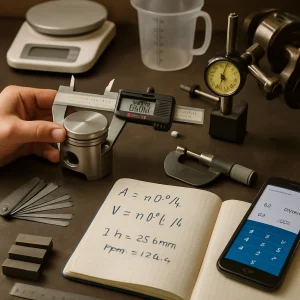
Learning objectives
- Understand common units and measurement systems used in workshop work, and perform reliable unit conversions.
- Apply basic algebra to rearrange and solve engineering formulas used in automotive repair and part verification.
- Use common measurement tools (rule/scale, vernier caliper, micrometer, dial indicator, feeler gauges) correctly and economically.
- Estimate measurement uncertainty, apply tolerances and significant figures, and perform practical checks suited to resource‑constrained environments.
Introduction
Accurate arithmetic, algebra and measurement are essential in a workshop: correct part dimensions, clearances, and simple calculations determine whether a repair is safe and functional. This topic focuses on the fundamentals you will use every day — units, conversions, algebraic rearrangement of common formulas, and practical measurement techniques using low‑cost or locally available tools.
- Units and measurement systems
- International System (SI) – preferred: metre (m), millimetre (mm), gram (g), kilogram (kg), second (s), pascal (Pa), newton (N), joule (J), watt (W), newton‑metre (N·m).
- Common workshop subunits: millimetre (mm), micrometre (µm or micron, 0.001 mm), centimetre (cm).
- Some imperial/US customary units are still encountered: inch (in), foot (ft), pound‑force (lbf), pound‑inch/foot (lb·in, lb·ft). Convert these to SI when required.
Useful unit conversions (memorize the key ones)
- 1 inch = 25.4 mm (exact)
- 1 mm = 0.0393701 in
- 1 m = 1000 mm
- 1 kg = 1000 g
- 1 L = 1000 cm3 = 1000 mL
- 1 bar = 100 000 Pa = 100 kPa
- 1 N·m = 1 newton metre (torque); 1 lb·ft ≈ 1.35582 N·m
- rpm to rad/s: ω (rad/s) = 2π × (rpm / 60)
Unit prefixes (common)
- kilo (k) = 10^3
- milli (m) = 10^-3
- micro (µ) = 10^-6
- Scales and measuring systems
- Linear scales: metric steel rule (mm), ruler with mm/1 mm graduations. Use metric where possible.
- Vernier scales: vernier calipers provide typical accuracy to 0.02–0.05 mm.
- Micrometers: provide accuracy to 0.01 mm or better (0.001 mm on high precision).
- Dial indicators: used for runout/flatness/axial movement; typical resolution 0.01 mm or 0.001 in.
- Feeler gauges: for gap measurement in thin increments (0.05 mm, 0.1 mm, etc.).
- Weight and volume: kitchen scales (kg/g), measuring jugs (mL/L) as rough solutions in constrained settings.
- Basic algebra essential for workshop calculations
Common algebraic tasks:
- Rearranging formulas to solve for one variable.
- Solving simple linear equations.
- Working with squares, square roots, powers.
Common formulas and how to rearrange them
- Area of circle: A = π × (D^2) / 4
- Solve for diameter D given area: D = sqrt(4A / π)
- Volume of cylinder (engine displacement for one cylinder): V = π/4 × D^2 × L
- Rearranged for D: D = sqrt(4V / (πL))
- Clearance (radial): clearance = measured bore diameter − piston diameter
- Speed conversion: ω (rad/s) = 2π×(rpm/60)
- Power/torque relation: P (W) = τ (N·m) × ω (rad/s)
- Solve for torque: τ = P / ω
Worked algebra example (engine cylinder volume)
Given: bore D = 86.0 mm, stroke L = 86.0 mm.
Cylinder volume V = π/4 × D^2 × L.
Compute V:
- D^2 = 86.0^2 = 7,396 mm^2
- V = π/4 × 7,396 × 86.0 ≈ 0.785398 × 7,396 × 86 ≈ 499,000 mm^3 = 499 cm^3 (0.499 L)
Reverse example: given measured V and stroke L, compute D:
- D = sqrt(4V/(πL))
- Measurement techniques: tools and procedures
General principles
- Clean parts before measuring; dirt and burrs change results.
- Measure at room temperature; metals expand with temperature.
- Always zero instruments before use; check calibration with a gauge block or known standard (e.g., a steel rule edge).
- Take multiple measurements and use the average.
- Use the right tool for required accuracy: ruler for ±0.5–1 mm, caliper for ±0.02–0.1 mm, micrometer for ±0.01 mm or better.
Vernier caliper (typical low‑cost workshop tool)
- Use for outside, inside, depth, and step measurements.
- How to read/use:
- Clean jaws; close gently and set zero. If zero not exact, note the zero error and correct readings.
- Place object between jaws, close until slightly snug (do not overforce).
- Read main scale (mm) and vernier scale to nearest division.
- For digital calipers: zero at closed position and read display; verify battery and zero periodically.
- Typical accuracy: 0.02–0.1 mm depending on quality.
Micrometer (for shafts, piston diameters)
- Use for high-precision outside measurements.
- Procedure:
- Clean spindle and anvil faces.
- Close to zero and check/adjust zero.
- Place object, use ratchet stop to apply consistent force.
- Read sleeve and thimble (and vernier if present).
- Care: never force; keep dry and lightly oiled.
Dial indicator (runout/flatness)
- Use a magnetic base and contact point to measure runout or axial movement.
- Zero the indicator on a reference surface, then rotate the part and read peak‑to‑peak.
- Common use: checking crankshaft or flywheel runout.
Feeler gauges and gauge blocks
- Feeler gauges for small gaps (valve clearances, bearing clearances).
- Gauge blocks are ideal but often unavailable; use feeler gauges in combination with calipers for verification.
Low‑cost/locally available techniques
- Wire (lead/welding wire) method to measure inside diameter when proper bore gauges are absent: lay a thin wire across bore diameter, measure chord with caliper and compute diameter (requires algebra/trigonometry but useful).
- String and caliper: measure circumference by wrapping tight string, mark, and measure string length; compute diameter = circumference/π.
- Use a straightedge and feeler gauges to check warpage (eg. head or manifold); place straightedge, slide feeler gauges to find gap.
Wire method for bore diameter (simple formula)
If a wire of known diameter w is placed across the bore and the chord length c (measured with caliper) between wire contact points is measured, the bore diameter D can be found:
- D = (c^2 + 4h^2) / (4h), where h = radius − wire center height; an alternative practical approach is to convert chord to sagitta; provide exact formula in context if required. (In practice, use trusted bore gauge if available; wire method is an improvised alternative.)
- Significant figures, rounding and measurement uncertainty
- Record measurements with an appropriate number of significant figures according to instrument resolution.
- Example: a 0.02 mm caliper reading: report to 2 decimal places in mm (e.g., 25.34 mm).
- Rounding: do not overstate precision. If instrument resolution is ±0.02 mm, quoting ±0.01 mm is misleading.
- Uncertainty estimation (simple):
- Take at least three measurements at different orientations/positions.
- Report mean ± half range (simple spread): mean ± (max−min)/2.
- Example: measurements 25.31, 25.33, 25.32 mm → mean 25.32 mm, spread 0.02 mm → report 25.32 ± 0.01 mm (plus instrument resolution).
- Record method, tool, temperature and number of readings for traceability.
- Tolerances, fits and clearances
- Understand difference: nominal size, tolerance, allowance, clearance, interference.
- Example: piston bore clearance specification might be 0.03–0.07 mm. If measured clearance is outside this range, repair or replace.
- Standard fitting classes (informal overview): clearance fit (parts slide freely), interference fit (press fit), transition fit (may require light press).
- Always check manufacturer specifications when available. If not, use conservative safe values for performance and heat expansion.
- Common workshop calculations (with worked examples)
a) Piston-to-cylinder radial clearance
- Given bore = 86.00 mm, piston = 85.95 mm.
- Clearance = 86.00 − 85.95 = 0.05 mm. Check against spec (e.g., 0.03–0.07 mm) → acceptable.
b) Convert torque 50 lb·ft to N·m
- 1 lb·ft = 1.35582 N·m → 50 × 1.35582 = 67.79 N·m.
c) Cylinder displacement and total engine displacement
- Single cylinder V = π/4 × D^2 × L.
- If D = 86.00 mm and L = 86.00 mm (convert to cm or use mm^3 then convert to cm^3):
- V ≈ 499 cm^3 per cylinder.
- Total displacement for a 4‑cylinder engine: 499 × 4 = 1,996 cm^3 ≈ 2.0 L.
d) RPM to angular speed and torque from power
- Engine power P = 100 kW at 4,000 rpm.
- ω = 2π×(4000/60) ≈ 418.88 rad/s.
- Torque τ = P / ω = 100,000 W / 418.88 ≈ 238.8 N·m.
- Practical step‑by‑step measurement procedures
A. Measuring piston diameter with a micrometer - Clean piston and micrometer faces.
- Set micrometer to slightly larger than expected diameter; close gently with ratchet.
- Measure at three positions around piston circumference (90° apart) and along skirt height (top/mid/bottom).
- Record readings, compute average and taper (difference top-bottom).
- Compare with specifications.
B. Measuring bore with a vernier caliper (least accurate method but often used)
- Clean bore and caliper jaws.
- Use internal jaws; expand to touch bore at one position; note reading.
- Rotate caliper and measure at several positions (e.g., 12, 3, 6, 9 o’clock) and different depths.
- Average readings; note out‑of‑round (max − min).
C. Measuring runout with dial indicator
-
Mount part on rotating support (shaft or lathe).
-
Fix dial indicator so tip contacts the surface near measured diameter.
-
Zero indicator, rotate part slowly, record max deviation.
-
Runout = max − min reading; compare with allowed runout.
-
Common mistakes and how to avoid them
- Not cleaning surfaces before measurement → erroneous readings.
- Using a worn or uncalibrated tool → systematic error. Calibrate against a known standard.
- Measuring only once → may miss variation. Always take multiple readings.
- Confusing nominal with measured dimension. Always check tolerances.
- Over‑applying force with caliper/micrometer → compresses surface or bends thin parts.
- Measuring at wrong temperature (hot parts expand) → allow parts to cool to room temperature for precision measurement.
- Safety, care, and tool maintenance
- Handle precision tools carefully; store in protective cases.
- Keep tools clean and lightly oiled to prevent rust.
- Do not use measuring instruments as substitutes for other tools (e.g., using a caliper as a lever).
- When measuring sharp or heavy parts, secure them to avoid accidents.
- Practice problems (with answers)
Problem 1
A piston has measured diameters at three positions: 85.945 mm, 85.950 mm, 85.948 mm. What is the mean piston diameter and estimated uncertainty (use half range)? Record with appropriate significant figures.
Answer 1
- Mean = (85.945 + 85.950 + 85.948) / 3 = 85.9477 mm ≈ 85.948 mm.
- Range = max − min = 85.950 − 85.945 = 0.005 mm → half range = 0.0025 mm.
- Considering instrument resolution (0.01 mm), report 85.95 ± 0.01 mm.
Problem 2
Convert 2.5 inches to millimetres.
Answer 2
- 2.5 in × 25.4 mm/in = 63.5 mm.
Problem 3
A cylinder shows bore measurements: 86.02 mm, 86.01 mm, 86.05 mm, 86.00 mm. Compute mean bore, out‑of‑round (ovality), and if piston is 86.00 mm, determine minimum clearance.
Answer 3
- Mean = (86.02 + 86.01 + 86.05 + 86.00) / 4 = 86.02 mm.
- Out‑of‑round = max − min = 86.05 − 86.00 = 0.05 mm.
- Minimum clearance = smallest bore − piston = 86.00 − 86.00 = 0.00 mm → piston may seize; unacceptable.
Problem 4
An engine requires torque of 90 N·m. What is that in lb·ft?
Answer 4
- 1 N·m = 0.737562 lb·ft → 90 × 0.737562 ≈ 66.38 lb·ft.
- Quick reference cheat sheet
- 1 in = 25.4 mm
- RPM → rad/s: ω = 2π × rpm / 60
- Area circle: A = πD^2/4
- Volume cylinder: V = πD^2L/4
- Use average of multiple measurements; estimate uncertainty by half the range.
- Report values with precision consistent with instrument resolution.
Conclusion
Mastering measurement technique together with simple arithmetic and algebra ensures reliable work in the workshop. In resource‑constrained contexts, selection of the appropriate low‑cost tool, careful procedure, multiple readings, and conservative interpretation against specifications will produce safe, dependable results. Keep tools clean, verify zero/calibration frequently, and record measurement methods and uncertainty for traceability.
Further study suggestions
- Practice caliper and micrometer readings with known gauge blocks.
- Work through several real parts: pistons, shafts, bearings — measure and compare to spec.
- Learn limits, fits and standard tolerance tables relevant to automotive practice.