

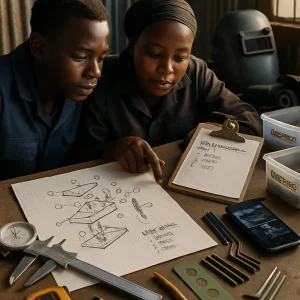
This topic explains how to prepare clear, usable assembly and exploded drawings, parts lists (Bills of Materials), and simple fabrication sketches suitable for workshop teams in resource-constrained African contexts. Emphasis is placed on practical, low-cost methods and locally available materials and tools, to support teamwork, inventory control and local manufacture.
Learning objectives
After studying this topic, learners will be able to:
- Produce legible assembly and exploded drawings that communicate how parts fit and the order of assembly.
- Create accurate parts lists (BOMs) linked to drawings for inventory control and procurement.
- Prepare simple fabrication sketches for local manufacture or repair, including essential dimensions and material notes.
- Use low-technology drafting methods and verification procedures suitable for workshops with limited access to CAD.
- Implement basic revision control and document management practices to support teamwork and safety.
1. Purpose and scope of assembly drawings and workshop documentation
Assembly drawings and associated documents are communication tools that ensure assemblies are built and maintained correctly, safely, and efficiently. They:
- Show how components fit together and in what order.
- Identify each part clearly for procurement or manufacture.
- Provide critical dimensions, materials, and tolerances needed for safe operation.
- Support inventory control, spare-parts management and local manufacturing.
In resource-constrained environments, drawings must be simple, unambiguous, and adapted to the materials, tools and skills available locally.
2. Types of drawings and documents commonly used
- Assembly drawing: shows assembled product with key dimensions, orientation, and references to parts.
- Exploded drawing: shows components separated along axes to illustrate relationships and assembly order.
- Part drawing (detail drawing): shows single part with complete dimensions and fabrication notes.
- Simple fabrication sketch: hand-drawn sketch used for workshop manufacture with essential dimensions, material and process notes.
- Parts list / Bill of Materials (BOM): tabulated list of parts with quantities, material, part numbers, and notes.
- Revision record / title block: basic administrative information (drawing title, author, date, revision).
- Fastener chart and standard symbols: reference for common bolts, nuts, washers, welding and surface finish symbols.
3. Drawing conventions and essential elements
Keep drawings clear and standardized. Include these minimum elements:
-
Title block (minimum fields):
- Drawing title
- Drawing number / local reference
- Author (drafter)
- Date
- Revision number and description
- Scale
- Unit of measure (mm or mm & °C / metric preferred)
- Approval / verifier initials
-
Views:
- Use front, top and side views as needed; for assemblies, include one isometric/exploded view.
- Indicate orientation with arrows or labels (e.g., “front”, “inlet”).
-
Scale:
- Use a scale that makes detail legible (e.g., 1:2, 1:1, 2:1). Indicate scale clearly.
- For hand sketches, use graph or squared paper to keep proportions.
-
Lines and symbols:
- Visible edges: continuous thick lines.
- Hidden edges: dashed thin lines (use sparingly).
- Centerlines: long/short dash lines for shafts, holes.
- Arrowheads: clear and consistent.
- Welding and surface notes: use simple text if standard symbols are not used.
-
Dimensions and tolerances:
- Dimension only what is necessary for assembly and manufacture.
- Include critical dimensions and allow reasonable tolerances; where precision is essential, specify tolerance (e.g., ±0.5 mm).
- Avoid over-dimensioning.
-
Part numbers and balloons:
- Use balloons (numbers in circles) on the drawing to link to BOM.
- Number parts logically and sequentially.
4. Preparing exploded and assembly drawings — step-by-step
-
Identify the assembly scope:
- Define what constitutes the assembly (sub-assembly vs. full assembly).
- Establish function and critical interfaces.
-
Collect physical parts and measure:
- Inspect the real assembly or prototype.
- Measure key external dimensions (use caliper, tape, micrometer as available).
- Photograph parts for reference from multiple angles.
-
Establish part numbering system:
- Use a simple hierarchical scheme; e.g., 100 for assembly, 110–129 for major subcomponents, 200s for fasteners.
- Keep numbers stable across revisions.
-
Create a layout view:
- Draw the assembled view showing how parts fit together.
- Add centerlines and key dimensions.
-
Create exploded isometric or pictorial view:
- Separate components slightly along logical assembly axes.
- Show fasteners and orientation.
- Number each part with a balloon that corresponds to the BOM.
-
Add assembly notes and sequence:
- Specify assembly order if important (e.g., rivet before plate).
- Include torque values, thread-locking requirements, or lubrication where necessary.
-
Prepare the BOM (see next section).
-
Verify and review:
- Have technician(s) or fabricator review the drawing and identify omissions.
- Build or mock-up the assembly if possible to check clarity.
5. Parts lists / Bill of Materials — contents and format
A practical BOM should contain enough information for procurement, inventory management and local manufacture:
Suggested fields:
- Item number (matching the drawing balloon)
- Part name / description
- Quantity per assembly
- Material (e.g., mild steel plate 6 mm, grade/stainless if required)
- Part number or local reference
- Dimensions or reference to detail drawing (or “see detail”)
- Manufacturing method (e.g., laser cut, hand-cut and welded, machined)
- Fastener specification (size, length, grade) where applicable
- Supplier or source (if known)
- Remarks (surface treatment, heat treat, paint color)
Simple BOM example (plain text):
Item | Part name | Qty | Material | Notes
— | —: | —: | — | —
1 | Pedestal base | 1 | Mild steel plate 6 mm | Cut & weld; refer detail D1
2 | Shaft | 1 | EN8 round 20 mm | Turn to Ø19.9 mm
3 | Bearing | 2 | 6204 | Press fit
4 | Bolt M10x30 | 4 | Grade 8.8 | Hex head, zinc
5 | Washer Ø10 | 4 | Spring washer + flat washer | Use both
When using manual records, keep a master sheet in a protected folder or a labeled binder.
6. Simple fabrication sketches — what to include
For workshop-ready sketches keep these elements:
- Clear title and reference (link to assembly number).
- Overall dimensions and critical dimensions only.
- Material specification.
- Process notes (e.g., “bend to 90° radius 20 mm; tack weld, then full weld; grind to flush”).
- Hole sizes and positions relative to reference edges; show center-to-center distances.
- Thread notes: specify thread size and depth (e.g., M8 x 1.25, 12 mm thread depth).
- Finish and surface treatment: paint, galvanize, anti-seize.
- Welding instructions: simple text such as “MIG weld, 3 mm fillet, both sides”.
- Critical tolerances: list only those that matter (e.g., shaft fit H7 / g6). If precision measurement tools are unavailable, specify practical fits (e.g., press fit, slight interference).
Example fabrication sketch notes:
- Plate A: cut from 6 mm mild steel to 200 x 150 mm, drill 4 holes Ø10 mm, centered 25 mm from edges; bend 90° along long edge; weld to pedestal base as shown.
7. Low-cost methods and tools for drawing in resource-constrained workshops
If CAD is unavailable, practical alternatives:
- Graph paper or engineering paper for proportional sketches.
- Scale rule and pencils (HB for layout, 2H for final lines).
- Transparencies or tracing paper for creating exploded views from an assembled drawing.
- Templates for circles, arcs and common shapes.
- Stencil set for consistent lettering and numbers.
- Photographs annotated by hand or by printing and marking—useful when time is short.
- Mobile phone cameras + free annotation apps to create digital records; photograph orientation marks and balloons.
- Simple spreadsheet (offline) for BOM if computers available.
Best practice: combine hand-drawn sketches with photographs. Attach photographs and sketches together in the work order file.
8. Standardization, numbering and labelling for teamwork and inventory control
- Use consistent part numbers and names across drawings, BOMs and inventory cards.
- Implement simple label tags: part number, short description, quantity, storage location.
- Store frequently used small parts in labelled bins; record replenishment thresholds (e.g., reorder when quantity ≤ 5).
- Use colour-coded tags or tape for quick identification (e.g., red = critical safety part).
- Simple Kanban: a card attached to a bin indicates reorder point and supplier details.
Inventory record fields (paper or spreadsheet):
- Part number | Description | Unit | Quantity on hand | Minimum quantity | Supplier | Last ordered date
For teamwork:
- Each drawing should indicate author and verifier so responsibility is clear.
- Keep a master folder with latest revisions available to team members—physical or digital.
9. Revision control and document management
Minimum revision control process:
- Assign a drawing number and initial revision A (or 00).
- Each change increments revision: A → B or 00 → 01 with short revision note (“changed bolt size to M12”).
- Update BOM and fabrication sketches simultaneously.
- Maintain a revision history table in the title block or on a separate sheet.
Title block revision example fields:
- Rev | Date | Description | Author | Approver
Archive old revisions physically in a separate binder or folder labelled “Archive” to preserve traceability.
10. Practical examples and exercises (recommended for classroom/workshop)
Exercise 1 — Exploded drawing and BOM (simple pump flange assembly)
- Task: Disassemble a small pump or gearbox; photograph and measure parts.
- Produce: A hand-drawn exploded view with balloons; a 1-page BOM with materials and quantities.
- Verify: Swap drawings among students and ask the group to reassemble the unit using only drawings and photographs.
Exercise 2 — Fabrication sketch for a bracket
- Task: Design a bracket to mount a bearing housing to a frame.
- Produce: A fabrication sketch with full dimensions, material, hole locations and bend notes. Prepare a parts card for inventory.
Assessment checklist:
- All parts numbered and listed on BOM.
- Critical dimensions and tolerances specified.
- Material and process notes present.
- Title block with drawing number, author, date and revision.
- A technician unfamiliar with the assembly can follow the drawing to assemble or fabricate.
11. Safety, quality and ethical considerations
- Document required safety procedures directly on drawings when they affect assembly (e.g., “use safety goggles during welding” or “apply thread-locker on rotating fasteners”).
- Ensure drawings include notes on critical safety parts (e.g., “Do not substitute bolt grade”).
- Avoid ambiguous instructions that could compromise safety.
- Maintain integrity of technical information: do not falsify measurements or quality records.
12. Practical tips and common pitfalls
Tips:
- Keep drawings simple and focused — omit non-essential detail.
- Use photographs to supplement drawings, especially for complex shapes.
- Prefer metric units and be explicit about unit in title block.
- Use standard fasteners where possible; this simplifies inventory and maintenance.
- Encourage cross-verification: another technician should check the drawing before fabrication.
Common pitfalls:
- Missing part on BOM due to oversight during disassembly.
- Over-dimensioning, producing contradictory dimensions.
- No revision record; old drawings used by mistake.
- Ambiguous material specification leading to incorrect local substitutes.
- Failing to show assembly orientation (e.g., left vs right), causing assembly errors.
13. Templates and quick-check lists (copyable)
Title block minimum (text to include at top/bottom right of sheet):
- Drawing title:
- Drawing number:
- Revision:
- Date:
- Author:
- Checked by:
- Scale:
- Units:
- Notes:
BOM quick template (columns):
- Item | Qty | Part name | Material | Part ref/drawing | Proc. notes | Supplier
Fabrication sketch checklist:
- Title and drawing number
- Material specified
- All critical dimensions noted
- Hole sizes and positions referenced from datum edges
- Bends, welds, surface finish notes
- Tolerances where needed
- Revision date and author
Assembly drawing checklist:
- Isometric or exploded view with balloons
- Part numbers match BOM
- Assembly sequence or notes included
- Critical fits and torque values indicated
- Safety/quality notes
14. Final notes for local manufacturing and scale-up
- Encourage use of interchangeable parts where possible to reduce tooling complexity.
- Where local manufacture is needed, include manufacturing-friendly features: simple straight cuts, standard hole sizes, common fasteners, and avoid complex castings if not available.
- Document common repairs and create preferred local designs that balance durability and manufacturability.
- Capture supplier/contact information and preferred local materials in the documentation to speed future procurement.
By following these principles and procedures, workshop teams can produce assembly drawings, exploded views and fabrication sketches that are clear, practical and adapted to local resources. Consistent documentation improves teamwork, reduces errors, supports inventory control, and enables local manufacture and repair.