

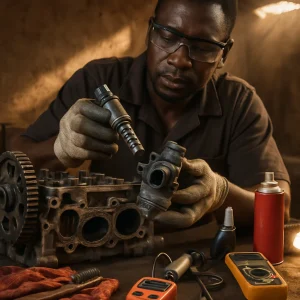
Scope
- Explain the function and effects of VVT and EGR on engine performance and emissions.
- Give practical service and diagnostic checks tailored to resource‑constrained African workshop conditions.
- Emphasise low‑cost, robust methods and safety.
Audience
- Beginner technicians working in basic workshops with limited diagnostic equipment.
- Focus on gasoline engines; where diesel differences matter these are noted.
1. Overview — Why cylinder charge control matters
Cylinder charge control is the deliberate control of the air–fuel mixture and residual gases inside the combustion chamber at different points in engine operation. Two common systems are:
- Variable Valve Timing (VVT): changes valve timing (and sometimes lift) to optimise breathing across engine speeds and loads.
- Exhaust Gas Recirculation (EGR): returns a controlled portion of exhaust gas to the intake to lower combustion temperature and reduce NOx emissions.
Together these systems:
- Improve drivability (idle stability, torque), fuel economy, and low‑speed torque.
- Reduce NOx emissions (EGR) and improve engine efficiency across the rev range (VVT).
- Require clean oil, functioning control valves and sensors; if neglected, they cause loss of power, poor idle, higher emissions and frequent faults.
2. Variable Valve Timing (VVT)
2.1 Basic principles
- VVT changes the timing of intake and/or exhaust valve opening and closing relative to crankshaft position.
- Common forms:
- Cam phasing (continuous or stepped): rotates camshaft relative to cam drive to advance/retard timing.
- Cam profile switching (discrete): engages alternate cam lobes for different lift/duration (e.g., Honda VTEC).
- Variable valve lift systems: change valve lift and duration (less common on low‑cost engines).
- Most modern VVT systems are oil‑pressure controlled by an oil control valve (OCV, also called VVT solenoid) under ECU command. The ECU uses inputs like cam and crank sensors, load, RPM and coolant temperature.
2.2 Effects on performance and emissions
- Advanced intake timing: can increase low‑to‑mid range torque, improve throttle response.
- Retarded intake timing: often used at high RPM to improve volumetric efficiency and to reduce overlap effects.
- Increased valve overlap (intake and exhaust open at same time) can promote scavenging at high RPM, improving peak power.
- Reduced overlap helps idle stability, reduces unburned hydrocarbons at low loads.
- VVT helps reduce pumping losses and improve fuel economy across the rev range.
- Indirect emission effects: better combustion control reduces hydrocarbons and CO; VVT by itself is not a NOx control method but can affect cylinder temperatures and hence NOx formation.
2.3 Common failure modes and symptoms
- Oil control valve (OCV) stuck or clogged → incorrect cam phasing.
- Cam phaser mechanical wear → noisy timing, loss of advance.
- Low/dirty engine oil → sluggish or non‑functional VVT operation.
- Camshaft or crankshaft position sensor faults → incorrect timing control, misfires.
Symptoms: - Check Engine Light (CEL) with timing-related codes (see codes list).
- Poor low‑end torque or weak top end.
- Rough idle, hesitation, misfires.
- Metallic noise from timing area (worn phaser/timing chain).
2.4 Practical service and diagnostic checks (low‑cost)
Tools suggested: flashlight, basic hand tools, clean rags, simple multimeter, small mirror, cheap OBD‑II reader (where available), oil catch tray, basic spray degreaser, screwdriver, small brush.
Stepwise checks:
-
Visual and basic checks
- Check engine oil level and condition. Very dark, sludgy oil indicates poor maintenance; VVT units rely on clean oil.
- Inspect for oil leaks around the valve cover, camshaft area and VVT solenoid.
- Check oil filter condition and service history.
-
Inspect OCV (VVT solenoid)
- Locate the VVT solenoid (follow service manual or labelled harness). Remove and inspect for sludge or metallic debris.
- Clean with an appropriate solvent (brake cleaner or parts cleaner) and blow through passages if safe and permitted. Do not damage the solenoid.
- For electrical solenoids: measure coil resistance with a multimeter; compare to spec where available. If totally open/shorted, replace.
-
Check operation (electrically)
- With OBD‑II live data (if available) command VVT operation and observe cam angle or OCV duty cycle.
- Without advanced tools, check for sudden change in idle or engine behaviour when the engine warms and during slight acceleration; absence of expected change may indicate stuck phaser/OCV issue.
-
Oil and filter maintenance
- Replace oil and filter at tighter intervals if engine sees dusty conditions or poor fuel. Clean oil prevents VVT sticking.
- Use manufacturer‑recommended oil grade. If only broad guidance is available, prefer fresh oil of correct viscosity and a good quality filter.
-
Mechanical inspection
- If noise is present, remove valve cover to inspect cam phaser and chain/belt condition (if trained to do so).
- Look for excessive play in phaser, broken timing chain guides or elongated chain.
-
Simple in‑vehicle tests
- Listen for rattles from timing area on cold start (possible chain/phaser wear).
- Compare idle behavior before and after an oil change—improvement suggests oil contamination was the issue.
Notes for local workshops
- A clean filter and regular oil changes are the most cost‑effective prevention for VVT problems.
- Keep a simple parts cleaning setup and soft brushes to remove sludge from solenoid/ports.
- If replacement parts are scarce, salvaged good condition OCVs from known donor engines can be used after bench testing.
3. Exhaust Gas Recirculation (EGR)
3.1 Basic principles
- EGR recirculates a portion of exhaust gas back into the intake. The inert gases lower peak combustion temperature, reducing thermal NOx formation.
- Types:
- Vacuum‑controlled EGR valve (older gasoline engines).
- Electronically controlled solenoid/valve (modern gasoline engines).
- EGR cooler (more common on diesel) — tends to clog and fail; gasoline EGR cooling is less common.
3.2 Effects on performance and emissions
- Primary effect: reduction of NOx emissions.
- Secondary effects:
- Slight reduction in peak torque due to dilution of the charge.
- At idle and low loads, EGR helps reduce combustion temperature and NOx but can cause rough idle if flow is excessive or if ports are clogged.
- EGR increases soot and carbon deposition in intake ports and on intake valves, throttlebodies and EGR passages, especially with low‑quality fuel or oil contamination.
3.3 Common failure modes and symptoms
- Clogging of EGR passages and valve with carbon → valve may stick open or closed.
- Faulty EGR valve (vacuum diaphragm leak, electrical failure) → improper EGR flow.
- EGR sensor or position feedback faults.
Symptoms: - Rough idle, stalling, hesitation.
- Increased soot and black smoke during acceleration (more common in diesels).
- Check Engine Light with EGR codes (see list).
- Reduced fuel efficiency or engine pinging when EGR is not functioning (less NOx dilution).
3.4 Practical service and diagnostic checks (low‑cost)
Tools: hand tools for valve removal, small wire brushes, carb/throttle body cleaner, vacuum pump (hand‑held cheap vacuum tester) for vacuum valves, multimeter, OBD reader if available, rags, gloves and eye protection.
Stepwise checks:
-
Symptom confirmation and safety
- Warm engine to normal operating temperature before diagnostic checks.
- Ensure proper ventilation and use gloves/eye protection when cleaning carbon deposits.
-
Visual inspection
- Inspect EGR valve and surrounding manifold for carbon build‑up or soot leakage.
- Note any broken vacuum lines (for vacuum systems), cracked rubber, or loose electrical connectors.
-
Basic functional test (vacuum EGR)
- With engine idling, apply vacuum to EGR valve using a hand vacuum pump. A working valve will cause a change in idle (roughness or lower idle) as EGR opens. If it has no effect, valve or passages may be clogged.
- If vacuum cannot be applied (diaphragm leaking), valve must be replaced.
-
Basic functional test (electronic EGR)
- Use OBD live data to command EGR operation. If OBD not available, observe engine response when EGR is commanded (if vehicle supports manual testing via a switch or diagnostics).
- Check wiring and power at the valve connector with multimeter.
-
Cleaning the EGR valve and passages
- Remove the EGR valve following safe procedures and allow it to cool.
- Use a brush and approved solvent (carb or throttle body cleaner) to remove carbon from valve body and passages. For heavy carbon, repeat cleaning rather than aggressive scraping that could damage mating surfaces.
- Clean intake manifold EGR ports and throttle body surfaces where oil/soot accumulates.
-
Reinstallation and test
- Replace gaskets as required.
- Start engine and observe for improved idle and drivability.
- For diesel EGR coolers (if present), inspect for coolant leaks; replacement or professional cleaning may be needed.
-
Temporary diagnostic block (use with caution)
- As a diagnostic step, temporarily blocking EGR passages (e.g., removing EGR valve and fitting a temporary blank) can show whether symptoms change. If blocking eliminates rough idle, the EGR system/valve or passages are likely the cause.
- Warning: do not operate vehicles long‑term with emissions control systems disabled; this is only for short diagnostic checks and may be illegal.
Notes for local workshops
- Frequent cleaning is often necessary where poor fuel quality and oil consumption cause heavy carbon.
- Consider installing a crankcase ventilation catch can where oil vapor contributes to intake deposits (if compatible with vehicle design).
- Avoid “quick” fixes that disable EGR permanently; instead focus on cleaning and reliable valve operation.
4. Interaction between VVT and EGR
- Both affect cylinder temperature, combustion timing and emissions; faults in one system can mimic the other.
- Example: a stuck‑open EGR can cause rough idle and misfires that may be mistaken for VVT faults. Conversely, a stuck VVT phaser increasing overlap can cause rebreathing symptoms similar to excessive EGR.
- Diagnostic approach should isolate systems stepwise: check oil and VVT first when symptoms relate to timing; check EGR when symptoms relate to soot, rough idle or NOx codes.
5. Simple diagnostic flow (practical sequence for low‑resource setting)
- Gather information: symptoms, recent maintenance, fuel quality, oil change history.
- Check oil: level, smell (burnt), colour, presence of sludge.
- Read fault codes (cheap OBD‑II reader if available). Note cam/crank and EGR‑related codes.
- Visual inspection: connectors, vacuum lines, leaks, oil contamination.
- Clean OCV / remove and clean EGR valve and passages.
- Perform simple operational tests:
- Hand vacuum on EGR valve (vacuum systems).
- Listen and observe for changes when engine warms (VVT engagement usually evident as change in torque/idle).
- Replace small inexpensive parts first: filters, gaskets, solenoids (used good condition parts acceptable if new unavailable).
- If unresolved and noisiness or chain wear suspected, arrange for higher‑level inspection (timing cover removal) when possible.
6. Low‑cost preventive measures and workshop practices
- Frequent oil and filter changes using recommended viscosity. In dusty or hot climates shorten intervals.
- Use good air filtration and inspect/replace air filters frequently.
- Keep intake and throttle body clean during routine service.
- Use quality replacement parts for OCVs and EGR valves; if using salvaged parts, bench test first.
- Train staff to recognise early signs (idle changes, power loss, black soot) and act early before mechanical damage.
- Maintain simple records of oil changes, part replacements and diagnostic codes.
7. Common diagnostic trouble codes (examples)
(Use an OBD reader and consult vehicle manual for exact definitions)
- VVT / cam timing related: P0010–P0018, P0020–P0028 (camshaft actuator/circuit/cam position issues), P0340 (camshaft position sensor), P0011/P0021 (timing over‑advanced/retarded).
- EGR related: P0400–P0408 (EGR flow/sensor/position).
Note: code ranges are generic OBD‑II examples; model‑specific codes and interpretations are in service manuals.
8. Safety and ethical notes
- Always work on a cool engine where required; hot exhaust components and coolant can cause burns.
- Use gloves, eye protection and adequate ventilation when using cleaners/solvents.
- Avoid long‑term disabling of emissions systems; repairs should restore intended function.
- Keep a safe disposal process for used oil and solvents, following local regulations.
9. Quick reference checklist (for routine service)
- Check oil level/condition: top up or change if very dark/sludgy.
- Replace oil filter each oil change.
- Inspect and clean VVT solenoid/OCV every 30–50,000 km (adjust for local conditions).
- Inspect and clean EGR valve and EGR passages if rough idle, hesitation or soot observed.
- Replace worn vacuum hoses and cracked connectors.
- Keep air filter clean; replace when clogged.
- Use OBD scanner to clear and monitor codes after cleaning/repairs.
- Record service actions and observed symptoms.
10. Conclusion — Practical priorities for longevity
- Preventive maintenance (clean oil, filters) is the most effective and low‑cost approach to keep VVT and EGR functioning under harsh conditions.
- Regular visual checks, basic functional tests (vacuum pump, listening for changes, simple multimeter checks) and cleaning of solenoids/valves will prevent most failures.
- When uncertain or if mechanical timing components appear damaged, escalate to more advanced repairs rather than continuing symptomatic fixes.
Further reading and resources
- Manufacturer service manual for specific engine procedures and specifications.
- Basic OBD‑II code guides and cheap code readers for workshop use.
- Safe handling guides for solvents and used oil disposal.
End of topic.