

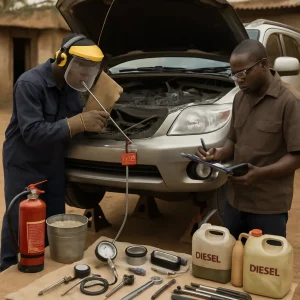
Overview
This topic provides a competency-focused, practical approach to diagnosing diesel engine faults and performing safe work on diesel fuel systems in resource‑constrained African contexts. It emphasizes stepwise troubleshooting workflows, correct use of basic measurement tools, safe work practices for high‑pressure fuel systems, and pragmatic risk‑mitigation strategies suitable where advanced equipment is not available.
Learning objectives
After completing this topic, the learner will be able to:
- Apply a structured, symptom‑based troubleshooting workflow for common diesel faults.
- Use basic measurement tools correctly (multimeter, compression tester, basic fuel pressure gauge, hand vacuum gauge, tachometer/stopwatch), and interpret results against expected ranges.
- Identify and control hazards associated with diesel fuel systems, especially high‑pressure injection systems.
- Implement low‑cost, robust work practices and risk mitigation methods appropriate to constrained environments.
- Demonstrate safe isolation, pressure relief, and leak‑detection procedures before and during work on fuel systems.
Required tools and consumables (low‑cost / locally available examples)
- Digital multimeter (DC volts/ohms)
- Basic compression tester with appropriate diesel adaptors (mechanical or in‑line)
- Hand‑operated fuel pressure gauge or a graduated syringe for low‑pressure priming tests
- Timing/ tachometer (or handheld strobe where available; otherwise use engine rpm measurement)
- Long screwdriver or mechanical stethoscope for listening to injectors (use with caution)
- Graduated measuring syringe or clear tubing and jar for injector return-flow tests
- Basic hand tools, torque wrench where possible, screwdrivers, open/box wrenches
- Jack stands or sturdy improvised supports and wheel chocks
- Personal protective equipment (PPE): safety glasses, face shield if available, leather gloves, heavy long-sleeve clothing, ear protection
- Clean containers for fuel, absorbent material (sand, soil or used cloth), drip trays
- Fire extinguisher (dry chemical preferred); if unavailable, water should be used only for cooling—not for fuel fires
- Tags/labels and marker for lockout
Note: Always prefer manufacturer‑specified equipment for testing high‑pressure systems. Use improvised methods only for low‑pressure checks and initial triage; never improvise when the work requires pressure‑rated instruments.
Core safety principles
- Assume all fuel lines and injectors are under pressure until proven otherwise.
- Never use bare hands to check for leaks from high‑pressure injectors; use cardboard or a purpose‑made leak locator.
- Relieve system pressure by the manufacturer’s prescribed method before disconnecting any fuel fittings.
- Secure vehicle on level ground, set parking brake, chock wheels, and use jack stands before working under or near the vehicle.
- Isolate electrical power: disconnect battery negative terminal before significant work.
- Avoid open flames, sparks, or smoking in the work area. Keep a fire extinguisher immediately available.
- For fuel injection puncture injuries: treat as surgical emergency — seek immediate medical attention; do not attempt to suck out injected fluid or apply tourniquets.
- Clean spills promptly; collect waste fuel and contaminated rags in sealable containers for proper disposal.
General stepwise troubleshooting workflow (competency framework)
Use the following structured workflow for an efficient, safe diagnosis. Document findings and only proceed to the next step when previous checks are complete.
-
Safety and prepare
- Secure vehicle, chock wheels, disconnect battery (where required), ensure ventilation, wear PPE.
- Note symptoms and operating conditions (cold/hot start, load, smoke color, noises).
-
Visual inspection and basic checks
- Look for obvious leaks, loose or damaged hoses, corroded connectors, clogged air intake or filters, fuel tank level, and fuel filter condition.
- Check battery state (voltage at rest and under cranking), starter operation, and fuses/relays.
-
Confirm cranking and compression
- Verify engine cranks at normal speed. If cranking is slow, address battery/starting circuit first.
- Perform a compression test (all cylinders) and compare results; significant variation >10–15% indicates mechanical issues (valve, ring, injector).
-
Fuel delivery and pressure checks
- Check fuel filter(s), priming pump, lift pump operation (if fitted).
- For low‑pressure delivery checks use a hand fuel pressure gauge or syringe; for high‑pressure systems only use rated gauges or rely on certified service.
- Bleed air from system per manufacturer instructions; listen for air ingress.
-
Injector and timing checks
- Use a mechanical stethoscope or listening method to detect injector operation.
- If injector balance/return flow tests are possible with available equipment, compare injector return volumes.
- Confirm valve and injection timing (mechanical timing marks or ECU data where available).
-
Advanced diagnostics (if required and safe)
- Perform cylinder balance tests, leak‑down tests, or return‑flow measurements using calibrated instruments.
- For electronic/common‑rail systems, read fault codes with diagnostic tools if available.
-
Repair, verify, and document
- Make repairs following safe procedures. Reassemble and verify symptom resolution under controlled conditions.
- Dispose of waste and clean work area. Update maintenance records and recommend follow‑up.
Symptom‑based stepwise procedures
A. Engine will not start (cranks but does not fire)
- Safety: secure vehicle, battery disconnected where required between tests.
- Check cranking speed: measure battery voltage during cranking; voltage should typically remain above ~9.6 V for a healthy cranking cycle on 12 V systems.
- Fuel supply:
- Confirm fuel in tank and no clogged inlet.
- Check primary/secondary filters for blockage; replace if heavily contaminated.
- Operate primer pump; observe flow at fuel filter or lift pump outlet.
- If no fuel at filter outlet, inspect lift pump/electrical feed.
- Air in system:
- Bleed air from filters and lines per procedure, then attempt start.
- Compression:
- Perform compression test. Typical diesel compression ranges depend on engine design; many diesels read between 300–500 psi (20–35 bar). Refer to manufacturer specs.
- Low compression → investigate valves, head gasket, piston rings.
- Injector operation:
- Listen for injector clicks; if no operation, verify electrical feed for electronic injectors or mechanical actuation.
- If injectors operate but no fuel is atomized, check high‑pressure pump and lines.
- If high‑pressure system suspected:
- Do not disconnect high‑pressure components without manufacturer‑rated tools.
- Seek specialist assistance or use diagnostic equipment.
Decision points: If fuel flow is absent, fix pump/filter/lines. If compression low, repair mechanical. If injectors not actuating, repair electrical/ECU.
B. Hard starting or runs rough at idle
- Check glow plug system (if applicable): measure resistance of glow plugs and voltage supply; replace faulty items.
- Inspect air intake and EGR (where fitted) for restrictions.
- Fuel quality and filters: drain water separator, replace filters, check for contamination.
- Injectors: check return flow balance or use listening test; fouled injectors may cause roughness.
- Turbocharger: inspect for shaft play and air leaks in intake system.
- Electrical: weak battery or poor cranking can cause poor starts.
C. Loss of power, excessive smoke
- Check fuel filters and lift pump pressure.
- Measure boost and intake restrictions; a clogged air filter or intercooler leak reduces power.
- Excessive black smoke: indicates rich mixture or poor atomization — suspect injectors, high‑pressure pump, or turbocharger.
- Excessive white smoke: may indicate poor combustion due to low compression or incorrect timing.
- Blue smoke: indicates oil burning (rings, valve guide seals).
- Perform compression and fuel system checks as required.
D. Fuel leak detection (high‑risk)
- Never use hands to feel for leaks. With engine stopped and pressure relieved, use a rag/cardboard to detect seepage when priming.
- For live‑engine leak detection, stand to the side and use cardboard, not hands, to locate leaks.
- If a high‑pressure leak is found, stop engine immediately, isolate, relieve pressure, and repair with rated fittings.
Measurement procedures and interpretation (basic)
- Battery voltage (rest): ~12.4–12.7 V is fully charged. Under cranking, avoid dropping below ~9.0–10 V.
- Charging voltage (engine running): typically 13.8–14.6 V for healthy alternator/regulator.
- Compression: compare across cylinders; absolute values must be compared to manufacturer spec. Consistent low values suggest engine wear.
- Low‑pressure fuel checks: lift‑pump pressure/flow should match manufacturer or typical range for the system; lack of flow indicates pump/filter/air ingress problems.
- Injector return flow: collect return flow from each injector into a graduated syringe while engine idles at specified rpm for a fixed time (e.g., 15–30 s); excessive return on one injector indicates leakage. Use care—ensure return lines are safe and route into container.
- Electrical checks: verify continuity and voltage at connectors before replacing components.
Note: For high‑pressure common‑rail systems (pressures may exceed 1000 bar), only use pressure gauges and adapters rated for the system. If not available, rely on low‑pressure checks and non‑invasive diagnostics. Do not attempt to fit un rated gauges/adapters to high‑pressure fittings.
High‑pressure fuel system safe work procedure (summary)
- Obtain and follow manufacturer procedure. If not available, do not proceed with disassembly of high‑pressure components.
- Relieve system pressure using correct method (e.g., turn ignition to “ON” to prime and drain pressure via specified bleed point, or remove fuse/relay and crank with fuel return to a container per manual).
- Wear eye protection and face shield; stand to one side when bleeding.
- Use pressure‑rated hoses, couplings, and gauges. Do not use improvised fittings on high‑pressure ports.
- Tag and secure lines to avoid accidental reconnection.
- When checking for leaks with the system pressurised, use cardboard to locate spray and avoid direct exposure.
- Replace sealing washers, O‑rings and torque fasteners to specified values. If torque wrench is unavailable, note recommended torque and use calibrated manual feel where permitted; however, critical systems require correct torque — seek assistance if uncertain.
Low‑cost / pragmatic techniques and local adaptations
- Use clear tubing and a clean jar to observe lift‑pump output when a dedicated gauge is not available.
- For initial leak-detection, cardboards or stiff paper safely indicate the direction and strength of a spray without hand exposure.
- Use a long screwdriver as a mechanical stethoscope to listen for injector operation. Place the handle against your ear and the tip on the injector body; exercise caution and do not touch moving parts.
- Collect fuel drips in clean containers (old oil cans) for re‑use where permitted; mark and label all collected fluids.
- When a calibrated compression tester is unavailable, use a borrowed unit or send the unit to a central workshop; do not rely only on cranking feel.
Caveat: Improvisation must never replace pressure‑rated tools for high‑pressure work.
Risk mitigation in constrained environments
- Work in open or well‑ventilated spaces to reduce inhalation exposure.
- Implement a buddy system: have at least one other person present for tasks that carry significant risk (e.g., pressure relief, heavy lifting).
- Use locally available PPE when manufactured items are not available (e.g., heavy leather gloves, welding goggles) but avoid substitutes that increase risk (thin plastics).
- Maintain a basic emergency kit and local clinic contacts; document the nearest emergency services.
- Institute simple lockout/tagout using visible tags and disconnecting battery terminals.
- Store and label consumables and fuels in secure containers away from living quarters.
- Train on and practice spill response using sand/sawdust/soil and bunds to contain spills.
Competency checks / assessment tasks
- Demonstrate a safe vehicle setup for work under the engine bay (correct jacking, stands, chocks, battery isolation).
- Perform a visual inspection checklist and record findings.
- Execute a compression test on a diesel engine, record all cylinder pressures, and interpret results relative to a provided standard.
- Bleed a basic fuel system and show restoration of fuel flow with safe techniques.
- Identify and document a fuel leak without direct manual contact and outline corrective action.
- Demonstrate use of a multimeter to diagnose a simple electrical fault (e.g., bad glow plug circuit or starter relay).
Documentation and follow‑up
- Record all test data (voltages, compression readings, fuel flow volumes, observed symptoms).
- Create a short repair plan and estimate the minimum parts and tools required.
- Advise the customer or owner of actions taken, safety precautions, and recommended follow‑up maintenance intervals.
Final notes
- Always consult vehicle/manufacturer documentation for specifications and detailed procedures. Where those are not available, apply conservative safety practices: use rated tools for high‑pressure work, avoid improvising on critical safety components, and refer complex high‑pressure or electronic faults to a qualified service provider.
- Emphasize prevention: regular filter changes, good fuel storage practices, and systematic inspections reduce diagnostic work and improve safety in constrained environments.
References and manufacturer data should be consulted for specific pressure values, torque settings, and diagnostic thresholds for each engine model.