Participants 3


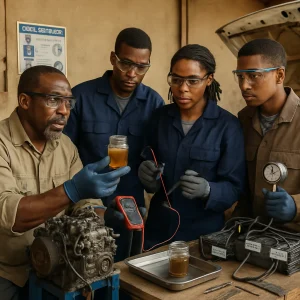
This lesson provides foundational knowledge and practical skills for the inspection, maintenance and safe handling of diesel engines and high‑pressure fuel systems, specifically adapted for learners working in resource‑constrained African workshop environments. It balances essential theory with hands‑on practice using low‑cost, robust methods and locally available materials, so learners can perform competent, safe work on diesel power units and their management systems.
Learning outcomes
- Describe basic diesel engine operation and the principal forces and cycles involved.
- Identify common sensors, actuators and electronic control elements used on diesel engines and explain their roles.
- Differentiate major fuel injection technologies and the implications for maintenance and diagnostics.
- Perform standard fuel supply inspections, recognise contamination and wear, and carry out safe replacement procedures using locally available tools.
- Apply systematic, low‑cost diagnostic techniques to isolate common faults and implement appropriate corrective actions while observing safety requirements.
Teaching approach
- Competency‑based: emphasis on demonstrable skills and decision‑making.
- Balanced theory and practice: concise conceptual briefings followed by supervised practical exercises.
- Contextualised methods: adaptations for low‑resource settings, such as use of durable, low‑cost tools, improvised test techniques where safe and appropriate, and sourcing of local consumables.
- Peer learning and mentor feedback: group tasks, guided troubleshooting and assessment by demonstration.
Lesson topics (overview)
- Diesel engine fundamentals — Basic combustion cycle, engine components, compression ignition principles, effects of compression ratio and air‑fuel mixture on performance and emissions.
- Sensors and electronic control systems — Overview of common sensors (MAF/MAP, crank/cam position, oil pressure, coolant temperature, fuel pressure), ECUs, basic wiring and diagnostic signals, and simple fault‑finding strategies without specialised equipment.
- Fuel injection technologies — Overview of distributor pumps, inline pumps, common‑rail, and unit injectors; differences in operation, maintenance needs and failure modes; implications for safety when working with high‑pressure systems.
- Fuel supply inspection and replacement — Visual and simple instrumental inspection of supply lines, filters, tanks and strainers; recognising contamination and air ingress; safe procedures for filter and line replacement in limited‑resource settings.
- Practical diesel diagnostics and safety — Systematic diagnostic workflow for common symptoms (starting, power loss, smoke, rough running), safe isolation of high‑pressure components, required personal protective equipment (PPE), spill control and waste fuel handling.
Prerequisites and safety
- Recommended prior learning: basic mechanical workshop safety, introductory engine theory and elementary electrical literacy.
- Safety is paramount: high‑pressure diesel injection systems can cause serious injury. Learners will be instructed in safe isolation procedures, correct use of PPE (safety eyewear, gloves, protective clothing), safe handling and disposal of fuels and contaminated materials, and emergency first‑aid for injection injuries. Tasks that present a high risk will be performed under direct supervision or demonstrated by the instructor.
Assessment and expected competence
- Assessment will combine practical demonstrations, fault‑finding tasks in simulated low‑resource scenarios, and short written/oral checks of theory and safety knowledge.
- On successful completion, learners will be able to inspect and maintain diesel fuel supply components, perform basic diagnostics using low‑cost methods, and carry out routine repairs and replacements in a safe, resource‑appropriate manner.
Materials and equipment (examples)
- Basic hand tools, fuel filter wrenches, pressure gauges or low‑cost adaptations where safe, multimeter, simple test lamps, clean containers for fuel inspection, suitable PPE, basic consumables (filters, seals).
- Emphasis will be placed on improvising safely with locally available materials and on maintaining tool and workshop cleanliness to protect fuel system components.
This lesson equips learners with the practical competence and safety awareness to maintain and diagnose diesel engines effectively in challenging environments, supporting reliable vehicle operation and safer workshop practices.