

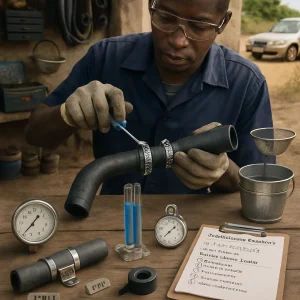
This topic explains how to identify and quantify flow losses in piping systems commonly encountered in automotive workshops and field operations, and provides practical, low-cost repair and sealing techniques suitable for resource-constrained African contexts. Emphasis is placed on safe procedures, the use of locally available materials, and simple optimization strategies to restore reliable, efficient fluid flow.
Contents:
- Identification of flow losses and symptoms
- Basic calculation methods (friction and minor losses)
- Field measurement techniques (flow, pressure, and leak detection)
- Practical piping and hose repair techniques (rubber, metal, threaded joints)
- Sealing methods and material selection (fluid-specific guidance)
- Optimization and preventive strategies for low-cost contexts
- Safety, testing, and documentation checklist
1. Identification of Flow Losses — Signs and Inspection
Common indicators of excessive flow loss or pressure drop:
- Reduced flow rate at the outlet (slow coolant circulation, weak fuel flow)
- Lower-than-expected pressure on gauges
- Component overheating (engine, turbocharger oil cooler, radiator)
- Cavitation or audible flow noise (whistling, sputtering)
- Vibration or surging in pumps
- Increased fuel consumption or loss of power
- Visible leaks, wet stains, or bulging hoses
Systematic inspection steps:
- Visually inspect hoses, clamps, fittings, and pipes for cracks, chafing, bulges, corrosion and deposits.
- Follow the line from pump to device to identify constrictions, sharp bends, kinks, or collapsed sections.
- Check filters, screens and strainers for blockage or contamination.
- Operate the system and note location(s) of audible leaks or pressure fluctuation.
- Use simple tests (see Section 3) to quantify flow/pressure at points of interest.
2. Basic Calculation Methods for Flow Losses
Flow losses in a piping system are the sum of friction (distributed) losses along straight lengths and local (minor) losses at fittings and changes in geometry.
Key relations:
-
Cross-sectional area:
A = π D^2 / 4(D = internal diameter, m)
-
Velocity:
V = Q / A(Q = volumetric flow rate, m^3/s; V = mean velocity, m/s)
-
Reynolds number (to determine flow regime):
Re = ρ V D / μ(ρ = density, kg/m^3; μ = dynamic viscosity, Pa·s)- If Re < 2,300 → laminar; Re > 4,000 → turbulent. Between these is transitional.
-
Friction (Darcy-Weisbach):
- Head loss due to friction:
h_f = f (L / D) (V^2 / (2 g))- f = friction factor (dimensionless)
- L = pipe length (m)
- g = 9.81 m/s^2
- Head loss due to friction:
-
Approximate friction factor:
- Laminar:
f = 64 / Re - Turbulent (smooth pipe, approximate, 4,000 < Re < 100,000):
- Blasius:
f ≈ 0.3164 / Re^0.25
- Blasius:
- For rough pipes and more accuracy use Moody chart or Colebrook equation (requires iteration).
- Laminar:
-
Minor (local) losses:
h_m = K (V^2 / (2 g))where K is the loss coefficient of the fitting.- Typical K values (approximate):
- Sudden contraction: 0.2–0.5
- Sharp 90° elbow: 0.9
- Long-radius 90° elbow: 0.3–0.5
- Tee (branch flow): 1.0–2.0 depending on flow direction
- Inlet (vena contracta): 0.5–1.0
- Exit: 1.0
-
Pressure drop related to head:
ΔP = ρ g h_total(Pa), whereh_total = h_f + Σ h_m.
Worked example (field-appropriate):
- Given: flexible hose D = 19 mm (0.019 m), length L = 2.0 m, flow Q = 30 L/min = 0.0005 m^3/s (water-like fluid).
- A = π D^2 / 4 ≈ 2.84 × 10^-4 m^2
- V = Q / A ≈ 1.76 m/s
- Re = 1000 × 1.76 × 0.019 / 0.001 ≈ 33,500 → turbulent
- Use Blasius: f ≈ 0.3164 / Re^0.25 ≈ 0.023
- h_f = f (L/D) (V^2 / 2g) = 0.023 × (2 / 0.019) × (1.76^2 / (2 × 9.81)) ≈ 0.39 m
- Two sharp 90° elbows (K ≈ 0.9 each) → ΣK = 1.8
h_m = 1.8 × (V^2 / 2g) ≈ 0.29 m - h_total ≈ 0.68 m → ΔP ≈ 1000 × 9.81 × 0.68 ≈ 6.7 kPa
Notes:
- For fuels and oils use correct ρ and μ for the specific fluid (diesel and engine oil have higher viscosity → lower Re → higher f).
- Calculation steps are suitable for simple field estimates; for critical systems use more detailed friction factor determination.
3. Field Measurement Techniques (simple, low-cost)
-
Flow rate (Q):
- Timed volumetric method: collect and measure volume in a bucket over a measured time (Q = Volume / time). Works for coolant, water test loops.
- Rotameter or inexpensive inline flow meters when available.
-
Velocity:
- Compute from Q and pipe area using
V = Q / A.
- Compute from Q and pipe area using
-
Pressure difference:
- Low-cost pressure gauges (mechanical) or a manometer constructed from transparent tubing and a column of water or oil can measure differential pressure.
- For small pressure drops a U-tube manometer works reliably.
-
Leak detection:
- Soap-water solution to find air or gas leaks (bubbles).
- Visual inspection for wetness, stains, or smell for fuel.
- Fluorescent dye (for coolant) and a UV lamp (if available).
-
Blockage/Restriction diagnosis:
- Measure pressure upstream and downstream of suspected restriction.
- Remove and inspect filters/strain screens.
4. Practical Piping and Hose Repair Techniques
General principles:
- For fluid systems, prefer permanent repairs using appropriate materials rated for the fluid (fuel, oil, coolant).
- Where temporary field repairs are necessary, prioritize safety (drain or isolate flammable liquids; ventilate), then ensure the repair is robust enough to return vehicle to workshop for permanent repair.
- Repaired component must be pressure-tested before returning to service.
A. Rubber hose (coolant or general low-pressure fluid) — common, low-cost repairs
- Small puncture or pinhole:
- Clean and dry area.
- Short-term: apply self-fusing silicone tape or vulcanizing inner-tube patch, cover with layered hose clamp(s).
- Better: cut out damaged section; insert a short piece (sleeve) of matching hose or inner tube (suitably sized), secure each end with two hose clamps (one clamp behind the shoulder).
- Split along length:
- If clean-cut and small: use a short repair sleeve and two clamps as above.
- If long or near end connection: replace hose.
- Bulging or soft spots:
- Replace the hose. Temporary use of a sleeve under a clamp is unsafe if the hose structure is weakened.
Materials:
- Spare matching hose, inner tube rubber strips, stainless steel worm-gear clamps (jubilee), spring-clamps, vulcanizing patches, self-fusing silicone tape.
B. Fuel line (pressurized or gravity-fed)
Important: Fuel systems are hazardous. Avoid open flames and sparks. Do not use standard epoxy unless rated fuel-resistant.
- Minor leak on flexible fuel hose:
- For temporary field repair: drain or isolate fuel, clean, wrap with fuel-resistant self-fusing PTFE silicone tape or use a fuel-line repair sleeve (commercial).
- Use two fuel-grade hose clamps and a proper fuel-rated sleeve (e.g., Tygon or nitrile fuel hose).
- Split or severely damaged fuel hose:
- Replace with correct fuel-rated hose and crimp or clamp with appropriate ferrule and clamp.
- If original uses crimped fittings, do not attempt to re-crimp with improvised clamps; use proper fittings or replace assembly.
Materials:
- Fuel-rated rubber/PVC/Tygon hose, crimp ferrules (if possible), heavy-duty hose clamps rated for fuel systems, fuel-resistant tape.
C. Rigid metal pipe (oil line, brake lines, coolant pipes)
- Small pinhole or hairline crack:
- Emergency: use a rubber patch (inner tube piece), place over defect and clamp with a metal strap clamp or two hose-clamps; this is temporary only.
- Better: use fuel/oil-resistant epoxy putty designed for that fluid and temperature (e.g., products specified for engine oil/coolant). Follow curing times and temperature limits.
- Larger rupture or threaded connection failure:
- Prefer cut-out and replacement of damaged section; use local machinist to fabricate a repair sleeve or coupling.
- For threaded leaks: remove, clean threads and re-seal (see Section 5).
Materials and techniques:
- Epoxy putty rated for the fluid and operating temperature (check manufacturer data).
- Metal strap clamps fabricated from local flat stock, with rubber lining (inner tube) underneath.
- Brazing/soldering for permanent repair if joint is accessible and operator is qualified (note: brazing should be used only by competent personnel and after degassing/cleaning and with fuel/oil drained).
D. Threaded joints
- For tapered threads (NPT, BSPT), reapply PTFE tape (wrap in direction of thread tightening) or use thread sealant paste rated for the fluid.
- For parallel threads (BSPP), use an O-ring or gasket if designed for it.
- For stripped or damaged threads, replace the fitting or fit a coupling sleeve; do not rely on excessive tape.
E. Quick couplings and couplers
- Ensure couplers are rated for pressure and fluid type.
- For low-pressure temporary use, fabricate a coupling using short lengths of pipe, two clamps and a sleeve. Mark as temporary.
F. Testing repaired lines
- Gradually pressurize system to operating pressure while observing for leaks.
- Use soap solution for pressurized air or gas tests (caution with fuel: avoid ignition sources).
- Run the system and re-check after 15–30 minutes under normal operating conditions.
- Mark all temporary repairs clearly and schedule replacement.
5. Sealing Methods and Material Selection
Select sealing materials appropriate for the fluid, temperature, and pressure.
Common sealing options:
- PTFE (Teflon) tape: good for water, air; ensure compatibility with fuel (use fuel-rated PTFE tape). Wrap in direction of thread tightening; 3–5 wraps common.
- Pipe dope / thread sealant: choose fluid-specific products (some are fuel/oil resistant).
- Hemp (oakum) + jointing paste: traditional for water/steam lines; not recommended for fuel or oil lines.
- O-rings and gaskets: use correct material (NBR, Viton, EPDM). Viton recommended for fuel and oils; EPDM for coolant (ethylene glycol usually incompatible with some elastomers).
- Self-fusing silicone tape: useful for temporary rubber hose repairs; ensure compatibility with fluid (many silicones are not fuel-resistant).
- Epoxy putty: used for metal and some plastics; ensure product is rated for temperature and fluid (coolant, oil, fuel-resistant types exist).
- Vulcanizing patches (inner tube repair): excellent for rubber hose patches; when vulcanized bond is achievable.
Guidelines:
- For fuel lines: use fuel-rated hoses, clamps, and sealants; avoid ordinary silicone adhesives.
- For coolant (ethylene glycol), use hoses and sealants rated for coolant and engine temperatures.
- For engine oil: high-temperature and oil-resistant materials required.
- Always consult product datasheets where possible.
6. Optimization Strategies in Resource-Constrained Contexts
Aim: reduce flow losses and frequency of repairs while using locally available resources.
Design and routing:
- Minimize length of lines when possible; every metre adds friction loss.
- Avoid unnecessary fittings and joints.
- Use long-radius bends instead of sharp elbows to reduce K-values.
- Keep diameters large enough for required flow — small increases in diameter significantly reduce head loss.
- For temporary designs, use multiple parallel hoses rather than one undersized hose where available.
Maintenance and cleanliness:
- Install easily-cleaned strainers or coarse filters upstream of sensitive devices; locally-made screens can dramatically reduce clogging.
- Schedule routine inspection and replacement intervals for hoses and clamps.
- Clean lines of deposits when possible (flush coolant systems; use appropriate flushing for fuel lines if contaminated).
Local-material strategies:
- Reuse inner tubes as sleeves and gaskets.
- Use stainless worm-gear clamps where possible; galvanised or good-quality mild steel clamps where stainless unavailable.
- Fabricate metal strap clamps and lined couplings from scrap flat metal with a rubber lining (inner tube).
- Train local fabricators to produce simple couplings and crimp ferrules for common hose diameters.
System-level optimization:
- Where possible, locate pumps and filters to reduce suction lift and inlet restrictions.
- Employ gravity-fed arrangements when safety and system design permit, reducing pump energy losses.
- Replace single costly components with multiple inexpensive, sacrificial units (easily replaced filters/strain screens).
Target operational ranges (practical guidance):
- For general non-critical liquid transfer, maintain velocities in the range 0.6–2.0 m/s for reduced friction and erosion.
- For fuel lines, follow manufacturer or component-specific guidelines; where not available, keep velocities modest and use fuel-rated materials.
7. Safety, Testing and Documentation
Safety first:
- When working on fuel, oil or pressurized lines, remove ignition sources, work outdoors or in ventilated areas.
- Use appropriate PPE: gloves, eye protection, flame-resistant clothing if brazing.
- Drain fluids into appropriate containers and dispose of waste per local regulations.
Testing protocol after repair:
- Visually inspect and ensure all clamps and fittings are tightened to torque appropriate for clamp type (if using torqueable clamps).
- Pressurize gradually to operating pressure; observe for leaks for at least several minutes.
- Operate system under normal load while monitoring temperatures and pressures.
- If repair is temporary, mark the component and schedule replacement with permanent repair materials as soon as possible.
Documentation and competency outcomes:
- Record nature of failure, repair method, materials used, and test results.
- Competency expected: learner can identify flow losses, perform basic loss calculations, execute a safe temporary repair using local materials, choose appropriate sealing method for the fluid, and validate repair by pressure/flow testing.
8. Summary Checklist (Field Reference)
- Inspect visually: hoses, clamps, fittings, filters.
- Measure flow/pressure if available: timed volumetric, manometer or gauge.
- Compute rough losses (use Darcy-Weisbach and K-values) to determine whether restriction or leak is cause.
- Select repair method based on fluid type:
- Coolant: hose replacement or sleeve + clamps; epoxy putty for small metal pipe leaks (coolant-rated).
- Fuel: replace with fuel-rated hose and clamps; temporary fuel-resistant sleeve only if isolated and ventilated.
- Oil/high-temp: use high-temp oil-resistant materials; avoid ordinary epoxies.
- Use correct sealing materials for threads (PTFE, fuel-rated sealant).
- Test under pressure, then in operation; recheck and schedule permanent repairs for any temporary fix.
- Document repair and mark temporary repairs clearly.
Recommended further reading (practical):
- Basic hydraulics/Darcy-Weisbach references and Moody chart (to deepen understanding of friction factors).
- Manufacturer datasheets for hose and sealant material compatibility (especially for fuel, oil and coolants).
- Local trade manuals for brazing and safe fuel-system handling.
End of topic.