AUTO_1: Foundation Automotive Technician Program (Beginners in Resource-Constrained African Contexts)
Course summary
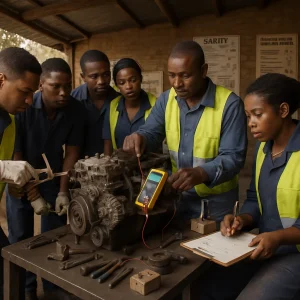
AUTO_1 is a beginner-level, competency-based foundation programme designed for learners operating in resource-constrained African environments. The course balances essential theory and structured hands-on practice to develop safe, practical skills in diesel and gasoline engine management, engineering drawing, engineering mathematics, engineering ethics, and fluid mechanics. All learning activities emphasize low-cost, robust methods and the effective use of locally available materials and tools.
Purpose and rationale
Automotive technicians in many African communities must diagnose, maintain and repair vehicles with limited access to specialised equipment, parts, and consumables. This course prepares learners to perform competent, safe and ethical work within such constraints by:
- Prioritising fundamental principles and diagnostic reasoning that are independent of specific proprietary tools;
- Teaching practical methods that use durable, low-cost techniques and locally obtainable materials;
- Embedding safety, professional conduct and resourceful problem-solving into every lesson.
Target audience
- Beginners and entry-level learners with little or no prior formal automotive training.
- Community-based mechanics, vocational trainees, and technical school students in low-resource settings.
- Learners seeking a foundation for further technical training or local employment in vehicle maintenance and repair.
Learning outcomes
On successful completion of AUTO_1 learners will be able to:
- Demonstrate fundamental theoretical knowledge of diesel and gasoline engine management systems.
- Read, interpret and produce basic engineering drawings relevant to vehicle systems.
- Apply elementary engineering mathematics to measurements, tolerances and diagnostic calculations.
- Explain the principles of fluid mechanics as they apply to engine lubrication, cooling and fuel systems.
- Perform a set of defined practical tasks to industry-appropriate competence using low-cost methods and locally available resources.
- Apply recognised safety practices and professional ethical standards in workshop and field settings.
Course structure
AUTO_1 is organised into six lessons. Each lesson contains multiple topics that combine classroom instruction, demonstrations and hands-on practical exercises.
-
Diesel Engine Management Systems
- Fundamentals of diesel combustion and injection systems
- Mechanical and electronic control principles, diagnostics suited to limited instrumentation
- Practical maintenance and low-cost testing techniques
-
Gasoline Engine Management Systems
- Carburetion and fuel injection basics, ignition systems and emissions awareness
- Fault-finding with minimal test equipment and substitution techniques
- Routine servicing and adjustments using locally available tools
-
Engineering Drawing I & II
- Introduction to graphical communication: orthographic views, sectioning, dimensioning
- Application to vehicle components, tolerances and simple assemblies
- Low-cost drafting methods and use of basic measuring instruments
-
Engineering Mathematics I & II
- Arithmetic, algebra and trigonometry applied to measurement, scaling and gearing
- Unit conversion, tolerance analysis, basic calculations for fluid flow and forces
- Practical problem-solving exercises tied to workshop tasks
-
Engineering Ethics
- Professional responsibilities, client communication and workplace safety culture
- Ethical decision-making in resource-constrained environments (e.g., trade-offs, honesty about repairs)
- Standards, documentation and maintaining trust with clients and colleagues
-
Fluid Mechanics I & II
- Properties of fluids, pressure, flow, and continuity as applied to lubrication, cooling and fuel systems
- Simple experiments, measurement techniques and improvised test rigs
- Practical diagnostics and maintenance of pumps, cooling circuits and filtration systems
Pedagogy and delivery
- Competency-based assessment: learners must demonstrate defined practical and theoretical competencies to progress.
- Blended methods: short, focused theory sessions complemented by hands-on workshops, guided projects and peer learning.
- Resource-appropriate techniques: emphasis on durable, low-cost procedures and creative use of locally available parts and tools.
- Safety-first approach: all practical work includes documented safety protocols and risk mitigation strategies.
Assessment and certification
- Assessment includes practical demonstrations, workplace-style tasks, written quizzes, and a learner portfolio documenting applied work and reflections.
- Competency checklists will be used to certify task-level proficiency. Successful completion leads to a foundation-level certificate suitable for immediate entry-level employment or further study.
Prerequisites and materials
- No formal prior qualifications required; basic literacy and numeracy are recommended.
- Suggested basic materials and tools list (adaptable for local contexts): hand tools, measuring instruments (tape, vernier or calipers), basic multimeter, improvised test fixtures, consumables common to local vehicle fleets.
- Emphasis will be placed on how to source, maintain and safely use inexpensive equipment.
Safety, ethics and sustainability
Throughout the course learners will be guided to adopt practices that protect personal safety, client vehicles and the environment. Ethical practice, correct waste handling and cost-effective maintenance strategies are core themes.
Conclusion
AUTO_1 equips learners with the foundational knowledge, practical skills and professional attitudes needed to work competently as entry-level automotive technicians in low-resource African contexts. Graduates will be prepared to deliver safe, ethical and effective vehicle maintenance and to continue building skills for more advanced technical work.
Course Content
About Instructor


Course Includes
- 6 Lessons
- 30 Topics