

Lesson: Engineering Ethics
Estimated study time: 60–90 minutes
Learning objectives
By the end of this topic, learners will be able to:
- Summarize the major phases of industrial and technological change and their defining features.
- Describe common patterns of technology adoption and diffusion relevant to resource‑constrained contexts.
- Identify how rapid technological change alters skills requirements and resource planning for automotive technicians in developing African contexts.
- Explain the ethical implications of adopting, modifying, or rejecting technologies in local communities.
- Apply practical strategies for responsible, safe, and sustainable technology selection and skill development in low‑resource environments.
1. Overview: phases of technological change
Technological change has occurred in broad, successive phases often called "industrial revolutions." Each phase introduced new capabilities, new social and economic structures, and new ethical responsibilities for practitioners.
- First Industrial Revolution (late 18th – mid 19th century): mechanisation powered by steam and water. Key features: concentration of production, manual-to-machine transitions, early safety and labour challenges.
- Second Industrial Revolution (late 19th – early 20th century): mass production, electrification, internal combustion engines. Key features: assembly lines, large-scale manufacturing, rise of standardized parts.
- Third Industrial Revolution (late 20th century): electronics, computing, and automation. Key features: computer control, diagnostics, software-driven systems.
- Fourth Industrial Revolution (21st century): cyber-physical systems, Internet of Things (IoT), artificial intelligence, connectivity. Key features: networked devices, data-driven decision making, rapid obsolescence of purely mechanical designs.
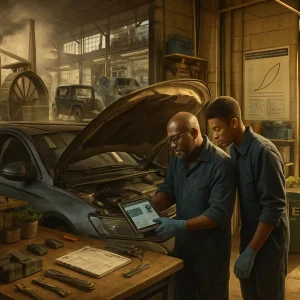
Implication for automotive technicians: systems once primarily mechanical increasingly include electronics, software, sensors, and networked components. The nature of maintenance, diagnostics, and safety assurance evolves accordingly.
2. Technology adoption patterns
Understanding how technologies spread helps technicians and institutions make realistic plans.
- S‑curve of adoption: innovations typically follow slow initial uptake (innovators), rapid growth (early and majority adopters), and eventual saturation (late adopters, laggards). Resource constraints can stretch or prevent the growth phase.
- Rogers’ categories: innovators, early adopters, early majority, late majority, laggards — useful for planning training and services.
- Leapfrogging: developing contexts sometimes skip intermediate technologies (e.g., widespread mobile phones where landlines were limited). Leapfrogging can provide rapid access to services but can create maintenance and equity issues.
- Path dependence and lock‑in: early choices (standards, suppliers, infrastructure) can constrain later options and increase costs over time.
- Hybrid adoption: coexistence of old and new technologies is common; technicians must service legacy and modern systems simultaneously.
Barriers to adoption in resource‑constrained contexts:
- Capital cost and financing limits.
- Lack of compatible spare parts and tools.
- Limited local training and diagnostic resources.
- Weak supply chains and infrastructure (power, internet).
- Regulatory and standards gaps.
3. How rapid change affects skills requirements
Rapid technological change reshapes what technicians must know and do:
- Broadening of competencies: from pure mechanical skills to include electrical basics, electronic diagnostics, and software literacy.
- Core practical skills remain critical: mechanical reasoning, safe work practices, measuring and interpreting physical data, improvisation with safety margins.
- Continuous learning becomes essential: lifelong learning, short courses, and apprenticeship models are necessary to keep skills current.
- Soft skills increase in importance: communication (explaining risks to customers), ethical judgement, documentation, and management of parts and information.
- Multimodal troubleshooting: technicians must combine hands‑on inspection with data from electronic diagnostic tools and interpret incomplete information.
- Teaching and mentoring skills: experienced technicians must pass on tacit knowledge; structured mentorship reduces risk from rapid turnover.
Competency-based training implications:
- Emphasize foundational principles (mechanics, thermodynamics, fluid mechanics) so learners can adapt to new technologies.
- Teach how to assess reliability and maintainability of technologies, not only operation.
- Provide problem-based and context-relevant practical exercises using locally available vehicles and tools.
4. Resource planning implications
Appropriate resource planning reduces ethical and practical risks when adopting new technologies.
Considerations for workshop owners, trainers, and policymakers:
- Tools and diagnostic equipment: invest in robust, upgradeable tools; prefer multi-purpose and open‑protocol devices where possible.
- Spare parts and consumables: favour technologies with locally available or easily reparable parts; plan for stocking critical items.
- Energy and infrastructure: evaluate electricity quality, fuel availability, and internet connectivity required by new equipment.
- Training and human resources: budget for regular retraining, mentorship programs, and knowledge transfer.
- Financing and lifecycle costs: evaluate total cost of ownership, including maintenance, training, and disposal costs.
- Standards and safety systems: adopt or develop local standards and safe operating procedures appropriate to context.
- Supplier selection and warranties: prefer suppliers with clear support for parts and training, or open-source communities that provide documentation.
Checklist for procurement decisions:
- Is the technology maintainable locally? (spares, tools, skills)
- Can safety risks be managed with available resources?
- What is the expected lifespan and obsolescence risk?
- Are there local staff or partners who can provide training?
- What are the environmental disposal requirements?
5. Ethical implications of technological change
Technicians and institutions must consider ethical responsibilities when participating in technological transitions.
Key ethical domains:
- Safety and risk: new technologies introduce unfamiliar hazards. Ethically, technicians must ensure competent maintenance, disclose risks, and refuse work beyond competence until trained.
- Equity and access: technology choices can widen or narrow access to services. Avoid choices that privilege a few customers while marginalizing the majority.
- Environmental stewardship: consider emissions, waste (electronics, batteries), and resource use. Adopt repair-first and recycling approaches where possible.
- Cultural and social appropriateness: ensure technologies respect local practices and needs; avoid imposing solutions that communities cannot maintain.
- Transparency and informed consent: when retrofitting or installing technologies that affect safety or privacy (e.g., telematics), inform clients clearly about implications and costs.
- Professional integrity: maintain accurate records, avoid cutting safety corners to reduce cost, and report systemic hazards to authorities or professional bodies.
Examples of ethical dilemmas:
- Installing cheaper aftermarket electronic modules that lack documentation and may fail, versus recommending a costlier, documented OEM solution.
- Adopting vehicle telematics that improve diagnostics but collect driver data without clear consent.
- Retrofitting emission controls when spare parts are unavailable—should technicians accept work knowing it will likely fail?
6. Practical strategies for responsible practice in resource‑constrained African contexts
Actionable approaches that align ethics with practical realities:
For individual technicians:
- Maintain competence boundaries: do not undertake electronic/ software work without training; partner with colleagues or refer when necessary.
- Focus on robust, repairable solutions: prefer simple, well-documented components that can be fixed locally.
- Keep clear records: document work done, parts used, and known limitations—this supports safety and future maintenance.
- Engage in peer networks: share knowledge via local associations, WhatsApp groups, and community workshops.
- Adopt basic data hygiene: back up diagnostic data, label parts, and keep simple, paper or digital inventories.
For workshops and training centers:
- Invest in foundational training: strengthen understanding of mechanics, measurements, fluid mechanics, and diagnostics.
- Run mixed-technology exercises: include both legacy vehicle systems and newer, electronics-rich systems in practicals.
- Build apprenticeship and mentorship programs: pair experienced technicians with learners for tacit skill transfer.
- Create a parts-sourcing strategy: identify multiple suppliers, teach parts inspection, and consider cooperative procurement.
- Implement safety management: standard operating procedures, PPE, and waste handling for oils, batteries, and e-waste.
For policymakers and program designers:
- Support modular, competency-based curricula that anticipate mixed-technology environments.
- Encourage open standards and local servicing rights to prevent vendor lock‑in.
- Facilitate access to affordable training and micro‑finance for tool and parts investment.
- Promote manufacturer take-back and recycling programs or local recycling initiatives.
7. Case studies and examples (brief)
- Mobile phones and leapfrogging: Many African countries leapfrogged landlines to mobile phones. Technicians adapted by learning telephony basics and setting up local charging/repair services. The lesson: new platforms can create local markets but require new skills and supply chains.
- Motorcycle (boda‑boda) modernization: Introduction of fuel‑injected engines and electronic ignition increases fuel efficiency but raises diagnostics and spare parts demands. Workshops that combine mechanical competence with basic electronic training remained most sustainable.
- Solar-powered battery charging and diagnostics: Solar pumps and charging systems offer independence from grid power but require technicians who can size systems, manage batteries, and dispose of battery waste safely.
8. Exercises and reflection questions
Practical exercises (workshop or assignment):
- Technology mapping: Select three common automotive technologies used locally (e.g., carburettor engines, EGR systems, aftermarket ECUs). For each, list: required skills, spare parts availability, typical failure modes, and ethical considerations for repairs.
- Resource planning scenario: You run a small workshop planning to offer diagnostics on modern diesel common‑rail engines. Create a short plan that covers tools, training, parts, safety measures, and financing—all within limited capital.
- Hazard assessment: Choose a recent repair job involving electronic components. Identify potential safety risks to users and the workshop, and propose mitigations.
Reflection questions:
- Which historical phase of technological change most strongly affects your daily work, and why?
- Have you observed leapfrogging or hybrid adoption in your community? What positive and negative effects resulted?
- When might it be ethically preferable to refuse or defer a repair?
9. Key terms
- Leapfrogging: Bypassing intermediate technologies and adopting more advanced solutions directly.
- S‑curve of adoption: The typical pattern of slow initial uptake, rapid growth, and eventual saturation of an innovation.
- Path dependence / lock‑in: Early choices that make later changes difficult or costly.
- Appropriate technology: Technology chosen for its suitability to local conditions, maintainability, and sustainability.
- Obsolescence: The process by which a technology becomes outdated and unsupported.
10. Further reading and resources
- Rogers, E. M. (2003). Diffusion of Innovations. (Useful for understanding adoption categories.)
- E. F. Schumacher, Small Is Beautiful: Economics as if People Mattered. (Overview of appropriate technologies.)
- Practical Action (practicalaction.org) – resources on appropriate technology and small enterprise.
- Engineers Without Borders / Engineers Against Poverty – case studies on community‑appropriate technical solutions.
- Local vocational training centres and unions: seek regional curricula and short courses on automotive electronics and diagnostics.
11. Summary
Technological change is continuous and accelerates the blending of mechanical, electrical, and digital systems. In resource‑constrained African contexts, technicians face both opportunity and ethical responsibility: to select practicable technologies, maintain safety and equity, plan resources realistically, and commit to ongoing learning. Competency-based training, robust local supply chains, mentorship, and an ethic of repairability and transparency are essential strategies for navigating rapid change responsibly.
End of topic.