-
From Theory to Plan: Translating Principles into Lessons32 Topics
-
Active Learning Strategies44 Topics
-
Differentiation and Personalized Learning5 Topics
-
Formative Assessment: Techniques and Use4 Topics
-
Classroom Management: Routines, Procedures and Environment5 Topics
-
Collaborative Learning and Group Work6 Topics
-
Questioning, Feedback and Scaffolding5 Topics
-
Technology Integration and Digital Activities6 Topics
-
Inclusive Practices: Equity, ELL and SEN Strategies7 Topics
-
Reflection, Action Research and Professional Growth4 Topics
Participants 3

Practical Example: 45-minute Lesson Plan

didactec 23.09.2025
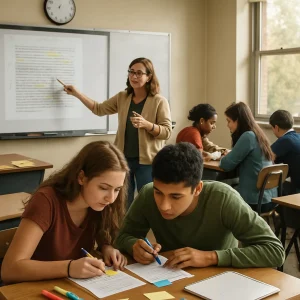
Lesson Overview (What, Why, How)
- What (objective): Students will make and justify inferences from a short literary passage using textual evidence and collaborative reasoning. They will produce one written inference linked to two pieces of textual evidence.
- Why (purpose): Inference is central to literary understanding and critical thinking (Vygotsky: social mediation/scaffolding; Piaget: developmental sequencing). This lesson translates theory into classroom practice: activation, modeling, guided practice, formative checks and differentiated supports to secure durable learning.
- How (approach): Brief activation → explicit modeling (think‑aloud) → collaborative scaffolded practice (paired annotation + structured protocols) → independent check (exit ticket) → targeted homework. Variety of interaction patterns and learning styles are used (aural, visual, kinesthetic, verbal).
Reference pedagogical principles: scaffolding and social learning (Vygotsky), staged cognitive development (Piaget), collaborative problem solving (Barron), and memory/attention design (three‑question model; chunked segments to respect attention span).
Grade / Course
- Upper middle / lower high school literature (can be adapted across grades 7–11)
Duration
- 45 minutes
Materials & Prep
- Printed short passage (see sample text below) — one per student
- Highlighters (2 colours per student), sticky notes, pens
- Whiteboard/Smartboard and markers
- Mini whiteboards or paper for quick checks
- Exit‑ticket slips (or digital form e.g., Google Form)
- Timer visible to students
- Rubric/checklist for inference (teacher copy)
- Backup: extra printed copies if projector/tech fails
Sample Passage (original; use as class text)
(Length: ~8 sentences — intentionally compact to allow deep reading in class)
“Marisol paused at the threshold of Mr. Ortega’s old shop and inhaled the familiar mixture of dust and orange peel. The bell above the door sighed; the clock behind the counter read a quarter to three though sunlight lay thick on the sill. Mr. Ortega was bent over a ledger, his hands steady but slower than they used to be; beside him, a stool had been placed for someone who no longer came. When Marisol set the wooden box on the counter, Mr. Ortega lifted his head, and his smile trembled as if remembering a name that wanted to stay forgotten. She handed him the box without a word and watched the way his knuckles whitened for a moment, then relaxed.”
Learning Objectives (measurable)
By the end of the lesson students will be able to:
- Identify at least two specific details from the text that support an inferred idea (identify evidence).
- Write a clear inference about a character or situation (claim) grounded in those textual details.
- Explain briefly, in one or two sentences, the reasoning that connects evidence to inference (warrant).
(Aligned to higher‑order skills: critical thinking, textual analysis, communication.)
Minute‑by‑Minute Plan (annotated)
0:00–0:04 — Warm‑up / Motivation (4 min)
- Activity: “3–2–1 Quick Recall” (Inspection triangle variant)
- Students take 60 seconds to write: 3 words that describe the mood from the passage title (teacher displays title only: “The Old Shop”), 2 things they expect to appear in the text, 1 question they have.
- Purpose: Activate prior knowledge, set purpose, engage curiosity (Ausubel: advance organizer).
- Differentiation: Students who need language support may use picture prompts or lists of mood words.
Teacher moves: Circulate, listen for patterns; record 1–2 volunteer expectations on the board to orient class.
Checks for understanding: Quick scan of responses; verbal thumbs up/down on whether expectations match the group.
0:04–0:12 — Read & Model (8 min)
- Activity:
- Teacher reads the short passage aloud (1st reading) with emphasis, modeling fluency.
- Silent re‑read by students (2nd reading) while highlighting two types of detail: observable facts (use yellow) and emotive/figurative language (use pink).
- Teacher Think‑Aloud (model): While reading again, the teacher annotates (projected or on the board) — e.g., “I notice the clock reads a quarter to three but sunlight is thick — does that mean a clock is wrong, or does it suggest something about Mr. Ortega’s perception? I infer he may be losing track of time (I’ll note that as a tentative inference).”
Purpose: Demonstrate how to move from observation to tentative inference (explicit modeling of cognitive process).
Differentiation: ELL students get a vocabulary mini‑list printed (e.g., threshold, ledger, trembled), and a sentence‑frame for inferences.
Checks: Cold call two students for one observed detail each; validate highlighting work.
0:12–0:26 — Guided Collaborative Practice (14 min)
- Structure: Pair annotation + “Claim-Evidence-Reasoning” (CER) protocol
Steps:
- Pairs compare highlighted details (2–3 min).
- Each pair completes a structured worksheet:
- Claim (inference about character or situation)
- Evidence (two short quotations or paraphrases with line numbers)
- Reasoning (1–2 sentences connecting evidence to claim)
(Worksheet is scaffolded with sentence starters: “I infer that __ because __” / “This suggests __ since __”.)
Teacher moves: Circulate, listen for misconceptions (e.g., claiming without evidence), redirect thinking with probing questions: “Which words tell you that? How does that word suggest X?”
Differentiation:
- Struggling pairs: Use a sentence‑frame and allow paraphrase instead of direct quote.
- Advanced pairs: Ask for a counter‑inference (alternative plausible interpretation) and evidence to support it.
Checks for understanding:
- Monitor 3–4 pairs and make live, brief feedback comments.
- Use mini whiteboards: each pair writes a one‑line claim when teacher signals; teacher quickly scans and gives group feedback.
Time cues: 7 minutes for pairwork + 2–3 minutes for teacher check and 2 exemplar pair presentations.
0:26–0:34 — Share & Class Discussion (8 min)
- Activity:
- Select 2 pairs to present their CER (1‑minute each).
- Class uses “Yes/Not Yet” protocol to evaluate whether the evidence supports the claim. Students must raise thumbs (yes) or sticky note (not yet) and write one question for the presenter.
- Teacher role: Facilitate, push for deeper explanation: “You said Mr. Ortega’s smile trembled — does that definitely point to sorrow? Could it indicate memory? How does the stool detail affect your reading?”
Differentiation:
- If class is reticent, use small group reporting instead of whole class to lower anxiety.
- Provide guiding questions for presenters (e.g., “Why did you choose that phrase as evidence?”).
Checks for understanding:
- Teacher records common successful warrants and any frequent gaps (e.g., inference unsupported).
0:34–0:41 — Independent Practice / Exit Task (7 min)
- Activity: Individual exit ticket (written)
- Prompt: Write one inference about Mr. Ortega or Marisol. Provide two textual details and one sentence explaining how the details support your inference.
- Criteria: Claim + two evidence items (quoted or paraphrased) + 1 connecting sentence.
Teacher collects slips (or students submit digitally). This is the primary formative check.
Differentiation:
- Allow students with IEP accommodations extra time or allow oral exit ticket to teacher assistant.
- Provide an exemplar answer on the back of the worksheet for students who need extra scaffolding.
Checks for understanding: Rapid review of 6–8 exit tickets as they are turned in to check distribution of performance. Flag students needing urgent follow‑up.
0:41–0:45 — Closure & Homework (4 min)
- Summarize (teacher): Reiterate the skill steps — Observe → Select evidence → Make inference → Explain reasoning.
- Quick reflective prompt (Information Ladder mini): On the board students write (or say): After this lesson I (1) know __, (2) understand __, (3) can use this in __.
- Homework (extension and consolidation):
- Main: Read a one‑page short story excerpt (teacher provides link or printed copy). Annotate two lines that suggest something not stated and write a short paragraph (5–7 sentences) inferring and citing evidence.
- Enrichment: Compose a brief speculative backstory (200 words) for Mr. Ortega based on inferences; include three lines cited as “proof”.
Differentiation: Homework has tiered options — basic (paraphrase evidence), standard (direct quotes + reasoning), advanced (alternative interpretations + cross‑text connection).