-
From Theory to Plan: Translating Principles into Lessons32 Topics
-
Active Learning Strategies44 Topics
-
Differentiation and Personalized Learning5 Topics
-
Formative Assessment: Techniques and Use4 Topics
-
Classroom Management: Routines, Procedures and Environment5 Topics
-
Collaborative Learning and Group Work6 Topics
-
Questioning, Feedback and Scaffolding5 Topics
-
Technology Integration and Digital Activities6 Topics
-
Inclusive Practices: Equity, ELL and SEN Strategies7 Topics
-
Reflection, Action Research and Professional Growth4 Topics
Participants 3

5. Worked example — 9th‑grade biology lesson

didactec 27.11.2025
Lesson Progress
0% Complete
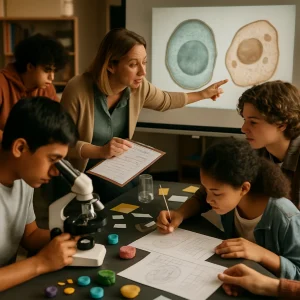
Topic: Cell Structure & Function (one 45–60 minute lesson)
Curriculum alignment (example)
- National/Local Standard: Biology 9 — Cells and Cellular Processes (or replace with your local code)
- Unit goal: Students will understand the structure and function of major cell organelles and be able to explain their roles in cell survival.
Lesson-level measurable objectives (ABCD style)
- Knowledge objective
- Given microscope slides and labeled diagrams (Condition), students (Audience) will identify and label (Behavior) at least 6 major organelles (nucleus, mitochondrion, chloroplast, cell membrane, cell wall, vacuole) in plant and animal cells (Degree) with ≥ 80% accuracy.
- Skill objective (investigative)
- Given a prepared investigation and sensor data or observation checklist, students will compare and record (Behavior) differences in structure between plant and animal cells (Condition) and construct (Behavior) a comparative table and one labelled sketch that correctly attributes three structural differences (Degree).
- Scientific explanation objective (higher cognitive/communication)
- Using evidence from microscope observations and textbook diagrams (Condition), students will explain (Behavior) how at least two organelles contribute to energy production and use (mitochondria and chloroplasts) (Audience) in a written paragraph that includes one claim, one piece of evidence and one explanation (Degree).
Student‑friendly outcomes (to display at start)
- “By the end of this lesson I can:
- identify and label the major organelles in plant and animal cells,
- make a clear table comparing plant and animal cell structures,
- explain how mitochondria and chloroplasts help cells get energy (and support that explanation with evidence).”
Success criteria (make visible)
- Identification: 6 organelles correctly labelled on a diagram or slide (≥80% correct)
- Comparison: Table includes at least 3 accurate structural differences and one example of where each is found
- Explanation: Paragraph uses claim–evidence–reasoning format; evidence cites an observation or diagram; reasoning connects organelle structure to function
Formative checks and where they fit in the lesson
- Motivation (5 min)
- Quick diagnostic: show two cell images — students write one observable difference on a sticky note (preconception check).
- State outcomes and success criteria (connect to real world: “why do plant cells need chloroplasts?”).
- Teaching chunk (10 min)
- Brief direct instruction with annotated diagrams and one worked example (label a slide together).
- Ask 2 targeted cold-call questions (retrieve & check).
- Activation (20–25 min)
- Microscope stations (or virtual microscope) — students identify organelles and complete a labeling worksheet (measures objective 1).
- Pair work: build comparative table and sketch; teacher circulates with a checklist rubric (measures objective 2).
- Extension: small group prepares one 2‑minute explanation of energy organelles using claim–evidence–reasoning (measures objective 3).
- Reflection (5–8 min)
- Information ladder / Exit ticket: “After this lesson I 1) know ___ 2) understand ___ 3) can use this info ___ 4) noticed ___.”
- Teacher collects exit tickets to adjust next lesson (formative data).
- Homework
- Short retrieval assignment: label a blank cell diagram (3 minutes), and write one Claim–Evidence–Reasoning sentence about energy organelles.
Summative evidence options (choose one or combine)
- Short lab report (group): embedded microscope images, table of differences, CER paragraph (graded with rubric).
- Practical performance task: label an unlabeled slide under time & produce a 3‑minute oral explanation.
- End-of-unit quiz: multiple choice (identification), short answer (compare), one CER paragraph (explain).
Sample rubrics (brief)
Identification rubric (6 points total)
- 6 correct = Proficient (6)
- 4–5 correct = Developing (4–5)
- 0–3 correct = Beginning (0–3)
CER paragraph rubric (4‑point)
- 4 — Claim clearly stated, evidence linked to observation, reasoning explains structure→function precisely
- 3 — Claim + evidence present, reasoning present but limited
- 2 — Claim + weak or irrelevant evidence, weak reasoning
- 1 — Claim only or incomplete
Accommodations for summative assessment (apply per student needs)
- Extra time, quieter environment, scribe for written tasks, alternative formats (oral explanation or recorded video), simplified language for prompts — all should still measure the same behavior (identify, compare, explain).
Differentiation ideas linked to objectives
- Struggling learners: scaffolded labels (word bank), paired with an expert peer, allow use of labeled diagrams during formative checks.
- Advanced learners: ask to predict how organelle function changes under stress (e.g., low light), or design a simple experiment to test chloroplast activity (photosynthesis proxy).