Back to Course
AA Top Teacher Theory vol 2_1: Classroom Activities
0% Complete
0/0 Steps
-
From Theory to Plan: Translating Principles into Lessons32 Topics
-
(A) From Theory to Lesson Plans
-
1. One-Page Lesson Plan Template (fillable)
-
2. Lesson Structure and Timing — Practical Rules of Thumb
-
3. Mapping Theory to Plan — How to Translate Constructs into Steps
-
4. Sample: Filled Lesson Plan (60 min) — Calculating Combinations (no probabilities)
-
5. Formative Question Bank (quick checks to map to objective & ZPD)
-
6. Quick Teacher Checklist — Before, During, After
-
7. Practical Tips & Pitfalls (12 + concise cautionary notes)
-
8. Short theoretical mapping (why this works)
-
9. Short Rubric Example (for counting/permutation lesson)
-
(B) Learning Objectives and Outcomes
-
1. Principles: What makes a good objective
-
2. Translate objectives into student‑friendly outcomes
-
3. Checklist for writing objectives & outcomes
-
4. Mapping objectives to the lesson structure
-
5. Worked example — 9th‑grade biology lesson
-
6. Quick teacher templates
-
7. Common pitfalls and how to avoid them
-
8. Final checklist before you teach
-
(C) Sequencing & Pacing
-
Micro‑sequence: the lesson template (for ~60-minute lesson)
-
Macro‑sequence: mapping a two‑week unit
-
Two‑week (10 × 60‑minute) pacing guide — ready to adapt
-
Justifying method choice (how to explain to students / why they’re doing it)
-
Monitoring progress & adjusting pace (practical cues)
-
Quick checklist for teachers (before each lesson)
-
Practical Example: 45-minute Lesson Plan
-
(D) Differentiation & Inclusion Strategies (summary)
-
Assessment & Checks for Understanding
-
Extensions & Cross‑Curricular Ideas
-
Common Student Errors & Teacher Prompts
-
Teacher Notes / Script Highlights (select phrases you might say)
-
(A) From Theory to Lesson Plans
-
Active Learning Strategies44 Topics
-
(A) Think-Pair-Share and Variants
-
Core TPS structure (teacher-script + timing)
-
Designing productive pairwork
-
Practical classroom workflow that connects to your lesson context
-
Follow-up TPS for generalization (Think–Pair–Share leading into theory):
-
Formative assessment and feedback strategies for TPS
-
Managing time and flexibility
-
Classroom materials and tech (checklist)
-
Appendix: Quick lesson-plan entry for a TPS activity (copy into your OneNote tab)
-
(B) Problem-Based Learning (PBL) Basics
-
Short PBL tasks for single lessons (ready to use)
-
60‑minute Civic Education PBL: Full scenario — “Community Green Space: Whose Priorities?”
-
Teacher preparation checklist (quick)
-
Good practice tips & pitfalls
-
(C) Hands-on and Manipulative Activities
-
Example 1 — Fractions: Building Equivalence, Addition and Comparison with Manipulatives
-
Example 2 — Physics: Motion Labs with Simple Materials (displacement, velocity, acceleration)
-
Classroom roles, group routines, and scalability
-
Assessment strategies (formative and summative)
-
Reflection protocols and consolidation
-
Quick templates you can copy
-
Practical teacher tips
-
(D) Simulations & Roleplay
-
Low-prep simulations (fast, scalable)
-
Assessment: formative rubric (sample)
-
Debrief & reflection (mandatory)
-
Sample roleplay: Mock Trial (classroom-ready template)
-
Practical tips & teacher moves
-
(E) Stations, Rotations and Learning Centers
-
Classroom routines and management
-
Station instruction template (one card for students)
-
Assessment checkpoints: formative and summative
-
Differentiation and supports (mixed-ability groups)
-
Full example: STEM rotation for mixed-ability groups
-
Sample short assessment checklist (station-level, teacher uses)
-
Monitoring, correcting progress, and feedback routines
-
Reflection, evaluation and closure
-
Teacher checklist before first run
-
(F) Practical Example: Active Lesson Sequence
-
Lesson structure (minute-by-minute)
-
Formative assessment & success criteria
-
Differentiation & accessibility
-
Classroom management & logistics tips
-
Teacher reflection prompts (post-lesson)
-
(A) Think-Pair-Share and Variants
-
Differentiation and Personalized Learning5 Topics
-
Formative Assessment: Techniques and Use4 Topics
-
Classroom Management: Routines, Procedures and Environment5 Topics
-
Collaborative Learning and Group Work6 Topics
-
Questioning, Feedback and Scaffolding5 Topics
-
Technology Integration and Digital Activities6 Topics
-
Inclusive Practices: Equity, ELL and SEN Strategies7 Topics
-
Universal Design for Learning (UDL) in Practice
-
Accommodations vs Modifications
-
Supporting English Language Learners (ELLs)
-
Strategies for Students with Special Educational Needs (SEN)
-
Culturally Responsive Teaching
-
Behavior Support Plans and Positive Interventions
-
Practical Example: Inclusive Lesson for ELL and SEN Learners
-
Universal Design for Learning (UDL) in Practice
-
Reflection, Action Research and Professional Growth4 Topics
Participants 3

Lesson 2,
Topic 27
In Progress
Sample roleplay: Mock Trial (classroom-ready template)

didactec 28.11.2025
Lesson Progress
0% Complete
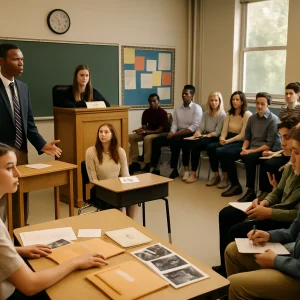
Purpose: practice persuasive reasoning, evidence evaluation and formal oral argument.
Time: 60–75 minutes (adaptable)
Materials: role cards, evidence slips, witness statements, verdict form, timer
Roles (example for a civic / language class):
- Judge (1) — keeps order, enforces time limits, reads verdict form.
- Prosecutor team (2–3) — presents case, calls witnesses, cross-examines.
- Defence team (2–3) — defends accused, cross-examines.
- Defendant (1) — may testify.
- Witnesses (2–4) — read prepared statements; optional improv answers under cross-exam.
- Jury (4–6) — listens, deliberates, returns verdict (binding for classroom).
- Clerk / Evidence manager (1) — organizes evidence packets and timeline.
- Observers (outer circle) — use rubric to give feedback.
Scenario (short sample)
- Case title: The Park Mural Dispute
- Charge: Vandalism? Community protest? Restorative action?
- Context: City mural painted overnight; property owner reports defacement. Painter claims community expression; owner claims damage. The case requires application of community standards, intent, restitution principles.
Preparation (teacher)
- Write short witness statements and evidence slips (photos, neighbor testimonies, city ordinance extract). Keep language clear and grade-appropriate.
- Print role cards with basic instructions and time allocations.
- Brief students on courtroom etiquette and time limits.
Procedure (60 min example)
- Setup & role assignment — 5 min
- Team preparation (prosecution & defence plan opening and witness order) — 10 min
- Opening statements (2 min each) — 6 min
- Witness testimony & cross-examination (3 witnesses, 6–8 min each incl. cross) — 24 min
- Closing arguments (3 min each) — 6 min
- Jury deliberation & verdict (10 min) — 10 min
- Debrief & feedback (use rubric, emotional check, reflection prompts) — 10–15 min
Guidance: limit speaking time strictly; model a good opening statement; coach students to cite concrete evidence rather than opinion.
Sample witness card (example)
- Witness: Neighbour (Ms. K.)
- Statement: “I saw a person paint the mural between 10pm and midnight. They left a note saying it was community art. I did not see any damage to the wall before.”
- Cross-exam prompts for opposing team: Where were you standing? Could you identify the painter? Did you see any tools or graffiti? How do you know the note’s author?
Jury instructions (simplified)
- Consider only evidence presented.
- Base verdict on standard of proof set by teacher (e.g., “preponderance of evidence”).
- Deliberate respectfully, record reasons for decision.
Debrief prompts (mock trial)
- What evidence changed your mind (if anything)? Why?
- Which cross-examination questions were most effective and why?
- How did taking a role change your understanding of the issue?
- If the case returned to you tomorrow, what would you ask differently?
Assessment & follow-up
- Use the rubric for jury and observer feedback.
- Optional written assignment: each student writes a 300-word reflection as their role or as themselves, comparing initial assumptions to what they learned.
- Re-run the same case at the end of the unit (or provide a slightly altered version) to measure development in reasoning and solution models.
Variations and extensions
- Mini‑trial (20–30 min): single witness, rapid openings and closings, quick jury.
- Restorative circle: replace verdict with community reparative plan; emphasises empathy and restitution over guilt.
- Cross-curricular: adapt case to science ethics, historical reenactment, literature character trials.
- Digital extension: record proceedings, have students edit and annotate video for self-assessment.