AA Top Teacher Theory vol 2_1: Classroom Activities
-
From Theory to Plan: Translating Principles into Lessons32 Topics
-
(A) From Theory to Lesson Plans
-
1. One-Page Lesson Plan Template (fillable)
-
2. Lesson Structure and Timing — Practical Rules of Thumb
-
3. Mapping Theory to Plan — How to Translate Constructs into Steps
-
4. Sample: Filled Lesson Plan (60 min) — Calculating Combinations (no probabilities)
-
5. Formative Question Bank (quick checks to map to objective & ZPD)
-
6. Quick Teacher Checklist — Before, During, After
-
7. Practical Tips & Pitfalls (12 + concise cautionary notes)
-
8. Short theoretical mapping (why this works)
-
9. Short Rubric Example (for counting/permutation lesson)
-
(B) Learning Objectives and Outcomes
-
1. Principles: What makes a good objective
-
2. Translate objectives into student‑friendly outcomes
-
3. Checklist for writing objectives & outcomes
-
4. Mapping objectives to the lesson structure
-
5. Worked example — 9th‑grade biology lesson
-
6. Quick teacher templates
-
7. Common pitfalls and how to avoid them
-
8. Final checklist before you teach
-
(C) Sequencing & Pacing
-
Micro‑sequence: the lesson template (for ~60-minute lesson)
-
Macro‑sequence: mapping a two‑week unit
-
Two‑week (10 × 60‑minute) pacing guide — ready to adapt
-
Justifying method choice (how to explain to students / why they’re doing it)
-
Monitoring progress & adjusting pace (practical cues)
-
Quick checklist for teachers (before each lesson)
-
Practical Example: 45-minute Lesson Plan
-
(D) Differentiation & Inclusion Strategies (summary)
-
Assessment & Checks for Understanding
-
Extensions & Cross‑Curricular Ideas
-
Common Student Errors & Teacher Prompts
-
Teacher Notes / Script Highlights (select phrases you might say)
-
(A) From Theory to Lesson Plans
-
Active Learning Strategies44 Topics
-
(A) Think-Pair-Share and Variants
-
Core TPS structure (teacher-script + timing)
-
Designing productive pairwork
-
Practical classroom workflow that connects to your lesson context
-
Follow-up TPS for generalization (Think–Pair–Share leading into theory):
-
Formative assessment and feedback strategies for TPS
-
Managing time and flexibility
-
Classroom materials and tech (checklist)
-
Appendix: Quick lesson-plan entry for a TPS activity (copy into your OneNote tab)
-
(B) Problem-Based Learning (PBL) Basics
-
Short PBL tasks for single lessons (ready to use)
-
60‑minute Civic Education PBL: Full scenario — “Community Green Space: Whose Priorities?”
-
Teacher preparation checklist (quick)
-
Good practice tips & pitfalls
-
(C) Hands-on and Manipulative Activities
-
Example 1 — Fractions: Building Equivalence, Addition and Comparison with Manipulatives
-
Example 2 — Physics: Motion Labs with Simple Materials (displacement, velocity, acceleration)
-
Classroom roles, group routines, and scalability
-
Assessment strategies (formative and summative)
-
Reflection protocols and consolidation
-
Quick templates you can copy
-
Practical teacher tips
-
(D) Simulations & Roleplay
-
Low-prep simulations (fast, scalable)
-
Assessment: formative rubric (sample)
-
Debrief & reflection (mandatory)
-
Sample roleplay: Mock Trial (classroom-ready template)
-
Practical tips & teacher moves
-
(E) Stations, Rotations and Learning Centers
-
Classroom routines and management
-
Station instruction template (one card for students)
-
Assessment checkpoints: formative and summative
-
Differentiation and supports (mixed-ability groups)
-
Full example: STEM rotation for mixed-ability groups
-
Sample short assessment checklist (station-level, teacher uses)
-
Monitoring, correcting progress, and feedback routines
-
Reflection, evaluation and closure
-
Teacher checklist before first run
-
(F) Practical Example: Active Lesson Sequence
-
Lesson structure (minute-by-minute)
-
Formative assessment & success criteria
-
Differentiation & accessibility
-
Classroom management & logistics tips
-
Teacher reflection prompts (post-lesson)
-
(A) Think-Pair-Share and Variants
-
Differentiation and Personalized Learning5 Topics
-
Formative Assessment: Techniques and Use4 Topics
-
Classroom Management: Routines, Procedures and Environment5 Topics
-
Collaborative Learning and Group Work6 Topics
-
Questioning, Feedback and Scaffolding5 Topics
-
Technology Integration and Digital Activities6 Topics
-
Inclusive Practices: Equity, ELL and SEN Strategies7 Topics
-
Universal Design for Learning (UDL) in Practice
-
Accommodations vs Modifications
-
Supporting English Language Learners (ELLs)
-
Strategies for Students with Special Educational Needs (SEN)
-
Culturally Responsive Teaching
-
Behavior Support Plans and Positive Interventions
-
Practical Example: Inclusive Lesson for ELL and SEN Learners
-
Universal Design for Learning (UDL) in Practice
-
Reflection, Action Research and Professional Growth4 Topics
Participants 3

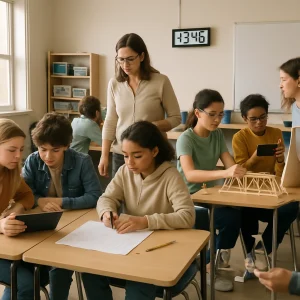
Stations, rotations and learning centers convert teacher-led content into active, student-centered practice. When planned and run deliberately they increase engagement, provide powerful formative evidence, and allow teachers to differentiate and assess in real time. Below is a practical, classroom-ready guide you can adapt immediately — including setup, teacher routines, assessment checkpoints, classroom management, a full example STEM rotation for mixed-ability groups, and templates you can copy.
Why use stations, rotations and learning centers? (Justification)
- Promote active learning: students practice, test ideas, explain to peers and produce artifacts — learning becomes doing, not just listening.
- Enable differentiation: multiple stations let students receive scaffolded support, targeted practice, or extension tasks based on readiness.
- Support formative assessment: frequent, short checkpoints reveal misconceptions early so you can correct them while learning is still in progress.
- Mirror real-world teamwork and problem-solving: stations build communication, role-taking and project management skills.
- Increase motivation: clear purpose, visible products, and shared accountability make tasks meaningful. Always explain this “why” to students before starting to raise commitment.
Classroom script example (teacher tells students before activity):
“You will rotate through four stations because each focuses on a different real skill we need to meet our learning goal: research, design, build and evaluate. Doing short focused tasks with your team gives you practice, feedback and a real product to share. I’ll be listening and checking in — if you get stuck I’ll give hints so you can solve it, and at the end we’ll evaluate what you learned together.”
Planning checklist (teacher)
- Define the competence goal precisely (use measurable verbs: design, test, justify, calculate).
- Choose number of stations (3–6 typical) and decide station roles and group size (3–4 students ideal).
- Prepare a clear one‑page instruction card for each station (task, time, materials, success criteria).
- Create short assessment checkpoints (one rubric/one checklist item per station).
- Plan grouping method (heterogeneous/ homogeneous/rotating) and transitions.
- Prepare materials, safety rules, and evidence-capture means (phone/tablet/camera, flipchart).
- Set timer and signals for transitions; plan formative prompts you will use while roaming.
- Decide final product and summative evaluation method (poster, lab report, video).
- Upload station instructions or rubrics to LMS for easy sharing after class.