-
From Theory to Plan: Translating Principles into Lessons32 Topics
-
Active Learning Strategies44 Topics
-
Differentiation and Personalized Learning5 Topics
-
Formative Assessment: Techniques and Use4 Topics
-
Classroom Management: Routines, Procedures and Environment5 Topics
-
Collaborative Learning and Group Work6 Topics
-
Questioning, Feedback and Scaffolding5 Topics
-
Technology Integration and Digital Activities6 Topics
-
Inclusive Practices: Equity, ELL and SEN Strategies7 Topics
-
Reflection, Action Research and Professional Growth4 Topics
Participants 3

9. Short Rubric Example (for counting/permutation lesson)

didactec 21.11.2025
Lesson Progress
0% Complete
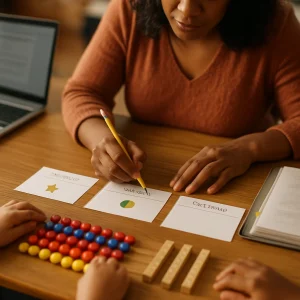
- Proficient (3): Correct answer; justification explicitly uses multiplicative reasoning and addresses repetition condition.
- Developing (2): Correct numeric answer but justification incomplete or partly incorrect.
- Beginning (1): Incorrect answer; reasoning absent or incorrect.
Use this rubric for exit tickets and quick marking.
10. Final note — iterate and save
Save and version your lesson: attach worked solutions, exit tickets, and student responses in OneNote or another LMS. After teaching, annotate the plan with time adjustments, typical student errors, effective scaffolds — these annotated plans become your best professional resource. Remember the four‑times rule: new methods generally need at least four rehearsals to stabilize into reliable classroom practice.
References (key theorists you can cite in plans)
- Vygotsky, L. (1986). Thought and Language. MIT Press. — ZPD, social mediation.
- Piaget, J. (1932). The Moral Judgment of the Child. Routledge.
- Ausubel, D. (1968). Educational Psychology, A Cognitive View.
- Barron, B. (1991). Collaborative Problem Solving.
- Barrett, M. (1991). Attachment Behavior and the Schoolchild.
- Maslow, A. (1954). Motivation and Personality.
- Yli‑Luoma, P. (1992). Predictors of Critical Thinking Abilities.
Use this structure each time you plan a lesson — it turns robust educational theory into classroom-ready steps, timing and checks so students learn efficiently and teachers teach effectively.