-
From Theory to Plan: Translating Principles into Lessons32 Topics
-
Active Learning Strategies44 Topics
-
Differentiation and Personalized Learning5 Topics
-
Formative Assessment: Techniques and Use4 Topics
-
Classroom Management: Routines, Procedures and Environment5 Topics
-
Collaborative Learning and Group Work6 Topics
-
Questioning, Feedback and Scaffolding5 Topics
-
Technology Integration and Digital Activities6 Topics
-
Inclusive Practices: Equity, ELL and SEN Strategies7 Topics
-
Reflection, Action Research and Professional Growth4 Topics
Participants 3

Reflection protocols and consolidation

didactec 27.11.2025
Lesson Progress
0% Complete
- Always close with reflection that ties concrete to abstract. Suggested prompts:
- What did you do? What worked? What didn’t?
- How does your manipulative model map to the symbolic representation?
- Where could your method fail in real‑life application?
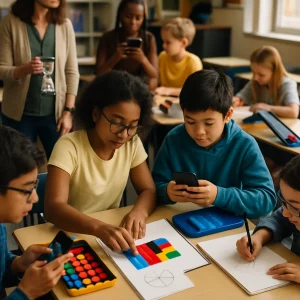
- Encourage students to photograph group outputs and upload to the class OneNote or LMS — this produces visible documentation and supports iterative improvement.
Differentiation, equity and cultural relevance
- Use culturally familiar examples (local foods, games, construction materials).
- Provide alternative representations (visual, auditory, kinesthetic) and allow choice of final product (poster, video, written report).
- Ensure manipulative kits are accessible and inclusive (easy to grip, colors with sufficient contrast).
- Provide extension tasks for fast finishers; provide scaffolded tasks for learners who need more structure.
Common pitfalls & troubleshooting
- Problem: students “play” with manipulatives without analytical focus.
- Fix: set deliverables (data table, sketch) and assign roles; use teacher checkpoints every 8–10 minutes.
- Problem: short attention span.
- Fix: chunk work into 10‑minute focused bursts with quick snacks (SNAPS) — quick pair chats, one‑minute rounds.
- Problem: abstract translation missing.
- Fix: require explicit mapping step: “Show me the tiles; then write the symbolic expression.”
- Problem: inconsistent measurement in physics labs.
- Fix: standardize release method, do multiple trials, use video for cross‑checking.
Safety and classroom logistics
- Physics: contain rolling objects (bumpers), use low heights for ramps, clear track ends, ensure students wear sensible footwear.
- Fractions/tools: scissors supervision, avoid very small choking parts for younger grades.
- Always model correct handling and set clear expectations for putting materials away.