-
From Theory to Plan: Translating Principles into Lessons32 Topics
-
Active Learning Strategies44 Topics
-
Differentiation and Personalized Learning5 Topics
-
Formative Assessment: Techniques and Use4 Topics
-
Classroom Management: Routines, Procedures and Environment5 Topics
-
Collaborative Learning and Group Work6 Topics
-
Questioning, Feedback and Scaffolding5 Topics
-
Technology Integration and Digital Activities6 Topics
-
Inclusive Practices: Equity, ELL and SEN Strategies7 Topics
-
Reflection, Action Research and Professional Growth4 Topics
Participants 3


Lesson Progress
0% Complete
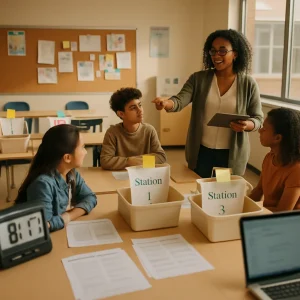
- Clear competence goal written and student-friendly.
- Station cards printed or uploaded.
- Materials prepared and in station bins (labeled).
- Timer and transition signal ready.
- Assessment checkpoints and rubrics printed or digital.
- LMS folder ready for uploads.
- Grouping plan decided and explained to students.
- Safety rules posted.
- Plan for reteach mini-station ready.
Final practical advice
- Explain the method and your justification to students at the start — tell them exactly how to act and what successful work looks like.
- Monitor actively, give corrective feedback in the moment, and collect evidence of learning.
- Break down problems with whole-class or targeted conversations when misconceptions arise.
- Always evaluate together: What was learned? How did the method feel? What should we clarify?
- Document outputs (photograph, scan flipchart notes) and make them visible to students (LMS or shared wall).
- Be bold and try new station designs — but be patient. Each new method should be practiced at least four times before judging its effectiveness.
Use the templates in this topic to create your own station cards, checkpoint rubrics and rotation schedules. Stations scale: use 3–6 stations for single lessons; use multi-lesson rotations for project-based units. Apply, adapt, and iterate — active learning through stations will transform practice when combined with clear goals, structured assessment checkpoints, and firm classroom routines.